Written in 2012, but never published.
Bulgaria has historic cities, breathtaking mountains, sun-baked coasts and not many tourists…for now at least. Andrew Laughlin returns to the country after 14 years, finding it changed, for the better and, potentially, the worse.
I first came to Bulgaria in 1998 on a Gap Year expedition around Eastern Europe before heading to the University of Manchester. At the time, my peers were jetting off to ‘find themselves’ in Thailand and India, but I just wanted something different; and different, indeed, was what I found.
At that time, Bulgaria had only emerged from Communism nine years earlier, and the pungent whiff of the Party was still everywhere. When I return to the country in 2012, I find it just as remarkable, but also changed significantly, particularly with the adoption of US-style consumerism. Bulgaria, it seems, is struggling to find its identity as an emerging destination on the tourist map.
“Look at those boys,” says Feodore, a 32-year-old Tae Kwan Do instructor sat drinking beer in the garden of the Art Hostel (double rooms from 32 Euro), a boho establishment in Sofia, Bulgaria’s capital. He points to a rowdy group of English lads, all wearing the matching t-shirts of a boozy birthday expedition and tucking into McDonalds. “I was drinking with them last night,” says Feodore. “They were all like ‘rahhh’, which is fine, you know. But it’s not what we’re used to.”
When I first came to Sofia, the chances of seeing another English person were slim. My first night involved stumbling into a restaurant, being baffled by the menu written in Bulgarian Cyrillic, and then just doing the ‘point and hope’ technique (food was lovely, as it happens). Upon returning the next night, the owner was so delighted that he called his cousin, who worked for the UN and spoke English, to come and translate.
But in 2012, after just a day in the dusty heat of the city, I see two stag parties of already pink-tinged Brits. People are beginning to wise up that Bulgaria is a cheap place to stay, eat and get drunk; particularly after EasyJet started cheap flights to Sofia in 2007.
“Smells like India,” says my girlfriend, Anna, accompanying me on the trip, as we exit our basic room in the Art Hostel. (Hostels are great when you’re young, but in your thirties you just tend to notice the health and safety issues.) She’s right, there’s a distinct smell to Sofia, a heady mix of exciting aromas and poorly installed drains. You can follow the many threads of the city’s long history; from ancient Moorish-style architecture through boxy Communist tower blocks tattooed with graffiti, to the glittering commercial skyscrapers. In the 14 years since I was last here, the Bulgarians have embraced consumerism wholeheartedly.
Alongside McDonalds, Subway has invaded, along with flashy coffee chains and designer shops such as Cartier and DKNY. But it’s an odd mix; the pavements are still utterly treacherous, Google Maps is virtually useless and very few people speak English – it’s the Western blueprint, but not even half finished.
After years spent behind the Iron Curtain, Bulgarians eye strangers with unease, and it’s easy to feel unwelcome. But crack through the rather prickly shell, and people are helpful, friendly and curious. Oh, and a shake of the head means ‘yes’, and a nod means ‘no’ – and they do do it.
The country is still really cheap. A 500ml bottle of the Zagorka local beer is around two Bulgarian Levs (£1) in a bar; you can get a freshly made pizza in a restaurant for just £3; and a two-course meal with wine in a decent eaterie costs around £25. But food in Bulgaria is a mixed bag.
Highlights are Shopksa salad (a take on the neighbouring Greek salad) and a spicy Hotpotch stew. But are many weird tasting dishes, such as a sloppy and deconstructed Spanish omelette called Mish Mash (an apt name if there was one) and too much processed cheese and meat. This is certainly not a destination on the culinary map.
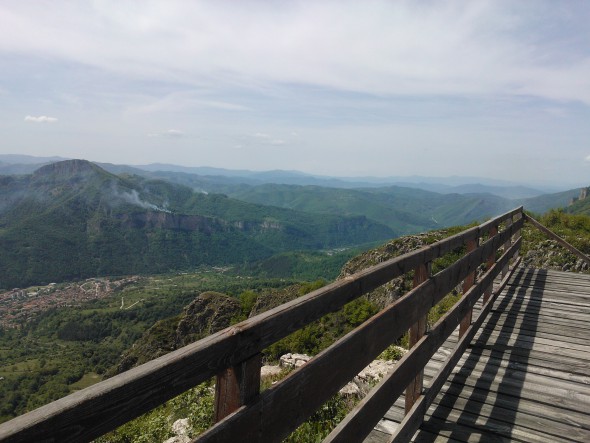
We depart from Sofia in a spine juddering mini-bus through lush green Bulgarian countryside of pine, conifers birch and cyprus towards the town of Teteven, amongst the Stara Planina, or ‘old mountains’. Mountains have particular significance for Bulgarians, even for the younger generations.
As we happily exit the bus, Hristo, a native of the town who lives in Sofia but returned to visit family, elaborates.: “They are special to us, partly because they are there and great to explore, but also because they represent safety, a safe haven,” he says. “No matter how bad things get politically or in war, the mountains are always there for us.”
Situated in the heart of the Balkans, above Greece and below Romania, Bulgaria has a tumultuous past. After siding with Germany in both World Wars, the country became a Communist Republic of the Soviet Union in 1946. But the country’s history goes much further back, and you don’t need to go to museum to feel it. Just walking the towns and cities brings constant reminders to past heroes, such as the great Vasil Levski – liberator of Bulgaria from the Ottomans, who gives his name to a Sofia football team and the national stadium.
We jump in a cab and take the long and equally spine juddering trip up into the hills to Villa Cherven, an alpine-style lodge in the shadow of the Cherven peak. Built by the family of Milena Stamboliyska in 2005, it features all the mod cons of a new hotel, but with an eco-focus and relaxed attitude. Don’t expect clean sheets every day; but do expect Milena to bend over backwards to make you feel welcome.
“When is breakfast?” we ask. “Whenever you want,” she replies, smiling.
The hotel has a trout farm, part funded by the European Union, which offers sport fishing, but there are also various walks up into the mountains, taking in winding streams and fields of wild horses; it feels like a mix of the Andes, Alps and Derbyshire’s Peak District. We take a trip up to the high cliffs above Teteven – a rather ramshackle mountain town – and watch as Mitko, Milena’s partner, parasails off the edge and floats gently down to land in the local stadium.
Over dinner, Milena talks about tourism in the country, and how the ski resort of Bansko and the sun-baked Black Sea Coast are starting to become overdeveloped. The area around Villa Cherven is protected under the EU’s Natura 2000 initiative, but other parts of Bulgaria are up for grabs.
“They build big hotels yet they are empty for most of the year. Then the government tells them to take them down, and clean up, but no one forces them too,” says Milena, who speaks great English after living in London for several years. “I think that we have to protect the nature, the country, because if we just develop the cities, the urban, people will not want to come. And the damage, it will be there forever.”
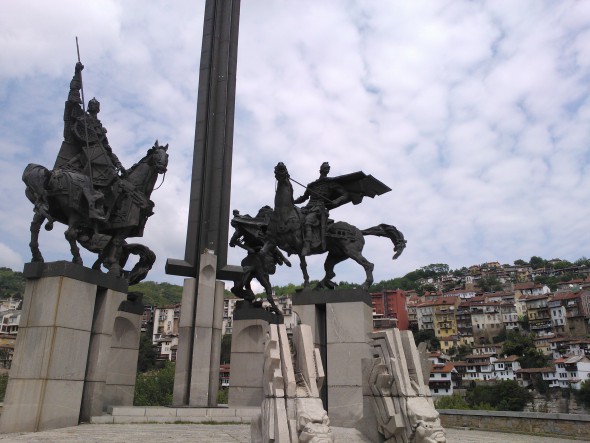
 We leave Teteven on another rather uncomfortable mini-bus trip to Veliko Tarnovo, the historic capital of the Second Bulgarian Empire (1185 – 1422). The town is steeped in history, its past echoing loudly around the surrounding valley. Red roofed buildings perch around the valley overlooking the town’s centrepiece, a giant sword piercing into the air, accompanied by four horsemen. The site was established in 1985 to mark the 800-year anniversary of the uprisings of Asen and Peter against the Byzantines and the liberation of Bulgaria. (The riders represent Assen and Peter, and their successors Tsar Koloyan and Assen the II.)
Veliko Tarnovo is also dominated by the Tsarevets, a castle dating back to the Second Bulgarian Empire.
We leave Teteven on another rather uncomfortable mini-bus trip to Veliko Tarnovo, the historic capital of the Second Bulgarian Empire (1185 – 1422). The town is steeped in history, its past echoing loudly around the surrounding valley. Red roofed buildings perch around the valley overlooking the town’s centrepiece, a giant sword piercing into the air, accompanied by four horsemen. The site was established in 1985 to mark the 800-year anniversary of the uprisings of Asen and Peter against the Byzantines and the liberation of Bulgaria. (The riders represent Assen and Peter, and their successors Tsar Koloyan and Assen the II.)
Veliko Tarnovo is also dominated by the Tsarevets, a castle dating back to the Second Bulgarian Empire.
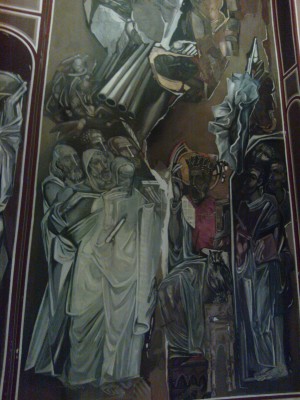
At the peak of the castle is the Patriarchal Cathedral of the Holy Ascension of God, which was rebuilt in the 1980s complete with distinct and rather tortured religious murals. At night, the castle is gilded with a glittering light and sound show, illuminating the night with brightly coloured beams and lasers. Stay at the basic but comfortable Minotel Rashev and you’ll have an excellent view through the panoramic windows as you tuck into the evening meal that is included in the £20 a night double price. Told you Bulgaria was cheap.
Onwards, we say, catching an old style cabinet train in the sweltering heat on a four-hour journey through the Bulgarian industrial heartlands to Varna, the largest city on the Black Sea Coast. After the three other locations, Varna feels emblematic of Bulgaria’s growing tourism industry. The cab drivers are even more ready to rip you off, and tacky souvenir shops litter the streets.
We check in at the Club Horizont, an upmarket club and restaurant complex that has started renting out some functional but well priced rooms. The stylish bar is a bit more expensive than the norm, but it’s great to sit in one of the four-poster outdoor booths and look out to the glittering sea, surrounded by Varna’s movers and shakers. You can head down to the (rather dirty) beach and soak up the rays, or dip in the cold but crystal clear waters. But make sure to visit Primorski Park, a sprawling recreation area spreading for 5km parallel to the sea.
The beautifully designed park features a bounty of attractions, including a striking but neglected observatory, refurbished aquarium, fairground, naval museum and an avenue lined with statues of Bulgarian heroes. The place is popular with Bulgarians, but how much longer they will have it to themselves is up for debate.
Varna feels like a city that is on the verge of a tourism boom. We look up at the cliffs overlooking the sea and they were being cleared and secured with giant netting. We stop a local on the coastal road and ask why they were doing it. He tells us that the official line is to increase safety, but everyone believes that it is to build a line of hotels beneath. All it may take is regular Easyjet flights to Varna airport and those hotels will spring up like expensive weeds.
Back at Club Horizont, a waiter mentions that he traveled from his home in Sofia to work the summer in Varna. We ask about the growing commercialism in Bulgaria. He smiles, and replies: “It is part of a global trend to make everything the same. Sofia has changed also, so much, but this is how it is these days. There used to be lots of Bulgarian restaurants, but now it is different. I just hope we can keep what is old, and balance what is new.”
 On the Road to Revolution