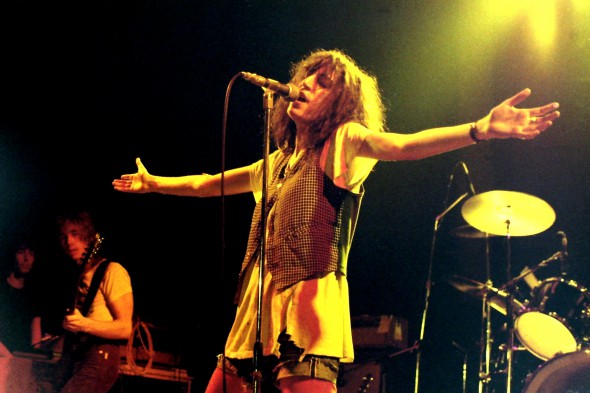
Punk’s poet laureate talks music, politics and how People Have the Power was secretly inspired by the Detroit Pistons.
Originally written in 2007 but never published
Passing her 60th birthday has done little to dull the rebellious fire within musician, poet and activist, Patti Smith. Despite never intending to be a musician, 2007 saw Smith inducted into the Rock ‘n’ Roll Hall Of Fame in recognition of her life as a punk icon. She also continues to speak out on issues such as war, civil rights, and even dental health. Uncompromising in appearance, art and beliefs – she is, and always will be, quintessentially Patti Smith.
Smith walks almost unnoticed into a wood panelled lodge on the grounds of the Jack Daniels distillery in Lynchburg, Tennessee. She wears a black suit jacket over a well worn T-shirt bearing a peace sign and the word ‘Love’. Her jeans are tucked into weather-beaten brown boots – it’s a look she’s hardly changed in more than thirty years. It is at first surprising to see a legend of the New York punk scene this far into the Conservative bible belt of America, a feeling she’s quick to counter.
“Actually, my grandfather was born in Chattannooga so I know the Tennessee area well,” Smith points out. “Also, my late husband [the musician Fred ‘Sonic’ Smith of proto-punk band MC5] was born in West Virginia. This area of the country and the music here resounds well with my upbringing. My grandfather was a honky-tonk piano player and my uncle played the banjo. I’ve always loved the ballads of Bill Munroe and Hank Williams. My southern roots are sort of left-handed, but they do exist.”
Over the years, Smith has consistently stood against injustice in the world: whether that may be tepid rock ‘n’ roll, corporate America or the regime of US president George W Bush. But she is contemplative when asked why she agreed to perform at an event to mark the 150th anniversary of goliath alcohol brand Jack Daniels [sharing the bill with Juliette Lewis, Shingai Shoniwa of the Noisettes and acclaimed backing group, The New Silver Cornet Band].
“I was quite surprised that they asked me,” she says honestly. “But really I said yes for my son, Jackson. I took pleasure in enabling him to come here and play with these musicians. It’s also turned out totally cool, though, you know. Everybody is open-minded and it’s just another form of communication. It’s not unusual for me, in a certain sense, to do these small gigs as I have done a lot of political rallies. When I worked with [former presidential candidate] Ralph Nader we went to the middle of nowhere for forty people. Nader would go hundreds of miles just because forty people wanted communication.”
One thing abundantly clear about Patti Smith is that she is never afraid to speak her mind, especially on subjects that make her angry. She presently draws most rancour from the occupation of Iraq following the 2003 US invasion. Her distaste for the post September 11th War On Terror caused her to pen the song Without Chains about the imprisonment of a 20-year-old Turkish citizen in the Guantanamo Bay detention camp in Cuba. But it was Smith’s support for the Green Party that led to her involvement with Nadar’s unsuccessful bid for the US presidency in 2000, an election ultimately won by Bush the younger. For Smith, the political left in America has been woefully weak since September 11th, which she describes as one of the “worst things that has happened” in her country, not only for the death toll, but also for its impact on American pride.
“It’s as though we have this magic shield around us and all of Europe can experience strikes and things happening, but not us,” she says. “The way the Bush administration geared everything up, it was as though anything you said in opposition meant that you were not patriotic and didn’t care about the people who died on September 11th. If you said anything then people would throw stones at you. You had to have some guts to speak out. For myself, I don’t care. If something is common sense, then you don’t worry about what your peers or anyone else says. You have to say what is right.”
Smith believes that the Bush administration used the media to convolute the nature of patriotism into nationalism, even, dare we say it, imperialism. Most Americans, she argues, were totally unaware that this was going on.
“A patriot is someone who comprehends and upholds the meaning of the law, which is completely opposed to imperialism,” Smith explains. “The word liberal is a weak word. I get annoyed by people who call me that because I am opposed to Iraq. That isn’t liberal, that’s normal – it’s just common sense. I think we should take a humanist approach that there are no righteous wars and that going into another country is immoral, illegal and carries the possibilities of huge expense and the cost of human lives. A humanistic approach has nothing to do with the left or right – it’s just common sense. But what a mess, eh?”
Everyone has a responsibility to speak out against injustice, according to Smith, but artists and musicians can generate vital energy to drive the cause. She recollects being 21 when Neil Young wrote the classic protest song Ohio about four students being killed by the National Guard at Kent State University during a 1970 rally against the US invasion of Cambodia.
“That song resonated all through America like an earthquake,” says Smith. “It bound us all together and made us see what happened. I think that artists alone cannot make huge changes, but they can inspire other people to do so. I wish more artists and musicians would come forward – like when Bob Dylan and Joan Baez came together during the civil rights movement. Before the Iraq war trying to get people to speak out was impossible. The few of us who did were maginalised and I wound up coming to Europe to march. They made it impossible to make any kind of point at all and it was all because people were afraid after September 11th.”
She adds: “I’m criticised all the time. People say, ‘why doesn’t she just shut up and play rock ‘n’ roll?’. I tell people, ‘if you don’t like it, then fuck you’. You can’t forget who you are. It makes me happy when I see the working class speak out and get angry, because that is where the numbers are, and that is where the change will come.”
Change is specifically why Smith got into rock ‘n’ roll in the first place. Raised in the tiny rural town of Woodborough, New Jersey, she grew up with the music of Little Richard and The Animals, later graduating to the Rolling Stones and Bob Dylan. Always fascinated by the power of words, Smith became a music journalist in the 70s, when she identified a definite decline in rock music.
“Everything I ever did was for the preservation of rock ‘n’ roll,” she says. “In the 60s there was great music and I really felt empowered being a skinny, pimply weirdo from rural New Jersey. I loved rock ‘n’ roll so much, but in the early 70s it seemed to me like it was going downhill. Politically, sexually, and revolutionarily – it felt like it was losing its strength. It was getting glamorous, snotty and corporate. So I started writing music and performing, just to agitate things, to get some kind of action going and remind people where rock ‘n’ roll was supposed to be – the grassroots, speaking for us, the people.”
After performing in various clubs across New York, Smith felt that she had made her statement and so prepared to quit music and return to painting and poetry – with the latter being arguably her greatest love.
“I’m not a musician,” she says plainly. “I can sing on key and I can play a little bit. I guess I would call myself a performer. The tools I have are certainly amateur but I use them to the best of my advantage because I like communicating with people. I don’t have any fear. Music is probably the highest of the arts because it is akin to mathematics and so can become as abstract as one desires. My whole life I have been writing poetry. I like language and words, and poetry is the highest form of coding and spiritual experience. It’s such as heightened language, which is why I will always cherish poetry the most.”
Music would come first, though, after Bob Dylan came to see her in “some shitty little club” in New York in 1974. The attention derived from Dylan’s visit led to a recording contract and Smith’s debut album, Horses, which is still widely revered as a classic record.
“When I did Horses I had no real track record in music and I didn’t want to do records, be a singer or have a band,” Smith says. “I grew up in a rural area and had never even seen a guitar in person until I watched a band play in the mid 60s. People didn’t have guitars where I grew up, especially girls.”
During the heyday of the New York punk scene in the late 70s, Smith was right at the heart of the action. Her music was raw, hard-hitting, and powerful – it fitted the mood of the times like a glove. Critically lauded from an early stage, her only real commercial success was Because The Night in 1978, co-written with Bruce Spingsteen. However, many more successful artists have come and gone since then, but nine albums later and Smith is still regarded as one of the most important musicians alive today.
“Music is in this really interesting, pivotal moment,” Smith responds, when asked what state rock ‘n’ roll is in today. “It’s not because there is anything specific that I love, it’s because I feel that people are experimenting and the new guard is becoming more independent. Record companies are in trouble and scrambling. It’s such as mess that it is not really owned by anybody. People are starting to redefine it and I think that has to happen every generation. It’s not a business and it wasn’t supposed to be. It’s a force and it’s re-birthing itself. I would rather this happened than music became set in stone and corporate. Right now, I like how music is keeping everybody guessing.”
Despite professing only a rudimentary knowledge of modern music, Smith has found a useful source for inspiration in late night foraging sessions into MySpace. Her daughter, Jesse, set up a Patti Smith page on the News Corporation-owned social networking site and she was amazed to find 200,000 people requested her as a ‘friend’. This fact was even more surprising considering she rarely sells more than 40,000 records of any album in America.
“Even though I hate [News Corp founder] Rupert Murdoch, the idea that people could come together in these places and listen to each other’s stuff for free is really nice,” she remarks. “People write me messages and then I go to their page to see what they do. I look at the pages and listen to the music; some are funny, some are interesting and occasionally they really amaze me.”
It is this vibrant, grassroots approach to music making that gives Smith hope about the future of rock ‘n’ roll. She uses the analogy of the 1980s Detroit Pistons basketball team [she got into basketball due to her late husband, who was an avid sports fan]. The Pistons did not have a star player to count on, but instead achieved great success by working as a unit.
“The Pistons were just a bunch of guys that ended up winning three championships because they were a collective force. There was something so metaphorically beautiful about that. It was really out of this atmosphere that myself and my husband wrote People Have the Power, secretly inspired by the Detroit Pistons. I like to think that right now music is in a Detroit Pistons place and we’ll have to see what happens next.”
Released in 1988, People Have the Power marked the end of a decade of self-imposed exile from music for Smith. The song was a rapturous, chest thumping call-to-arms of the kind Smith always has to the ability to forge. Sadly, her husband passed away in 1994 of heart failure, a loss that resonated deeply with Smith. Her closeness to his memory continues, as later during the Birthday JD Set she dedicated a version People Have the Power to him. During the song, she climbed into the small crowd to share the moment – it was pure Patti Smith.
“I never really expected to be alive at 60-years-old,” she muses with a laugh, “but since I’m here and happy, I hope am alive in another 40 years. It’s like the words in Smells Like Teen Spirit by Kurt Cobain, which says, ‘I know I’m worst at what I do best’. I’m not particularly sure what I can do best, but I like to perform and I like to communicate. I don’t have any ulterior motive other than to share good information. People can choose how I’ll be. I like people to laugh, but I also like to inspire people to, for instance, take good care of their teeth and not eat a lot of salt or fast food. I’m a mom, but I still have it in me that if my amp gives me trouble then I will put my foot through it.”
Smith retains a great admiration for Nirvana frontman Cobain, but she was angry when he chose to take his own life in the same year she lost her husband. “When you watch someone you care for fight so hard to hold onto their life, [and] then see another person just throw theirs away, I guess I had less patience for that,” she was quoted as saying at the time. However, her artistic admiration for Cobain runs deep, leading her to include a slowed-down, country-influenced cover of Smells Like Teen Spirit on her new covers album, Twelve.
“To some people it was shocking or blasphemous that I should do this version, but really Kurt Cobain loved this style of music,” she remarks. “He loved Leadbelly and did a cover of In The Pines, which was one of my favourite songs. That was the kind of music that I was brought up with – even though I am not known for it, it’s still in my roots. I thought that it would be so great to do the version as a homage and a thank you to him. Obviously, why do it any other way because who’s going to do it greater that Nirvana? Even at this time in my life, with all the shit I have seen, when I sing those lyrics I feel right there.”
Despite being a force for change, not all ‘progress’ in the world is agreeable to Smith. The 2006 closure of CBGBs – a legendary club where Smith preached the good word of punk and poetry to New York – was of pivotal significance to the 61-year-old. She still lives in the Big Apple, but feels that the loss of CBGBs was symptomatic of a wider incursion of corporate life into the once bohemian city. This fact is especially hard for someone who has always praised art over affluence.
“New York used to be cheap for artists. The loss of CBGB was a sign of how money and corporate power is taking over,” says Smith, eyes burning bright with passion. “I don’t want to be part of this – people with cell phones and stretch Hummers. Our world is very fucked up and my country is in a bad place. We have one specific life to navigate the world; we don’t need to feel depressed and defeated. Even though the Bush administration has clearly defeated me I will be a living thorn and poke him until he bleeds. I have seen the bottom, but there is always something worth living for. We don’t deserve all the material things in life, but we do deserve happiness.”
 On the Road to Revolution