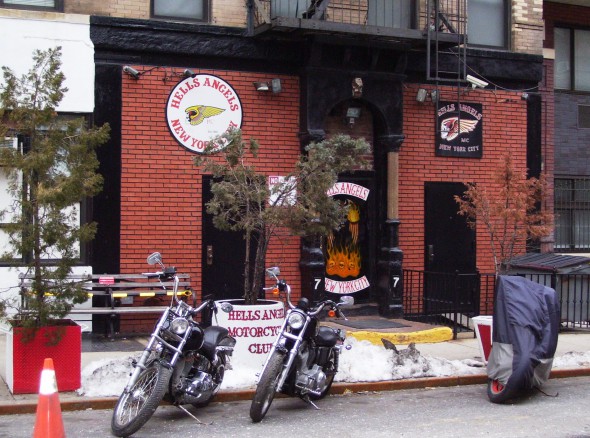
“Hells Angels clubhouse East Village” by Beyond My Ken – Own work. Licensed under GFDL via Wikimedia Commons
“The Hells Angels [pictured] is the only organised crime organisation to have a deliberate and conscious PR team,” author and investigative journalist, Julian Sher, says. “The Mafia don’t hold news conferences or charity events. But Hells Angels have always been conscious of their image.”
An expert on Hells Angels, Sher has studied the fabled biker gang extensively and interviewed many of the major players around the world. He has also co-authored the books, Angels of Death: Inside the Bikers Crime Empire and The Road to Hell: How the Biker Gangs are Conquering Canada.
In the past, questions have been asked about biker gangs in the UK, particularly after Gerry Tobin was shot dead whilst riding his motorcycle home from a Warwickshire biker gathering known as the Bulldog Bash in 2007.
“That case is a classic example of how the Hells Angels say, ‘We’re just a motorcycle enthusiasts club.’ But motorcycle enthusiasts don’t get targeted assassinations on the highway,” says Sher. “Wherever the Hells Angels go, blood and violence inevitably follows. We don’t actually know why Tobin was murdered. It could be an internal matter, a rival gang or strictly personal. But we’ve seen it happen all too often in other countries.”
As Sher explains, the Hells Angels is an international franchise, incorporated in California, with the ‘Deaths Head’ logo trademarked. He claims that it is as hard to open up an unsanctioned Hells Angels group, as it is an unauthorised branch of McDonald’s.
”This is a very exclusive club. There are only 2,500 or so members around the world. It’s more difficult getting into the Hells Angels in Britain than the army. So when the Hells Angels say violence is committed by just ‘a few rotten apples’, it doesn’t hold water. This is a very carefully screened and selected group.”
According to Sher, the Hells Angels boast a flexibility and cellular structure that would “make Al Qaeda jealous”.
“Chapters around the world are autonomous, but joined by a common framework,” he says. “They are an outlaw motorcycle group who call themselves the ‘one-percenters’, which distinguishes themselves from the other 99% of law abiding, motorcycle enthusiasts. When I spoke to its leaders, they said, ‘We are out on our own and do not respect society.’”
Behind the Angel’s rebel image, Sher adds, there exists a sinister back-story. Ralph ‘Sonny’ Barger, one of the founding fathers of the Hells Angels during the 1950s, made clear in his autobiography the vast amount of drugs – in use and trafficking – that the Angels were involved with during the 60s.
“He also described the 70s as being a ‘gangster era’ for them,” continues Sher. “Those are his words. Around the world, and I don’t mean every member, but in each country Hells Angels have been convicted of drugs, extortion and murder. They have also used violence to either quell internal dissent or to take on rival gangs.”
In England, the violence has been periodic. In Battersea, in 1999, Hells Angels were convicted of the savage killing of two members of a rival gang – the Outlaws. In Windsor, an unsanctioned Hells Angels Chapter was quelled with a shoot-out.
Sher asserts that the Hells Angels are still heavily involved in the drugs trade. In Canada they are considered the leading organised crime organisation, heavily involved in the supply of cocaine and marijuana. “In America, also, they are deeply rooted in the meth-amphetamine trade. There was a case in 1994 where Hells Angels from Canada used their London base to import 500kg of cocaine from Latin America. So we know the drug connections are real.”
According to Sher, police and authorities from around the world have been slow to realise the danger of the Hells Angels. He says they have often been considered just a “bunch of old geezers on bikes”, though another reason for this delusion has been the effective PR web spun by the Angels.
“They create two almost contradictory but self-fulfilling images. The main image is of terror and power – the gruff, tough-talking biker. The Hells Angels wear their patch to say ‘Don’t fuck with us’. That PR image is very important for them, but at the same time they have been trying to moderate the brand. So they began inventing charity runs to make people think of them as rebel enthusiasts.”
In Britain, this has been particularly successful. Along with the Bulldog Bash and numerous charity events, the Angels have also participated in the Queen’s Jubilee Parade in the past. Sher believes that the British Hells Angels leaders must be willing to condemn the violence and drugs. He has debated with senior members of the Angels [both in interviews and on the radio] that if they wish to be left alone as “just a bunch of motorcycle enthusiasts” then they should get their house in order.
“They never say, ‘Anybody who does this in our name is out of the club’. No member of the Hells Angels around the world has ever been thrown out for selling cocaine. Part of the mystique of the Hells Angels is that they use their status as American icons. They are typical Americana – replacing the horse with the Harley. It’s the image of freedom and standing up to the establishment. If they are indeed courageous then they should condemn the drugs and the violence. But you’ll never see that from any Hells Angels around the world.”
Edited from an original article published in total:spec magazine in 2008
 On the Road to Revolution