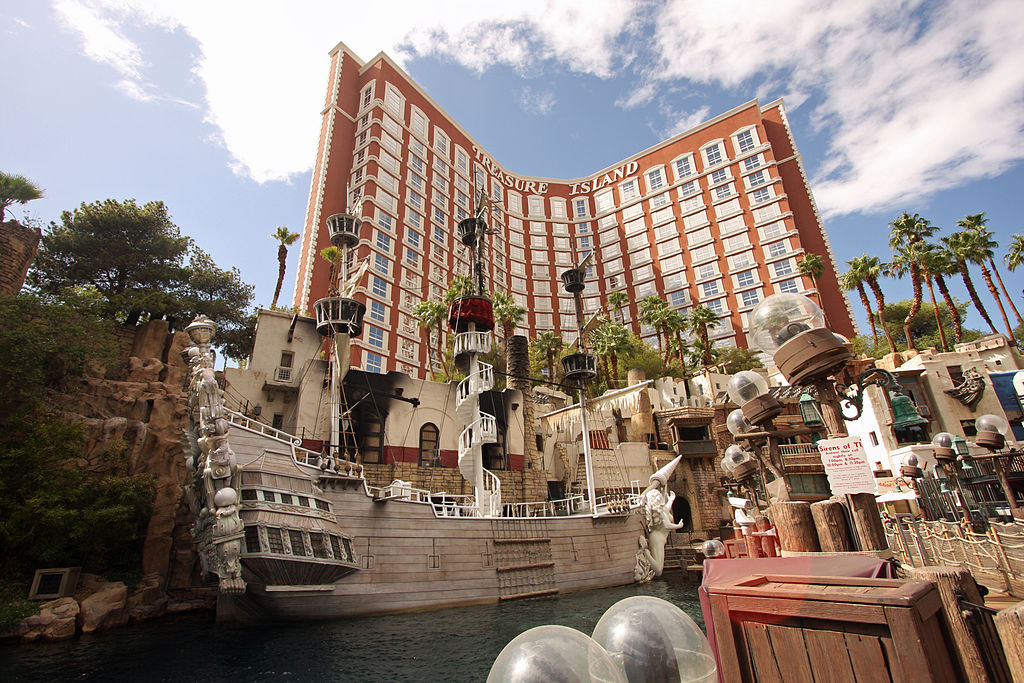
Image by Ronnie Macdonald from Chelmsford, United Kingdom (Treasure Island) [CC BY 2.0 (http://creativecommons.org/licenses/by/2.0)%5D, via Wikimedia Commons
When tycoon Steve Wynn opened the Treasure Island hotel and casino in 1993 to compliment the four-year-old, Mirage, it was decided that, despite the two casinos being within an energetic dice throw of each other, a tram should be built between them. After all, why should punters – loaded down with dollars and clutching their brightly colours yards of sugary cocktails – be expected to walk all the way over the road to get their next fix?
Riding this barely five-minute tram journey seems to epitomise the mind boggling nature of the glittering and brash neon oasis of excess in the Nevada desert. And why I feel Las Vegas and the casinos that made it famous are frivolous in all the worst ways.
As a technology journalist, I travel every January to the Consumer Electronics Show (CES), held at the sprawling Las Vegas Convention Centre, to see, hear and sometimes smell the good, bad and ugly ideas that will supposedly revolutionise our daily lives (very few actually do). After a long day eulogising their latest contraptions, many of the delegates decamp to the around four mile run from Russell Road in the south to Sahara Avenue in the north, known more commonly as the modern Las Vegas Strip.
Lining the Strip are towering edifices to consumption, each jostling to outdo each other with entertainment, gambling and the elusive yet ever desirable, ‘wow factor’. The Bellagio has its rightly renowned, balletic water jets performance; Paris has a giant recreation of the Eiffel Tower; The Flamingo has actual live flamingos in a park inside its grounds; The Mirage has a Polynesian volcano that ‘erupts’ in a blaze of fire and music every half hour each night; and Ceasers Palace conjures an overblown Roman epic led by a legion of ageing rock and pop stars, including – somewhat bizarrely – Matt Goss of Bros fame. (The original Downtown strip around Fremont Street has older, shabbier yet somehow more charming casinos like Binions and The Golden Nugget).
Although now rather a fading attracting compared to the real global gambling hubs, most notably Macau in China, Las Vegas is still the place for Americans – and foreign tourists – to have a grand blow out. Millions flock each year to the City of Sin in the hope of gorging at the grand alter of hedonism and possibly winning big by betting everything on black. They are put up in more than 60,000 hotel rooms crammed into this relatively compact locale. Indeed, the Strip houses 15 of the world’s 25 largest hotels by number of rooms, including the second biggest, The Venetian & The Palazzo, featuring a faux version of Venice complete with a covered canal navigated by Gondolas manned by ‘O Sole Mio’ crooning drivers. As you do.
As part of efforts in the 1990s to broaden the appeal of Vegas beyond grizzled gamblers, Treasure Island was originally intended to attract families. The $450 million resort launched with an entertainment marquee, games arcade and a ‘Buccaneer bay’ show on the strip with staged pirate battles every night. However, Treasure Island ditched most of its family attractions in 2003, replacing the arcade with a bar and nightclub as it focused more on adult visitors. Although the pirate battle remained open at Treasure Island until 2013, most casinos have more recently tried to move away from pitching Las Vegas as a place for families to come – not that that has actually dissuaded some.
“This isn’t a place for kids,” says my cab driver, after taking a break from making slyly xenophobic comments about Mexicans and Chinese people. “I carry rehydration packs in my cab, for kids. The amount of times people have come running to me, ‘hey, take us to hospital, my kid, he’s sick.’ It ain’t right, man. They have ’em out in the sun, it’s 100 degrees here in the summer, just a fucking towel over them, while they drink, smoke, gamble themselves stupid. This ain’t no place for families, man.”
It is hard to disagree. Wandering around the casinos brings a strange sensation; the complete lack of comprehension of what time of day it is, the almost choking perfumed air mixed with a noxious fug of tobacco smoke, and the constant din of music, slot machines and solicitation. It’s a festival of drinking, smoking, gambling, winning, losing, cheering, sobbing and gorging that never starts or ends – it just endures.
Elderly ladies, bedecked in gaudy jewellery, feed dollars into flashing terminals, as though they were sleepily giving some petulant child its 3am feed. Big groups of lads bustle around the casino floor, always with drink in hand and hoping that the pretty waitresses aren’t just smiling at them for the tips (they always are). Giant dollops of men and women scoot around on mobility chariots, their gelatinous fat folds drip over the sides as they glide from one table to the next. It must be breakfast/lunch/dinner time soon, they ponder.
Restaurants on the Strip serve up a high fat, high sugar diet covering all the main Las Vegas food groups – meat, desserts, alcohol and cheese. Mountains of food are served, devoured and, most likely, wasted every day in this city. Pancakes the size of hubcaps are stacked in piles at breakfast. Towers of thick cut burgers are served with mountain ranges of fries at lunch. And then a herd of steaks trots out at dinner, some the size of bath matts.
Although you can enjoy a galaxy of cuisines on the Strip, often put together by top chefs, everything has a sweet, sugary taste to it. Even vegetables feel like they have been processed, packed and sweetened to ‘taste’. But there’s always another place to eat. Another place to try. Another ‘all-you-can-eat’ special just around the corner. Being in Las Vegas is like being on an endless walking buffet, although just like many places in America, nobody actually walks anywhere in the city unless they have to.
Colossal six-lane highways cris-cross the city, filled with stocky cars and trucks guzzling cheap petrol as they loop constantly from one restaurant, casino or shopping mall to the next. You can’t blame the people inside – it is virtually impossible to walk anywhere further than one casino to to the next in Las Vegas (seriously, take a longer walk and experience the curious, even concerned looks you get from passing motorists). If you don’t take a car or cab, instead you can rely on the free trams to do the walking for you – there are also bizarrely short connections between the Monte Carlo, Aria and Bellagio, and the Mandalay Bay, Luxor and Excalibur.
Alongside a bus that few people seem to actually use, ‘public’ transport in Las Vegas also includes a Monorail system that was established in 1995, later expanding in the 2000s. Yet, while it does go to the Convention Centre, it doesn’t go anywhere else genuinely useful, such as the airport or somewhere with vaguely fresh air. Rather, it just keeps you in an infinity loop, always a convenient distance to the casinos and always close to a place to gamble and spend money.
In many ways Las Vegas and its casino embody the American Dream. Here, anyone can supposedly live like a king, and anyone can be a winner. You could arrive with $5 in your pocket and leave with $5 million, along with a belly full of cheap food and booze. But while anyone can be a winner, reality is that for most the odds are well stacked against them. And poke beneath the glittering, smoke-and-mirrors veneer of Las Vegas and you soon see that there’s not much of genuine substance to the City of Sin.
Some will accuse me of being a killjoy, or for ignoring the more culturally rich parts of Vegas of which I am yet to uncover (for which, I apologise in advance). But while there’s absolutely nothing wrong with fun and excess for fun and excess’s sake, every time I come to the Strip I’m struck by how flimsy it all is, and how Las Vegas promises more than it delivers. The city appears to be just an engine for separating you with your money as soon as possible, and spitting you out the other side, bloated, broke and bewildered. It is Disneyland for Adults, only Mickey Mouse always demands a tip.
Move just a few blocks away from the vast lobbies of The Strip’s top hotels and you soon see a different story. Barren lots sit idle, with tumbleweeds of nudey bar cards rolling across their deserted surfaces. Down-on-their-luck types sit despondently on the sidewalks, drinking oversized cans of weak American lager and lazily raising their heads to passers-by to ask for money.
Despite being the biggest economy i n the world, many people in America are struggling. In San Francisco on the California coast, an estimated 6,500 people live rough on the streets, more than double estimates for the whole of England. For all its supposed riches, Las Vegas also clearly has many people who have fallen through the cracks and found little or no net to catch them. Maybe they played the game, maybe they didn’t. And all the while the roulette wheels of The Strip keep on spinning.
 On the Road to Revolution