The End of the Line is a 10-part travelogue journey to some of the highest Remain and Leave areas in the United Kingdom’s 2016 Referendum on EU membership. It was written over two years from 2018 to 2020, before Coronavirus made Brexit seem like a spot of man flu.
East Lindsay voted 70.7% Leave in the 2016 EU Referendum
Originally written in October 2018
On a boring train journey from London to Grantham, where we were due to change for a connection to Skegness, my girlfriend (still in post at the time) and I watch a terrible film. We half listen as two young men, all gangly limbs and charity shop chic clothing, planned their new events business. They were called Miles and Casper, but also had a business partner called Xander. Casper bristled with irritation as the important phone call he had left to make on a train kept cutting out, because, well, he was on a train. Presumably ‘for a thing’, they dissected the latest radio listening figures, expressing bemusement at how many people listened to popular radio networks, such as Heart FM.
We arrive into Grantham station conveniently as the connection we were supposed to get to Skegness rolls out of the station. An almost daily calamity somewhere on Britain’s modern rail network orbits a galaxy of guaranteed smaller inconveniences. A missed connection, an overly packed carriage, nowhere to sit, flooded toilets, and carriages more worn-in than a regional commuter service in Siberia. There’s always either a robotic apology, a weary apology, or, sod it, no apology at all. Overcrowded, overloaded, miserable; but at least our rail fares are reliably expensive.
On the platform at Grantham station two old crones eyed our still creaking train with docile expressions. They smiled at the new arrivals, revealing a mini Stonehenge of brown teeth inside their half-gaping mouths. One was under a blanket, the other seemingly melting slowly into the bench where they sat. It’s unclear whether they are waiting for a train, or just waiting.
With an hour to kill until the next connection, we hole up in the waiting room. A pretty stain-glass window depicts the glory days of steam trains in a rather stirring image. Around the edges are various destinations: Edinburgh, London, Durham, Doncaster. Coloured light shines through the windows, illuminating a vending machine in an ethereal light. A young man in a tracksuit ranges around it, wondering why his selected Monster energy was staying so steadfast in its original position.
Outside, trains whizz by with a ‘heee-hawnk’. The red and white livery of LNER blurs past, followed by the orange and blue of East Midlands. A towering woman enters the waiting room, peroxide blonde curls mounded on her head like a Mr Whippy ice cream. Leopard skin leggings cling to her for dear life. And then emerges a ginormous pink suitcase, like a veritable rolling wardrobe, pushed by her wiry husband, out of breath in a grey sports tracksuit.
We sit down on the scooped plastic of the waiting room chairs and idly take in the atmosphere. Two young women enter, all dressed for a night out, despite it being 3.30pm. They sit opposite to us and each retrieve a can of Bacardi Breezer alcopop from a bag.
‘Can we drink these here?’ one asks the other.
They shrug, crack them open and tuck in. The next train to Nottingham rolls in on the platform behind us. The women get up.
‘Easy to drink this,’ one says to the other, ‘Like fizzy pop.’
We watch as people got on and off the train. Two other women enjoy one last vape before heading off to Nottingham. They’re also dressed to the nines, cleavage raised up proud like IKEA shelving. They wear tight jeans with rips in them, as appears to be trendy again. Through slashed holes peek ridged rolls, like orange bread dough baking in a denim mould. They finish vaping and board the train for the 30 minutes-ish journey to Nottingham.
A man wearing a baseball cap, a giant spidery tattoo on his neck and drinking a pint can of energy drink, barrells down the platform trying to keep up with his girlfriend. Another man walks into the waiting room wearing a curious combo of a bobble hat and shorts. ‘Is it warm or is it hot? I just can’t decide’, he didn’t say. He squints up at the screen displaying train information. After looking away, the squint remains, suggesting that is actually his normal expression. A heavy-set man enters the room and body slams himself down heavily on a seat. He talks on the phone loudly, but it is impossible to understand anything apart from periodic expletives. Outside, a boy rides his bike down the platform. It starts to drizzle.
Eventually, the crawling passage of time does its work and the 2.27pm East Midlands train to Skegness rolls into the station. It was already half full with people coming from Nottingham. After everyone gets on and settles into their seats, the train creaks slowly out of Grantham and heads out through the usual industrial sprawl that tends to congregate around railway stations. Like unruly teenagers, dirty warehouses loiter in the area, while giant mega-stores are ringed by sprawling car parks. From a distance we see St Wulframs church, with its pretty, towering Medieval spire.
We first arrive into the market town of Sleaford. The attractively station’s tile mosaics add a splash of colour to the Yorkshire stone buildings. A woman boards the train. She walks on match stick legs, her face a blotchy nicotine colour. She appears twitchy, eyes darting hither and yon. She’s followed by an older woman, laden down with bags. She sits on a chair with the effort of someone who has just climbed Mount Everest. The train rolls out of the station as the drizzle thickens.
Onwards, through Heckington: an even prettier station, with rich red brick buildings, lead roofs and draping greenery. And then, the time has come – we arrive into Boston. This was the place with the highest percentage of the local population to vote for the Leave side in the EU Referendum, at 75.6%. The writing had been on the wall. According to the 2011 Census, Boston had the highest proportion of immigrants from Eastern Europe than anywhere else in England and Wales. Just over 10% of the town’s population of 65,000 hailed from old Eastern bloc countries, mostly Poland, earning Boston the unimaginative nickname, ‘little Poland’.
A Policy Exchange report from January 2016 described Boston as the least integrated place in England and Wales. In the research, Boston ranked lowest of all 160 towns and cities assessed based on how minorities were integrated on identity and structure, and how well they mixed with other ethnic groups in the town. An enclave of Tsykie and pierogi, it seemed, surrounded by a sea of Lincoln Lager and haslet pies. While Boston may have been dubbed ‘little Poland’, most of its population, in part at least, seemingly wished it wasn’t.
Boston station isn’t draped in St. George’s flags and burnished with ‘foreigners out’ signs. It’s just a station. Vending machine filled with overpriced snacks, staff looking bored, trains parading listlessly past and the only splash of colour being a large advert for a local Thai restaurant. A scrapheap sits by the trainlines on the way in, but it’s just a scrapheap. Not a smart-arse metaphor.
Rolling out of Boston station, the train passes by the river Whitham. A man eyes me suspiciously from a few seats ahead as I made some notes. I discreetly put my notebook away. New build bungalows and cookie-cutter homes pass by the window in a blur of mundane mediocrity. We arrive at Wanfleet and a barrelous man with high-waist trousers gets off. The male passenger down the carriage still fixes me with a stare. I try not to think how much he looks like a Brexit voter.
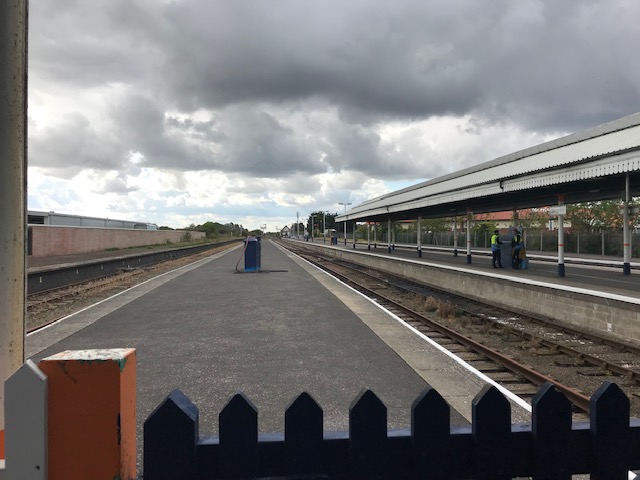
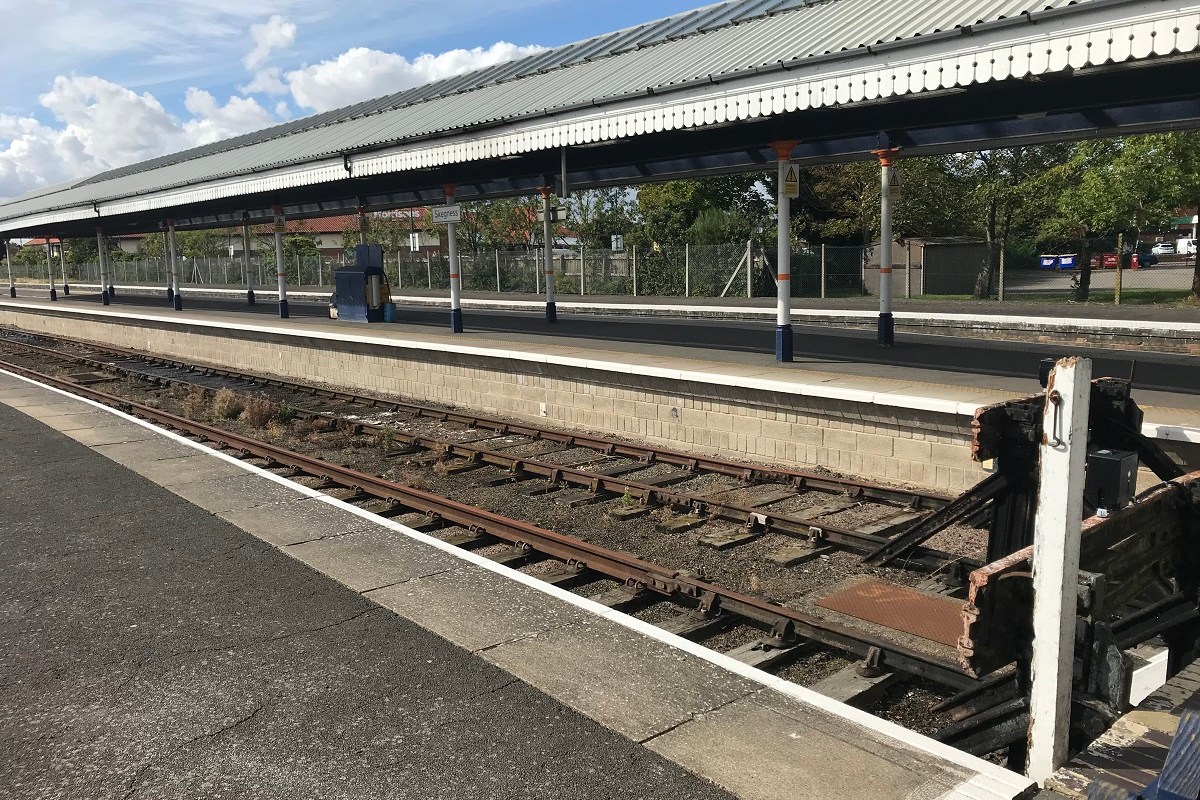
At just before 4pm, we arrive into Skegness station. It had stopped drizzling and there was even a hint of sun peeking through the grey clouds. We gather our things and head for the train door, careful to go the opposite way to the Brexit voter. The man, I mean, the man. As we exit the train, a gaggle of drunken women of varying ages chant, ‘oo are ya, oo are ya’, at no one in particular.
Skegness. Or, as it’s also variously known; Skeg, Skeggy, Costa Del Skeg, or possibly most optimistically, Skegvegas. This seaside town sits in the East Lindsey district of the Lincolnshire coast. It had a population of around 20,000 at the time of our visit in September 2018, many of whom worked in the seasonal tourism industry. The name Skegness may derive from the word Skegg in Norse language, dating back to the Danish period of settlement in Britain. Skegg meant ‘bearded one’, possibly referring to the beard-shaped headland on the banks of the coast. However, this could also be one of those historical ‘facts’ that is, in fact, total bollocks.
Outside the station is the Jolly Fisherman, a symbol of Skegness. At the time, the rotund fella was ringed by bright orange workman’s tape. It was unclear what, if any, work was actually being done. Skegness did start life as a fishing village, and it would be easy draw comparisons with disputes over fishing quotas that, for some, played a role in the EU Referendum. However, the Jolly Fisherman has little to do with actual fishing.
The development of Skegness as a seaside resort started in the early 1870s, led by the Earl of Scarborough. This culminated in the railway line opening in July 1873, effectively putting the small town on the tourism map. In 1908, Great Northern Railway wanted to turn Skegness into a premier seaside get-away. It needed an eye-catching advertising campaign and so turned to the work of an obscure painter called John Hassell. Hassell depicted the rotund Jolly Fisherman skipping with gay abandon down Skegness beach in a classic railway tourism painting. The slogan accompanying it noted, ‘Skegness is SO bracing’.
OK, the bitter North Sea wind is face-burningly cold, but do you really want to highlight that? It would be like Manchester saying on a poster, ‘It rains all the time’, or London going with, ‘watch out for your valuables’. The slogan stuck, though, and became somewhat of a badge of honour for the town. The poster worked, too. In 1913, 750,000 visitors flocked to Skegness. John Hassell apparently died penniless if reports are to be believed.
Oh, to be by the seaside
Despite growing up in the North of England, this was actually my first visit to Skegness. The place was instantly familiar to me, though. I used to holiday frequently further up this part of the English coast, including to Robin Hoods Bay in the North York Moors, along with Whitby and Scarborough. I have fond-ish memories of spending time in a Haven holiday camp in Primrose Valley when I was young. My mum, sister and I stayed in a static caravan. I can recall wearing shorts and a t-shirt, going to the camp disco with my mum and sitting with a styrofoam cup of slimy prawns listening to ‘So Macho’ by Sinitta. Ah, good times.
Haven was not the first British holiday camp. That was created in Ingoldmells, a parish north of Skegness, by Sir William Heygate Edumund Colborne Butlin, more widely known as Billy Butlin. Butlin was a South Africa-born entrepreneur who had escaped a troubled early life to build a tourism empire in Britain. He had originally opened a static fairground in Skegness in 1927. He was making a good living, but realised that the real cash was to be made by also offering accommodation. He opened Butlins Skegness in 1936, followed by his second site in Clacton in 1938. During the Second World War Butlins was occupied by the Royal Navy, renamed as HMS Royal Arthur, and used for training. There were up to 4,500 personnel barracked there and it was bombed by the Germans in 1942.
Butlins enjoyed huge success in the immediate post-War period, but fortunes changed in the 1970s as the rise of cheap package holidays to Spain decimated the UK seaside towns. Alongside being affordable, Costa Del Sun also wasn’t face-meltingly cold for most of the year. Butlins Skegness remains in operation to this day, but has diversified to music events and festivals to broaden its appeal. As of 2018, it attracted a reported 4m visitors a year and generates millions for the local economy.
Skegness has been twinned with the chocolate box German town of Bad Gandershien since 1979. Yet, Skegness’s local council in 2018 was majority UKIP. At the time of our visit, it had nine UK Independence Party councillors to eight Conservatives, two Labour and one Independent. Vote Leave blanketed Skegness around the referendum. Posters littered the roads with big promises about ‘taking our country back’. It worked; East Lindsey voted to leave the European Union by 70.7%, just a touch behind neighbouring Boston.
On Sunday, 26 June 2016, three days after the vote, at around 6am Matthew Lewis White strung a makeshift border across Sea View road in Skegness made of wheelie bins, bits of fencing and a pushchair. The man, in his early 20s who was allegedly still intoxicated from the night before, took it upon himself to enforce the not yet agreed border to our European neighbours. When Adrian Carrington-Hunt approached the unofficial barricade at 6.55am, White demanded to see his passport in order to let him pass.
Carrington-Hunt insisted that he didn’t have a passport with him (or, possibly, pointed out that he didn’t actually need one to go down a road in Skegness), but White was insistent. After Carrington-Hunt attempted to break the wheelie-bin barrier down, White head-butted him, exulting: “Now what are you going to do?” After pleading guilty White was given 12 months conditional discharge and ordered to pay £100 in compensation.
We exit the station and walk towards town. High Street is a narrow, near pedestrianised street with faded shops boxing you in. A few branded chains have set up in Skegness but mostly you’ll see local shops with names like Flippers, Spall’s and Peter’s. Vape shops sit next to fish and chip bars. Sweet smells combine together in an intoxicating mix. Many people rove around in mobility scooters, wheelchairs or have some kind of mobility aid. Some look way too young to be in such a situation. As we walk down the High Street news of the latest Brexit debacle sounds out on a radio. No one seems bothered.
Why didn’t I book the Quorn hotel?
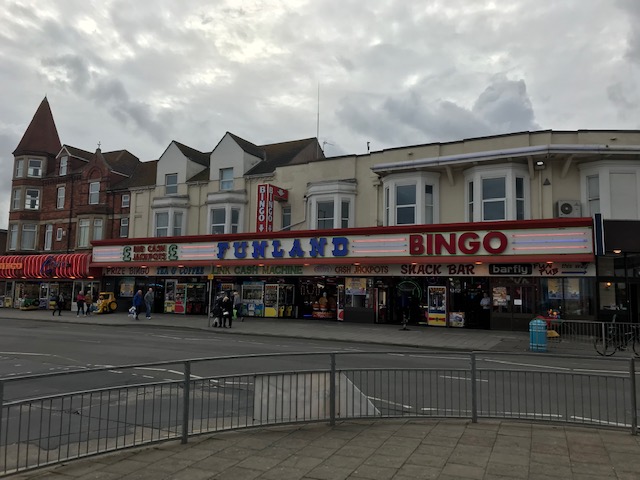
Onwards we head to our hotel, located on the main seaside strip. We head down the promenade past the bingo calling arcades and what must be one of the biggest Yates’s Wine Bars in Britain. We pass people enjoying the afternoon Skegness fun. Tribe-like families bounce from attraction to attraction, with mothers and fathers herding children like angry shepherds. An irate father tries to calm his daughter’s volcanic meltdown by lifting her up by her pony tail. All around rings the orchestra of the seaside; the bleep of machines, the lyrical chime of announcements, the thunder of music systems competing against each other, and groups of people shouting their approval for everything and nothing. And in the far distance, you can just about make out the hushed tones of the North Sea lapping against the sandy Skegness beach.
The Grand Hotel is a dusky peach and maroon guesthouse nestled in a row of seaside hotels. Close by is the Quorn Hotel, presumably hoping to hook in the vegetarian crowd. I rebuke myself for not booking just to see if the meat substitute theme continues within. As with most regional hotels in England, The Grand Hotel has a whiff of Fawlty Towers about it. There’s an atmosphere; an uptight tension so delicately restrained. Andreas checks us in. It’s a brisk process enabled by booking online in advance, as is the norm these days. We head up to the room, eyeing the Stannah Stairlift runners on every staircase as we go.
After spending a few moments checking out a basic but functional room, we venture back out to explore Skegness. We head straight to an arcade, with the blast of noise almost as bracing as the North Sea air outside. Inside, it’s mostly gambling machines; slots, bandits, electronic casino terminals. Many are themed to the Deal or No Deal Channel 4 game show. Noel Edmund’s well-worn face beams out, always on the phone to the banker, goading me to make a Brexit analogy. Be gone you bearded harpy.
After some searching we find a shooting game themed to the rather dreadful Terminator Salvation movie (the one in which Christian Bale allegedly had a meltdown that was leaked on the internet. Seriously, Google it). We grab plastic assault rifles and posture like cocksure twats on a stag do. While spending a rather disappointingly short time battling the tyranny of Skynet, bafflingly we attract a small crowd. A family group hover around watching as we try in vain to have decent reaction speeds. When the resistance truly was futile, we turn for the inevitable small talk.
‘Can we have a picture?’ the dad of the family says. He motions to my girlfriend’s Aircast boot that was doing a pretty poor job of correcting a problem with her ankle.
‘He’s got one, too,’ the dad adds, motioning to what we assumed was his brother, who was in a mobility scooter but was awkwardly getting up to show off his own Aircast boot.
‘Twins,’ the dad says, beaming. We smile. My girlfriend poses for the photo. We exchange pleasantries and shuffle off.
Walking Dead, Jurassic Park, Transformers; all the games follow a similar pattern of shooting the hell out of something as fast as possible until the game decides that, like a weary landlord facing the last regular on a Friday night, ’you’ve had enough, son’. It was fun, but also a very fast way to blitz through a tenner.
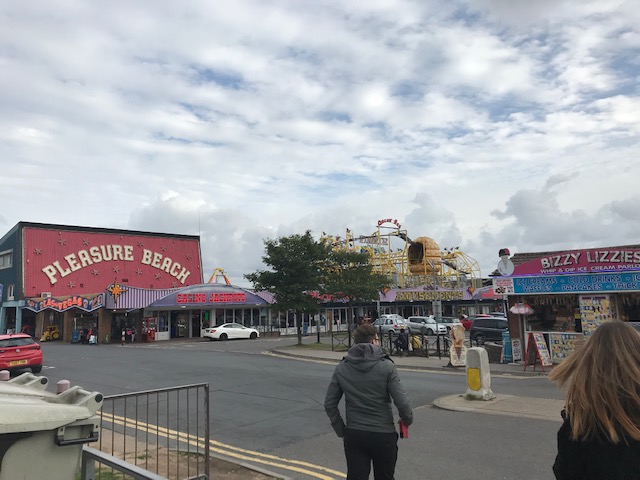
Around the corner is the Tower Cinema, a building rather loosely described as ‘art deco’ and showing various blockbuster films. A giant banner constantly beams out adverts for what’s on. At the time, it says, ‘Come to Skeggy and see ama Mia..’, crucially mangling the actual name of the film. A couple, both in mobility scooters, zip across the road and into the Marine Boat House Bar, a functional corner pub that had clearly seen some action over the years. Downstairs a sprawling bar has the feel of being on a ferry to France. Instead, we head upstairs for a view over the road.
The place is mildly busy, with some drinking, but most eating. A hulking man in sweat pants, sandals and socks hovers over a table like a silverback gorilla. He appears pensive, concerned, awaiting his partner’s return with a plate of carvery that it would be an understatement to describe as heaped. He beams at the mound of roast potatoes, Yorkshire puddings, meat and a scattering of vegetables. It sits on the plate like a food hillock, soon to be dismantled like a thousand years of wind erosion in fast forward. This was truly an impressive sight to behold as we sat and drank our fizzy lager.
It was time for Churchills. If you Googled ‘Brexit pub’, Churchills would no doubt pop-up. There’s a parade of St Georges flags outside and a statue of Winston almost as big as the one on Parliament Square in London. (In reality, it’s arguable whether Sir Winston would have approved of Brexit. A united Europe was one of his greatest ambitions, and on September 19, 1946, he even publicly advocated for a United States of Europe as a way to ensure the horror of World War II was never repeated). Churchills is the kind of pub that you creep into, expecting an O.K. Coral intake of breath. As is often the case, however, the reality is very different.
In fact, Churchills is a standard British pub. It serves beer, it serves wine, it serves spirits, and it serves food. It isn’t covered in pretentious dove grey paint with filament light bulbs. Aside patriotic accoutrement draped wherever possible, Churchill’s idea of decoration is dusty fairy lights in the shape of wine grapes. Everything isn’t preceded with the word artisan as an excuse to add a 30% premium to the price. There’s a shirt and shoes dress code on Saturday nights. The bar staff uniforms oddly look like they were borrowed from a Beijing bordello. Oh, and screens; screens everywhere showing sport. Tiny little tellies installed on the beer pumps so you can watch while you wait is clearly a touch of genius.
Churchills isn’t intimidating in the slightest and you’ll only find trouble if you seek it out. We sit on that grey Saturday afternoon and enjoy a drink, while watching Brighton lose 2-1 to Tottenham Hotspur on one television, and the undercard of Anthony Joshua’s heavyweight championship fight against Aleksander Povetkin on another. One television threatens to go into a stand-by, prompting protests from the locals until the non-plussed barmaid finds the remote control and puts them out of their misery. In another room, a group of people play oversized Jenga on a table. The chunky bricks topple over to mild cheers.
We get another drink and watch a truly dire boxing match on the Joshua Wembley bout. Two men appear to hug each other for an entire 36 minutes, yet neither seems to have an emotional revelation of some sort. Two ladies arrive in the pub dressed up for a night out. From some polite eavesdropping it appears they are a mother-daughter combo out on the town looking for love. It’s like the plot of a movie, but it’s probably best not to think of the genre. They sit at the bar and order mixing bowls of gin and tonic. As the pub fills with people arriving to get prime spots for the boxing, we take it as our cue to move on.
Googling ‘best restaurants in Skegness’ brings up a myriad of steak houses, burger joints and fish & chip restaurants. However, we opt for Saffron, the highest-rated Indian restaurant in Skegness at the time. At 8pm it’s absolutely heaving. A table opens up but it’s already booked. We slink away like rejected suitors. Thankfully, the second highest-rated Indian restaurant, Ghandi’s, is just a few minutes’ walk. It’s packed, too. A group of men we recognised from earlier in Churchills are lining their stomachs. They talk loudly and the staff politely but quickly take their orders. We sit and wait in what is loosely billed as a bar area. Leather banquettes surround a heavily carpeted floor. The walls are lacquered in black. The usual art you’d expect from an Indian restaurant bedecks the walls.
Staff buzz in and out attending to the tables. On one of the banquettes sprawls the young daughter presumably of someone who works there. She’s in her pyjamas, watching YouTube videos on a phone held about an inch from her face. We hear occasional buzzes and bleeps. So intently interested in the phone is she that others waiting wonder what she is watching. They observe her with head-tilted smiles, but the girl isn’t interested in the slightest, nor does she bother to move when new people arrive. They instead have to shuffle in and sit in a space getting ever smaller. After consuming what was clearly the second best Indian meal in Skegness, the young girl was still there in the same place watching videos on her phone at past 10pm when we left.
We head back to the Marine Boat House Bar to watch what was left of the fight. In just a handful of stadium bouts, more than 400,000 people have gone to watch Anthony Oluwafemi Joshua fight. He has become a phenomenon in a sport that can still heavily polarise opinion. His opponent that night, Povetkin, is a Russian who appeared to have some very powerful backers. But this was no Drago vs Stallone. The Russian was too polite and ordinary for that. And besides, Joshua didn’t need a story to sell a fight. He is the story.
On the upper part of Joshua’s right arm is tattooed a map of Africa, the nation of Nigeria pulled out in honour of his mother, Yeta. Joshua was born in the UK, but lived in Nigeria until he was 12, when he moved back to live in Watford. He could even have represented Nigeria at the 2008 Olympics had he not been reportedly turned down by the country’s selectors. Instead, he would go on to win Super Heavyweight Gold at the London 2012 Olympics, marked by the lion tattoo on his back. He’s now a multi-belt world champion, a multi-millionaire and a household name.
The male-heavy customer base of the bar show periodic interest in the fight. In-between trips to the toilets to snort cocaine, they shout and bay at the TV screens; ‘Kill ‘im’ and ‘knock im aht’ (Joshua eventually obliges in the seventh round – knocking Povetkin out, that is). What they did not appear to do is pay any interest to the tribes of females, dressed beyond the nines, ever hopeful that someone, anyone, will take an interest.
Even in the murky gloom of the bar, the glow of fake tan was at radioactive levels. The women wafted gusts of perfume as strong as napalm, and it mixed with the men’s vinegary sweat into an unholy fog. At some point, you’d imagine, these tribes would collide, as though on some warrior battleground, muscle-bound limbs and hair extensions torn asunder. We had no intention of being there when it happened, so we retire to Fawlty Towers for sleep.
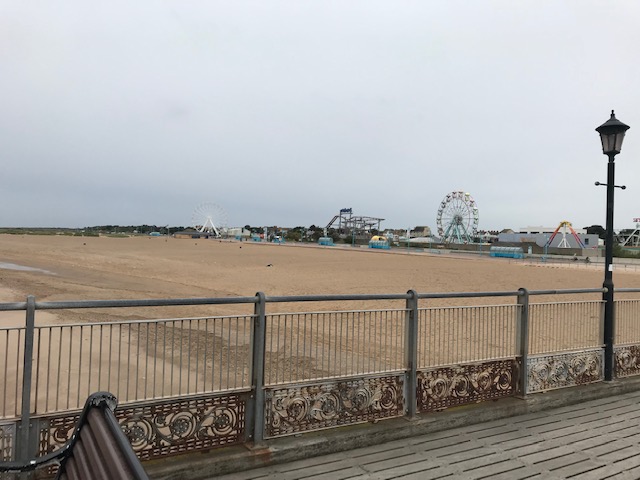
A golden beach extends
When we woke at 8am, it was already drizzling. Hotels in the north of England tend to kick out early, and we needed to be gone by 10 o’clock. It is always intriguing to see the other guests at a hotel at breakfast. It’s a bit like the morning after a house party, at which things went on that no one wants to acknowledge. Best just to keep your head down and mouth shut until it’s all over.
A buffet breakfast unfurls before us. The scrambled eggs appeared to have been around since last week, but everything else was fine enough. I get coffee and regret it. Across from our table sits a hulking man with a bald head, wearing a t-shirt with ‘unleash the monster’ emblazoned on it. He devours a plate of breakfast goods, as his female companion stares into the distance. From what you could divine, he appeared to be in the thralls of a fitness mid-life crises that some men tend to experience. They go from smoking, drinking and doing drugs to at some point deciding to get fit. It starts with the occasional jog and then, in an alarmingly short period of time, ‘yes, why shouldn’t I tackle a triathlon?’ Then in an equally short period of time, a major injury, because, well, you know.
Behind the mini hulk sit a group of four men, dressed in vintage Mod/punk outfits. The bands on their wrists indicate that they were in town for a Ska weekender. We ate our breakfast and the room gradually thinned out until it was just us and the punks. Skegness is a regular haunt for alternative music lovers, often travelling up from the Midlands. In a few weeks’ time from our visit, Butlins was due to host The Great British Alternative Music Festival 2018 (ticking all the boxes with that name), with a line-up including The Boomtown Rats, Bad Manners and Sham 69.
That’s a stark contrast to most other live music in Skegness, which tend to host an elaborate, multi-venue version of Stars in their Eyes. Shirley Bassey, Luther Vandross, Whitney Houston; they all have and haven’t played in the town. We look up and see that we were now alone in the breakfast room, with just a bored-looking waitress waiting for us to go.
Checking out I share some small talk with Andreas, a German from just outside Hamburg, who opened the Grand Hotel in 2014 and now runs it with his wife. He explains that running the hotel is so busy that he didn’t have any time recently to get back to Germany for his father’s funeral. It was the same when his mother died shortly after he opened the place. He tells me that soon he will close the hotel for the winter season, when the wind gets so cold off the North Sea that it costs him a fortune to heat the place.
We depart the hotel and wince at the icy morning air. The drizzle hits our faces in lightly stinging drops. There were no trains out of Skegness on that Sunday until 2.10pm. Just the previous week the timetable had been slashed down to the bare bones. Everyone was having such a good time that they wouldn’t want to leave, we presume. We head out to explore the town. There’s a unique bleakness to an English seaside town on a cold, rainy morning. Equally, it’s not without its charms, particularly when you have time to kill.
Across from the hotel is the Arnold Palmer Putting Course. It was unclear whether it had an official endorsement from the seven-time golf Major winner, but he would no doubt have approved of people honing their skills by getting a ball under a fibre glass rocket. We walk onwards away from town and then pause at an intriguing medieval castle. A knight in a suit of armour stands proudly atop the battle ramparts. Next to him flutters the flag of Lincolnshire – a yellow cross mirrored the St Georges, with green and blue quarters representing the land and sea respectively. In the middle a yellow fleur-de-lis represented the city of Lincoln.
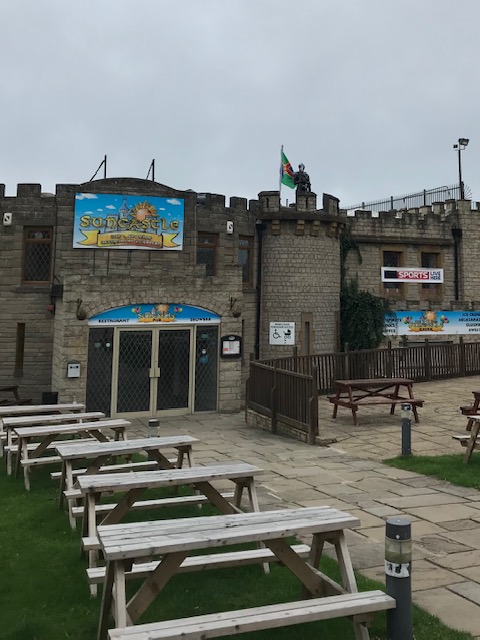
On closer inspection, this fortified structure in fact turned out to be a pub. Known as Suncastle, this alehouse boasts the enticing prospect of ‘castle themed rooms’ available for parties of up to 500 people. As it was too early to drink the £2-a-pint Carlsberg beer on offer, we move on. A bowling green is behind the pub and some old boys are already playing an early game. We stop for a moment and watch, until the bracing cold becomes too bracing to remain stationary.
To keep warm we head for a walk behind the bowling green and alongside a river. Greeting us is a sizeable mound of dog excrement at the entrance. Undeterred, we take a walk down the path as the water slowly flows alongside, a glistening oily slick on its surface, punctuated by the occasional carrier bag or piece of litter. You can take a boat down here in the summer, when the bright sunshine is probably somewhat kinder on the surroundings than a cold, wet and grey autumnal morning.
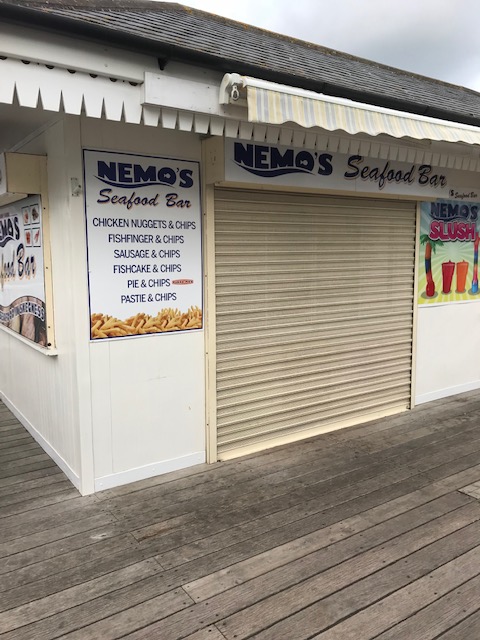
Down a sweeping curve of the boating stream, looking out onto the sea from the other side, are beach huts. As it was out of season, they’re mostly boarded up at the time. The sky hangs in a gloomy grey as we head onto the pier. These old wooden board piers are always a treat. We walk to the far end and look out to sea. The wind farms on the horizon are now a familiar part of British coastal economies. This moment feels satisfying; bracing, but satisfying.
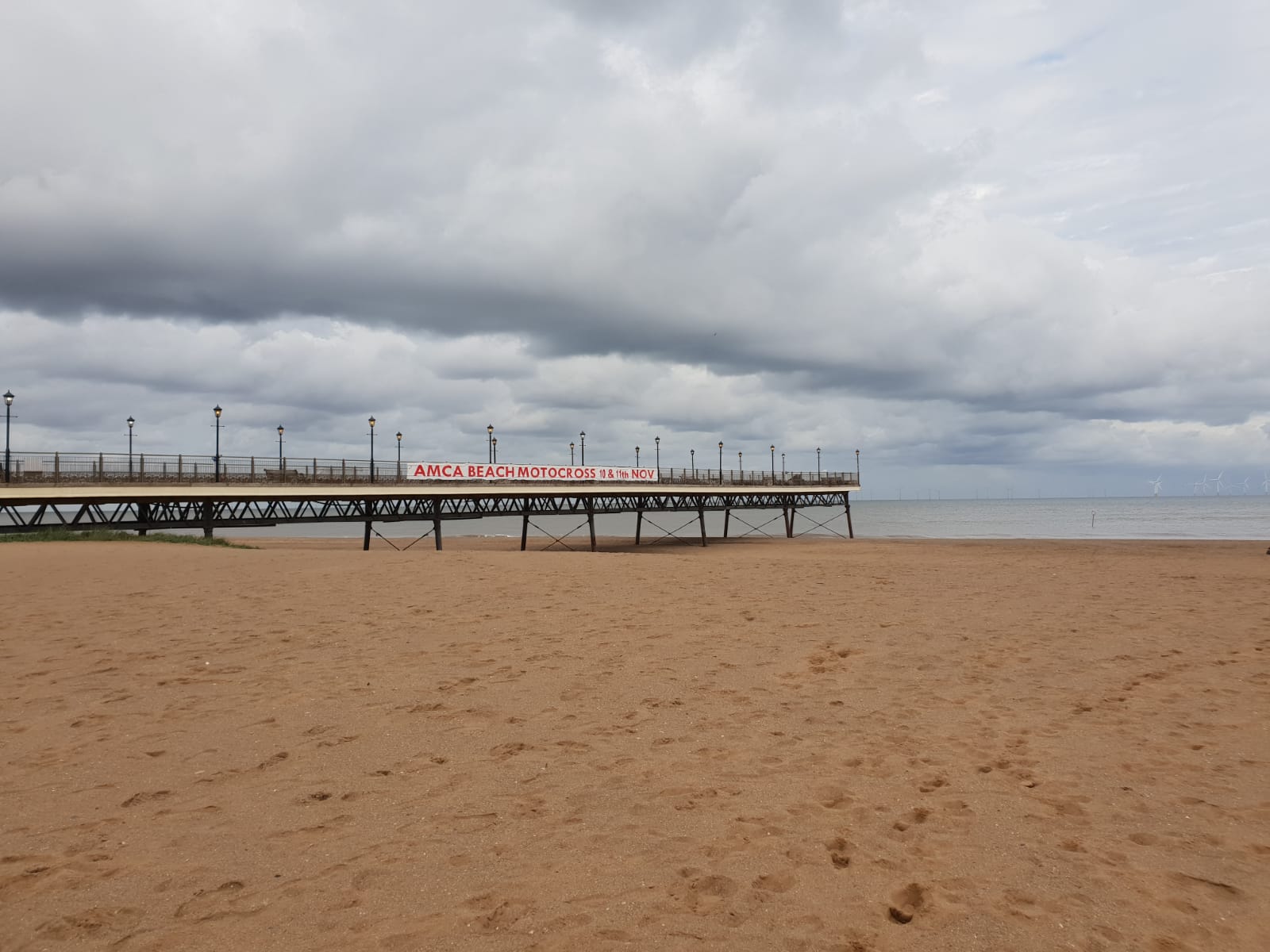
This golden beach, holder of a Blue Flag since 2011, extends either side of us. The sand is thick, clean and welcoming. Peer over and you could just about make out the lovely Gibralter Point Nature Reserve on the northern limit of the Wash. In 2017, parts of the Skegness foreshore gained ‘registered park and garden status’, effectively making the area Grade II listed. Skegness has so much going for it.
We head back past the scattering of rather sad looking stalls at the base of the pier, trying not to make eye contact for fear of a guilt purchase. A muddy looking pool promises some kind of fun for all the family (and presumably some kind of infection). A speaker belts out a pop-dance number that’s bracing for all the wrong reasons. Soon, we are back in town by the Clock Tower. Across from it is a rock shop. A sign proudly announces that this is British Rock, with a picture of a British Bulldog in varying shades of sugary pink and yellow. None of your foreign muck shall rot our British teeth.
A woman with a respirator in a specially-designed back pack inspects the produce. She’s joined by a pair of teenage parents, all dressed in sweat pants and sportswear, their child chomping at the bit to tumble out of the pram. Then a wiry drug addict joins the party, eyeing the sugary treats with suspicion. Instead of joining them, we head for a cup of tea. After refreshments, we visit Hildred’s shopping arcade. Opened in 1988, it appears to have hardly changed in thirty years. Shoppers flit between the stores selling jewellery, gift items and general knick-knacks.
A noticeboard at the far end of the arcade is filled with little colourful messages. One advertises an event entitled; ‘Relive the past, 1940s Remembered’. It promises World War Dress, memorabilia and, with somewhat foreboding, 1940’s style food. Another advertises a Remembrance Day Parade, while another punts a Christmas fayre – offensively early in October. In the corner a note is marked ‘save our services’ and calls on residents to protest downgrades at Pilgrim Hospital, in the neighbouring town of Boston, to the children’s ward and the neonatal and maternity units. There’s a Facebook group to sign up to.
We leave Hildred’s and head over to a covered market area. Stalls are setting up to sell their wares, including one with a veritable bounty of Betty Boo paraphernalia. A clothes stall has numerous signs saying ‘no dogs’, but is situated right next to another stall specialising in dog treats and accessories. A computer repair shop looks ready to be rebooted.
Onwards, back up the High Street; approaching midday the town becomes much livelier. Roving tribes of families patrol the streets, stonewash denim mixing with sportswear, like The Warriors reimagined by Jeremy Kyle. They hunt for something to occupy the little ones until they’d expired sufficienty pent-up energy, yet all the time keeping them fuelled up with sugary treats. The faint smell of dog excrement becomes stronger as we move further into town.
We pass the Smoke Safe vape shop, and then Williams bar, with the drooping ‘M’ in the sign held in place with yellow tape. We see another person with a respirator pack, and then have to side step out of the way of a couple on mobility scooters. They peer inside Flippers restaurant and ponder a deep fried lunch. We exit the High Street and head over to the precinct area in front of the station. The sign that announced ‘Welcome to Skegness’ on our arrival, pronounces, ‘See you again’, on the way out. We are an hour early for the train but there’s already a queue forming. A couple with unfeasibly large suitcases vape furiously at the front. They had clearly been there for a while.
As we stood and waited for the train, there’s time to think. Why does Skegness not only feel like the end of the line, but the end of the Earth? According to data from the Office of National Statistics (ONS), Skegness ranked as the most deprived seaside area in 2013. The ONS reported that deprivation levels, factoring in income, health, jobs, education and crime, were around two and a half times the national average. In data reported by the ONS in 2015, Skegness was in the top 20% most deprived areas in the UK. Between 2010 and 2015, the East Lindsay district, including Skegness, saw the 10th highest percentage point increase in the proportion of most deprived neighbourhoods.
Buoyed by the listing of the Skegness foreshore, consultants had been hired shortly before our visit to regenerate the foreshore and, in theory, bring back former glories. You can understand, though, why people in Skegness have heard all this before. British Railways tried to close Skegness station in 1964 following a decline in passenger numbers, but was unsuccessful. The station, giving a vital connection to the outside world, has clung on ever since. The Skegness Interchange Re-Development and Revival Project transformed the hub and introduced many improvement works in 2013. The funding came from the EU.
We shuffle into a regimented queue inside the station. Ahead of us in the queue a rotund man-child boasts about the sexual encounters he most definitely had the night before. His friend, rather unfortunately named ‘OJ’, sniggers along. The girls with them appear wearily familiar with the routine. The train eventually rolls out of Skegness. We settle back on the long journey home. On the way it becomes clear that the spectre of ‘disruption on the line’ had struck again. Are the London connections through Grantham running? It said they were but also that they weren’t on the mobile app. So, we ask the guard. He just checks the same app as we had and agrees that, ‘yes, that is rather confusing’. We ask National Rail on Twitter. Someone (or maybe a bot) replies that all trains were cancelled. We decide to chance it.
On the apparently cancelled train back to London, two young men sit down heavily in the seats in front of us. One wears a pink Nike cap, the other a beanie. They both have JD Sports draw-string bags filled with possessions. Wrist bands tell that they have been to Mint festival in Leeds. In the gap in between the seats we can see the phone screen one of the men is showing to the other. It has the Apple Maps app, clearly displaying the location point going in the opposite direction to that which they wanted; Boston.
‘I told you this is the wrong train,’ one says to the other.
They flag down the conductor.
‘What’s the next stop?’ one of the men asked.
‘London,’ the woman said, as the boys went a shade of grey.
‘I told you this is the wrong train,’ one repeats to the other.
 On the Road to Revolution