The End of the Line is a 10-part travelogue journey to some of the highest Remain and Leave areas in the United Kingdom’s 2016 Referendum on EU membership. It was written over two years from 2018 to 2020, before Coronavirus made Brexit seem like a spot of man flu.
Hastings voted 54.7% Leave in the 2016 EU Referendum
Originally written in February 2019
The last time I visited Hastings was in 2007. I had been sent to the Sussex seaside town to do ‘vox pops’ for a magazine I was working for at the time. On that chilly autumnal Saturday, I wandered around Hastings town centre, periodically accosting some unfortunate person who was out shopping. I’d shove a Dictaphone under their nose and then ask the confused individual a series of questions on the effects of privatisation of public industries (yes, I really did this). Then, my photographer would take a portrait of the person’s still puzzled expression, before I shuffled off to the next victim.
I was a staff writer on the magazine (which shall remain nameless), writing and editing a variety of pages on various topics, from pop music to politics. I can say with a good degree of confidence that the magazine’s editor (who shall also remain nameless) would have viewed leaving the European Union as a thoroughly decent idea. I was blissfully ignorant at the time, but the indicators were more than glaring. He commissioned me to do an interview with Brendan O’Neill, the controversial columnist and editor of Spiked Online, the libertarian online magazine. He sent me to see Matthew Elliott, then of the conservative lobbying group, the Tax Payers Alliance, but latterly the chief executive of Vote Leave, the official group campaigning for Britain to leave the European Union. I had absolutely no idea who Mr Elliott was and most likely asked him a set of truly inane questions at the time.
My editor saved his most aggressive editing for any left-leaning interview or subject I conducted or commissioned myself. A feature on climate change I put together was ordered for a near complete re-write as I apparently hadn’t come at it from a ‘critical perspective’ or reflected how climate science was apparently ‘a bit iffy’. To be fair, I was hideously hungover during the interview and had to pause proceedings while I went to discreetly empty the contents of my stomach in the toilet, but that’s another story. I was young and desperate for work at the time. Hell, I would probably have written a positive review of Mein Kampf if the price-per-word had been competitive
In both Brexit and Donald Trump’s rise to power in the US, the media and its practices have come under the spotlight. Critics claim that the so-called ‘mainstream media’ is guided by liberal bleeding hearts, cruelly robbing valiant right-wingers of the fair platform they deserve. In fact, the opposite is more than often true. At many times the media is pushed towards ‘small c’ conservatism, either overtly or with more subtle gait, akin to someone walking with one leg slightly shorter than the other. Whether media outlets are chasing revenue, pleasing some distant wealthy owner or striving towards some illusionary ‘balance’, the effect can be a completely imbalanced, impartial and distorted view of the world. The viewer, reader or Twitterer is left with a meal in which true fact is an ingredient they can only taste intermittently. And regardless of your chosen diet, that cannot be healthy.
On another Saturday, this time in February 2019, I again travel to Hastings on the train from Brighton. The two places are only an hour apart, yet they voted very differently in the EU Referendum (read more about Brighton here). Hastings wanted out by a decent margin, and that was despite the local Hastings MP at the time being Amber Rudd, the then secretary of state for work and pensions, who campaigned for the UK to remain. Rudd would also later call for a second referendum on leaving the European Union, against the wishes her own prime minister (again, at the time).
Sat on the train, I observe two young boys near me chatting away. Their plummy, posh voices jar with their urban streetwear outfits. They discuss their upcoming work experiences, both for some local creative media companies. One says, ‘it’s nice just to sit down for a bit, isn’t it.’ The other one agrees that it has been a really busy week. They can’t be more than 15 years old. I resist the urge to scream, ‘It’s all downhill from here!’.
The train rumbles onwards through the Sussex countryside. The trees outside are stripped and bare, giving everything a dulled colour palette, like Chernobyl on a good day. The sky hangs in a hazy grey. Hopeful patches of powder blue are few and far between. We roll through Lewes, the pretty town just outside of Brighton where property prices would make even a Londoner blush. Onwards we go, through the rolling hills of Sussex. A plump set of Hillocks puncture the horizon, like the upturned buttocks of a drunk, passed out face first.
The boys exchange vaguely braggy conversation about people they know who are making films, recording hit albums, or something like that. It’s probably 80% bullshit, but that would no doubt stand them in a very good stead for their future media careers. One of the boys gets off at Berwick, presumably heading home to an enormous country pile owned by his parents, whom he resented for some unclear reason.
Onwards. The scrub brush becomes thicker, the fields greener, the sky more flecked and brushed, as though freshly painted by Turner. A man in a blue puffer jacket, who had already been to the toilet twice in half an hour, eyes me suspiciously from a few rows ahead. I stop typing until he judges that I had learned my lesson, and looks away. We arrive into Polegate, with its boxy, 1970s buildings constructed in an architectural style that could best be described as ‘functional holiday camp’. A Union Jack flag flies limply on top of a shed in a back garden. Brighton & Hove Albion fans wait on the opposite platform, heading to Falmer to watch the Seagull’s 3pm FA Cup clash with West Bromwich Albion.
As the train rolls through Hamden Park I peer into the back gardens of people living beside the train line. Each passing property gives a little flash of insight into someone’s private world. A mad scattering of toys across a lawn in one, a carefully placed regiment of gardening tools in another. Empty chairs arranged around a fire. A well-kept shed placed far away from the house, with a solitary path towards it well-worn into the grass. My mind buzzes with each mini soap opera unfurling before my eyes.
‘Pat and John, married for 30 years, two kids, Paul and Anne, now grown up. Paul works in insurance and is going through a messy divorce from a childless marriage. Anne conformed to her parent’s wishes and found herself a mildly successful man to marry and set about pumping out three kids. John’s got high blood pressure, so Pat got him a Fitbit for Christmas…’
And then onto the next garden and the imagined stories held within.
We eventually arrive into Eastbourne. The sign at the station welcomes you to the Sunshine Coast, although today must be its day off. Eastbourne is an end of the line location. It too voted to leave the European Union, by 57.3% to 42.7%, virtually the same ratio as Hastings, and higher than the national average of 52% for leave. Eastbourne also defied its local MP, Lib Dem Stephen Lloyd, who campaigned for the Remain side. Like Rudd, he broke ranks with his party, although it was to vote for Theresa May’s disastrous withdrawal agreement. That’s the one that was voted down in Parliament by the biggest margin in history. Like Lazarus, the bill would later make a dramatic comeback from the parliamentary ooze as Boris Johnson’s reheated ready meal, just waiting for the bing.
As the train waits in Eastbourne station, I watch as a man in a deerstalker hat walks along the platform beside my window chatting away to himself about something. Nearby a ginormous teenager, about six foot five and 20 stone, stands like a towering colossus on the platform. His trousers aren’t quite long enough and they expose the crisp white socks he’s wearing. An elderly couple slowly board the train. Like rodeo riders, they calm rippling waves of various aches and pains to eventually settle themselves into a pair or seats. The train backs out the way it came, and I’m now facing backwards as we head off towards Hastings.
More back gardens to inspect. A tattered flag of St Georges flutters in the wind on a shed. Shed flags are popular around here. It’s now nearly impossible to have the national flag of England displayed on your property without it being automatically assumed that a racist lives there. So co-opted has the English flag become as a symbol that it’s hard to see a way it could be reclaimed as a national symbol. Maybe post-Brexit some bright spark will suggest a rebranding exercise involving Instagram influencers and then we can all go and immediately kill ourselves.
Despite the dulled colour palette, the countryside around the train line is pretty. Walkers are out in force due to the weather being quite mild today after the recent frost. The train line skirts the coast, heading through the rather bleak Normans Bay and onwards towards Cooden Beach. The line becomes so close to the sea that you can almost reach out and touch the salty waves. Regardless of the location, a coastal train line always feels glamorous and full of mystery. Although, the mystery most often on Southern-run trains is, ‘what exactly is that smell?’.
Alongside the coast the beach huts stand in proud lines. Dull suburban homes contrast jarringly with an occasional, outlandishly fancy-looking property that no doubt featured on TV show, Grand Designs, at some point. We arrive into Bexhill-on-Sea, a fairly standard Sussex seaside town elevated by the excellent De La Warr Pavilion. This Grade 1 listed, Art Deco-style building was extensively renovated in 2005 and is well worth a visit to see a range of art exhibits in one of the largest galleries on the south coast of England. You can catch an eclectic mix of performances in the theatre or just sit with a drink and look out towards the English Channel.
Onwards, the train strides besides the beach like a lumbering version of Chariots of Fire. Husks of old boats sit rotting on the sand. More beach huts, endless rows of them, all lined up on the front ready to defend a sea-borne invasion. Then the urban world returns. An enormous warehouse roves into view, housing megastores for TK Maxx, Carpet Right and Poundstretcher chains, just before St Leonards Warrior Square. This exchange station was previously called St Leonards on Sea, but adding Warriors Square makes it sound much more butch. It’s a bit like a wrestler called Kevin Willis becoming Kevin ‘The Reaper’ Willis. Ooo, scary. I can’t want to see his brutal takedowns and hear extensively how he doesn’t like talking about his charity work.
Finally, the train rolls into Hastings as the gloomy sky darkens. I quietly pray it isn’t an omen. Ok, technically I am stretching the ‘end of the line’ shtick with Hastings. It isn’t actually the end of the train line. Nearby Ore isn’t really either, although it is the end of the line from London Victoria, so that kinda counts, right? Let’s have a vote on it – oh wait, maybe not…
Exiting the train station, I walk towards Hastings town centre. Down Station Road I pass Mr Poppers jacket potato shack.. A woman wearing a fluffy pink jacket and a hat with pom-pom ears tucks into a jacket potato from a polystyrene foam tray. Further on a large square is ringed by shops in the Priory Meadow Shopping Centre. All the usual chains are here, some having just come out of administration, others just commencing the proceedings.
In the middle of the square stands a statue of a cricketer, caught in mid slog of a ball. The plaque indicates that this was unveiled by the Queen at the opening of the shopping centre and marks that the site was previously a cricket ground before it was sacrificed to the gods of commerce. I head inside the Priory Meadow, side-stepping two boys wrestling on the smooth floor. It’s lightly busy considering today’s a Saturday, but January is always the retail graveyard shift. Idle desperation exudes from the stores. Some cling to life by a razor-thin grip, hoping desperately not to join ‘the fallen’. Woolworths, Comet, and Toys R Us; just a few names lost to the big retail park in the sky (turn off at Junction 25 and follow the signs).
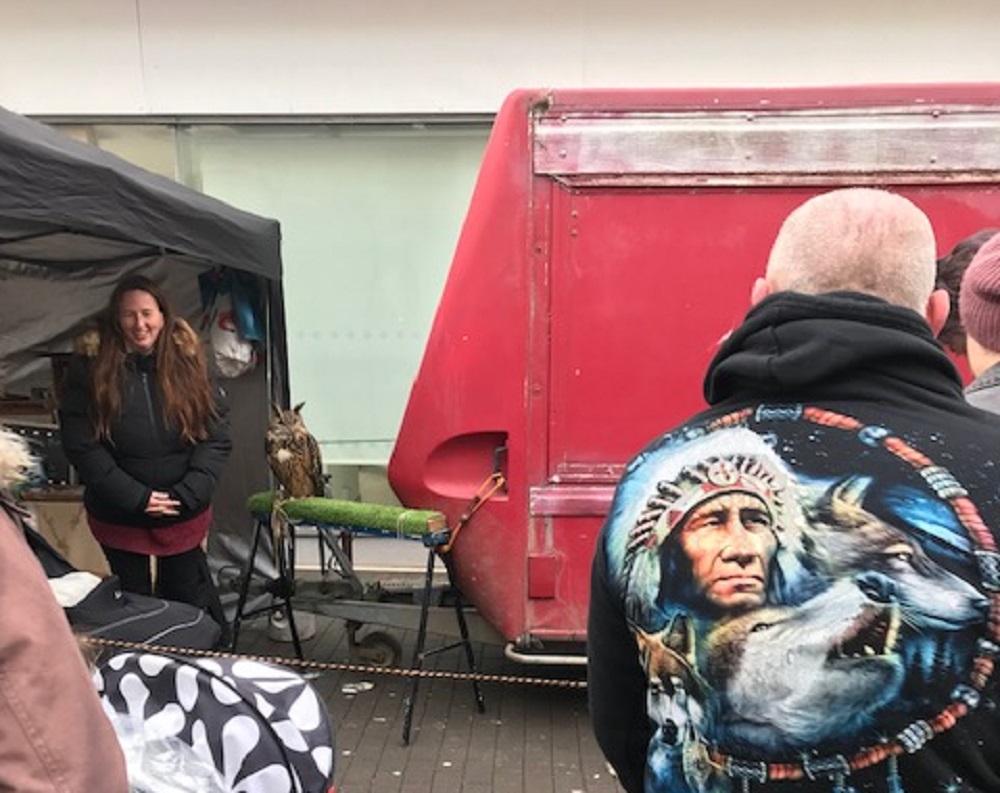
I join a gaggle of pensioners taking a break on the benches. They must be seriously worn out as there’s a sale on at Holland & Barratt. Outside of Priory Meadow, on Wellington Place, it is market day. There’s a fairly typical range of stalls selling a variety of tatt, but one catches my eye. A red trailer provides the backdrop for a makeshift owlery, with five different owls sat on perches eyeing the Saturday shoppers with bemused suspicion. A stall sells owl-related products, including memorabilia and owl-rearing equipment.
I have always been fascinated with owls. At times I’ve even considered whether it was possible to have one as a pet. Reluctantly, though, I resist the urge to ask the woman running the stand for more information. It was not beyond the imagination that I would be on the train home wondering how the hell I was going to look after Timmy the Tawny Owl, going absolutely bonkers on the seat next to me. Some dreams are best left unfulfilled…
As the market ebbs away and regular shops take over, I notice a free Palestine demonstration outside of Lloyds Bank (it doesn’t appear to be a protest against the bank, rather that this was a good place to put the stand). A man in an oversized US ice hockey jersey hands out leaflets calling for an end to the occupation of the disputed areas. He appears rather despondent at the lack of interest, but perks up when his colleague appears with a bag of savoury treats from Greggs for lunch.
An underpass leads towards Hastings old town. On either side of the passageway are murals to the town’s real claim to fame; the Battle of Hastings in 1066. This crucial event in British history was, and not many people know this, the first attempt at laser eye surgery (it didn’t go well, if you’re wondering). What happened here more than 950 years ago, when Duke William arrived from Normandy to take the throne and boot out the Anglo-Saxon elite, obviously has great resonance for the events of today.
The symbol of 1066 has been co-opted by both those supporting and opposing Brexit. While many see it as a symbol of fighting European invasion, others view it as showing actually how close we are to our European neighbours. On 14 December 2018, an anti-Brexit march, led by the European Movement 1066 branch, walked through Hastings and held a rally next to the Odeon cinema. The held a banner proclaiming ‘Hastings Loves Europe Since 1066’ and were entertained by Faux Bo Jo, a comedian parodying former Foreign Secretary Boris Johnson, who would later ascend to his own throne (with both eyes intact).
Two weeks before my visit, Tim Martin, the founder and chief executive of the cheap and occasionally cheerful Wetherspoons pub chain, was at the John Logie Baird branch of his empire in Hastings at 11am to talk to the locals about Brexit. The prominent Vote Leave supporter was on a tour of pubs in his chain to rally support for getting out of Europe without any sort of deal. According to the Hastings Observer, the bar was packed with hundreds of people, “most of whom seemed to be over the age of 55”. Somewhat bizarrely, a French television crew even turned up to cover the event.
The Observer reported that Leave supporters raised Union Jack flags and shouted down any Remain saboteurs. It sounded similar to the Nuremburg rallies but with an ample breakfast buffet. The biggest cheer was reserved for when Mr Martin claimed that leaving the EU would enable Britain to take back control of its fishing waters (more on that later). He claimed that instead of being a disastrous hammer blow to Britain as some commentators claimed, leaving without a deal would in fact be a blessing.
In an effort to practice what he preached, Mr Martin had already stopped various European drinks, like champagne, from being sold in his pubs. If you like that foreign muck, you aren’t really British, he possibly believed. “The volume of shooters we sell has actually gone up since we replaced German Jagermeister with Strika, an alternative made in Chorley,” Mr Martin said in Hastings, as quoted by the Hastings Observer. “The principal is that anything you can buy from the EU you can buy from elsewhere.” Well, with Chorley’s No 1 Herbal Liqueur already in the bag, who wouldn’t want to leave without a deal?
I emerge from the underpass and reach a forecourt dominated by a giant Argos. Across the way are boarded up shops, including the Crafty Vapes free house, billed as ‘the home of beer and vape’. It is unbelievable that such a concept had failed to take off and now sat empty. Some ideas are just way before their time. A little further ahead I reach the seafront. A large car park sits squat in front of the pebble beach, and then beyond it the sea. The water undulates in grey, choppy waves as the cold wind whips across the Channel.
I stop to have a brief text message exchange with my now ex-girlfriend. She wishes me well. She was supposed to come on this trip, but didn’t because we had just split up, and possibly because she didn’t want to spend her Saturday wandering around Hastings and trying not to buy an owl. One or the other. I’m still living at her flat. It’s rather messy, but manageable. I am on the way to be technically without a home, but not technically homeless. Unlike many people, I have the luxury of options when things go wrong.
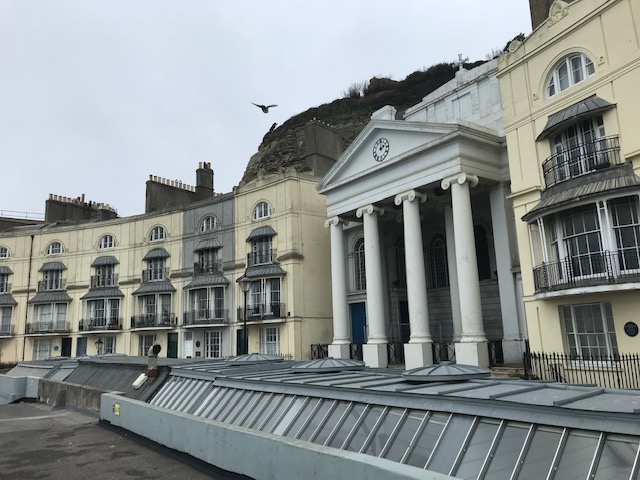
I head down Pelham Place, as the faint sound of amusement arcades rings out ahead. Pelham Crescent was clearly a grand sight in its day. Three blue plaques denote people of note once lived in these elegant buildings. You could see why, with the sweeping curve of the close enabling all buildings to look out to sea. They now appear down-at-heel and the imposing St Mary Church is boarded up. I stand and take it all in, before noticing that a pigeon lies dead at my feet, flat on its back as though it had passed out drunk. I wonder if it is too early for a pint.
Around the front of the crescent an old fish bar sits closed up, so I head into the pleasant St Mary’s in the Castle café and shop. I get a coffee, and take a seat to watch the world go by. On a table next to me two elderly women analyse the oven cleaner that one of them has just purchased. They bear concerned expressions as they read through the instructions. Upon finishing, one woman carefully puts the cleaner away, but concern remains etched on her face, as though some great evil would be unleashed when she comes to use it.
Despite it being a cold January day, Hastings bustles with activity. A steady stream of people pass by the window to distract my gaze from the sea beyond. A woman stops to readjust her dog in its pram. A young couple walk past; they couldn’t be more than 16 years old but are dressed as though they had just come from the set of drama, Peaky Blinders. They’re closely followed by two well-dressed men, both wearing felt trilby hats – one British racing green, the other a striking mustard yellow. A boy racer revs his over-tuned engine, and then the garishly-coloured car farts its way down the strip. Groups of kids hang around together, stuck in the limbo years before one of them appears old enough to get served alcohol.
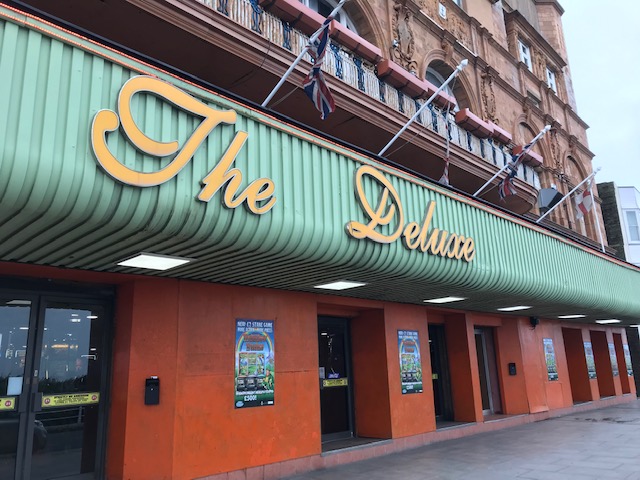
After finishing my coffee, I head out to explore. The Deluxe is a huge, vintage amusement arcade, filled with machines buzzing and bleeping away. Inside, people are mostly gambling, laboriously feeding money into the machines as though on the production line. Further up Old Town amusement arcade is equally vast, yet lacking such a vintage charm. A passageway from the sea leads to George Street, a pretty winding way with boutique shops, bistros and ‘olde-worldy’ pubs (some of which are actually olde-worldy). The pleasant place busies with people out for the day to shop, eat or drink, or all three.
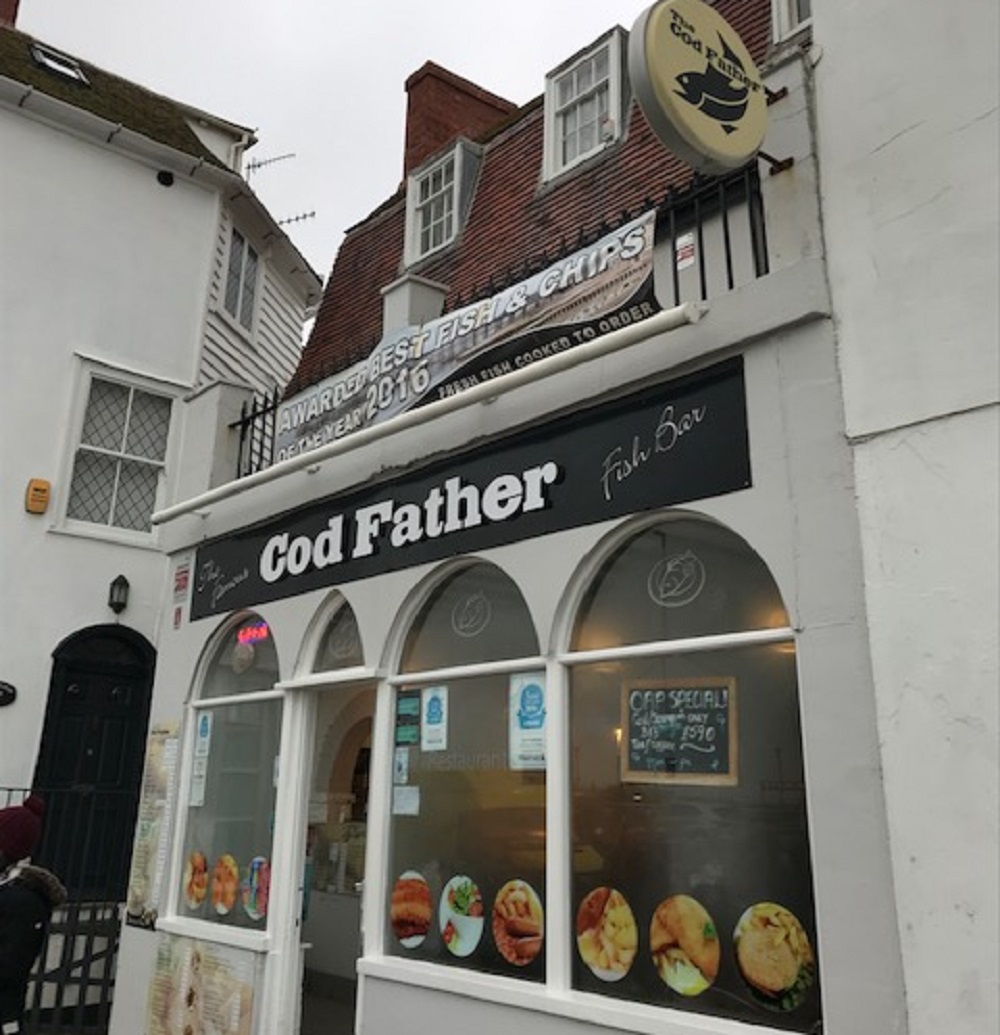
Although there are plenty of places at which to indulge in fish and chips, I choose the Cod Father, because, well, why wouldn’t you? According to a large banner above the shop, it was apparently voted ‘best fish and chips of the year in 2016’. Not only is this accolade now three years old, but it’s not particularly clear who awarded such an honour. A board advertises an OAP Special of cod or scampi with a cup of tea for £5.90. Damn you, youth.
As I sit on a bench and eat my 2016 award-winning chips, the clouds begin to darken above me. The seagulls flock and squall. Rain is on the way. Anticipating a deluge I move on, passing a group of teenagers who smell strongly of skunk weed. I head back down George street and into the Ye Olde Pub for a drink. Decor-wise, it combines genuine history with a modern interpretation in a somewhat jarring mix. Just like many places in Hastings it leans on the piracy theme, although the wi-fi password, Jacksparrow, rather limits any historical credibility to be had.
Speaking of pirates, I am due to stay in Rye that evening. It’s 20 minutes from Hastings and I’m booked in at the Mermaid Inn. This Grade II* listed hostelry dates back to 1156 and was once a favoured haunt of pirate gangs (some of whom no doubt left a positive review on Trip Advisor). Rye is in the district of Rother, which also voted to leave by 58.5% to 41.5% (you can see a pattern emerging here). Before heading there for the night, I pop into the Crowley pub by Hastings station for a final drink. It’s virtually empty, but clearly set to get lively later on. The noise of the band sound-checking can be heard upstairs, with the strumming of guitars and the plodding thud of bass.
The barman chats to a man, presumably in his late 30s or early 40s, with dreadlocks. His elegant dog sits attentive at his feet. The dreadlocked man discusses how expensive life has become, particularly for someone living on their own.
‘It’s just not affordable,’ he says, before changing tact. ‘Like going on holiday; it used to be that you could go camping to Wales and it would be a cheap holiday. Now, you got your petrol to drive to Wales, camping stuff, wood for a fire, it all adds up. It’s cheaper to go to Spain. What’s all that about? How can it be cheaper to go to Spain?”
The barman gives a snort of agreement and then returns to cleaning glasses.
“Madness,” the dreadlock man says, before ducking down to coo his dog. “Madness.”
‘No fishing selling out’
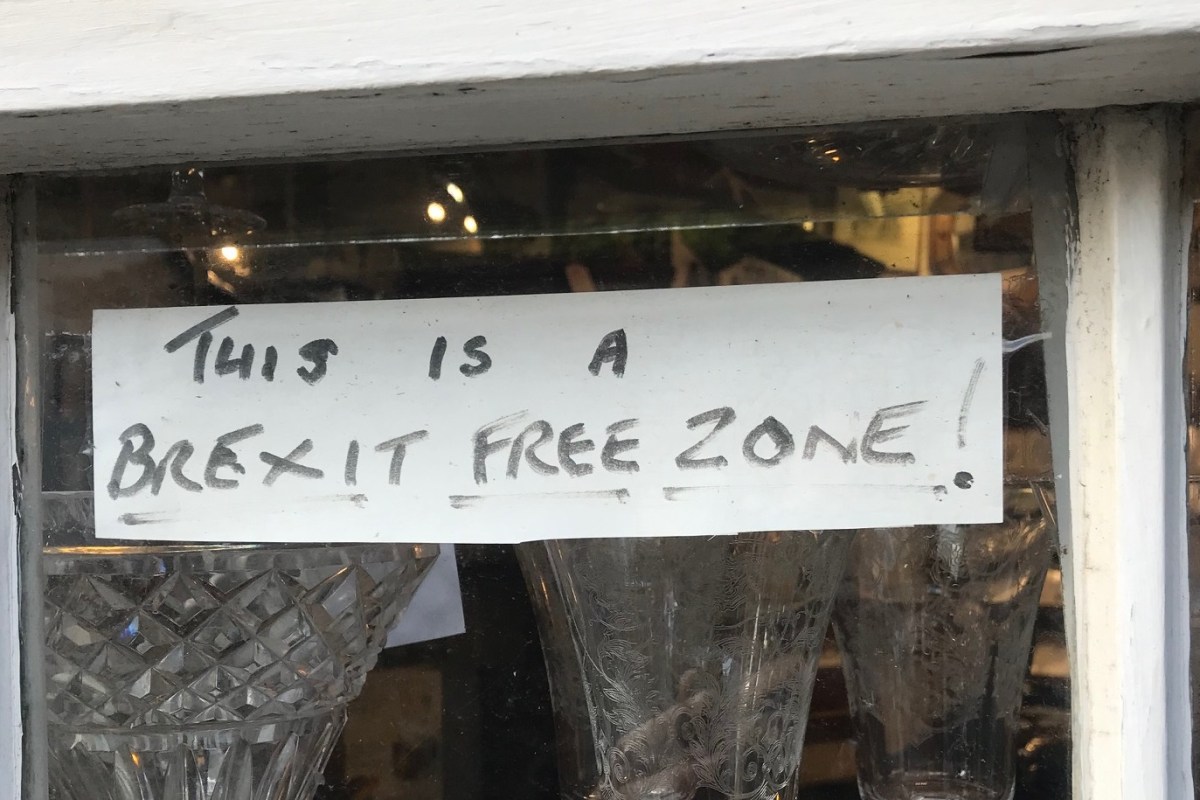
The following morning, I prompt mild panic in the hotel staff by turning up towards the end of the alloted time slot for breakfast and promptly ordering a full English. As I eat and browse the headlines on my phone, the dining room is dismantled around me, as though I am the last (and least aware) passenger on the Titanic. After eating, I exit the hotel and walk towards the station, taking a route up the slight incline of The Mint in order to work off the calorific breakfast. I notice a hand-written sign in the window of an antiques shop. It warns that the shop is a ‘Brexit-free zone’. I’ll take my business elsewhere, then.
There are few strings of words that strike greater fear into the Sunday traveller than ‘rail replacement bus’. It’s the weekend, so must be time to summarily punish anyone ambitious enough to consider an excursion on their two days of allotted leisure time. I clamber on the near empty double-decker sitting outside Rye station, and wait for the driver to finish vaping, before we roll off back towards Hastings. Despite the brisk and energising start to the morning, it now feels suddenly bleak. My mood starts to sink. It reminds of the moment in an episode of sitcom Father Ted when a rejuvenated Father Kevin forgets about his depression for a few delicious moments before boarding a bus and fatefully requesting the driver to put on the radio, only for the Radiohead song Exit Music (For a film) to come on. The world sluices of all colour as the father slumps into his chair, despondent once more.
The bus trundles through the Sussex countryside, only stopping for 10 minutes somewhere random while the driver sends a very important text message. He peers at his phone as though trying to re-programme the Hadron Collider. Each button press is carefully considered until he had finally reaches a coherent memorandum for whatever lucky soul is intended to receive it, and our amiable peregrination can therefore continue. Eventually, we arrive into Ore, a sprawling mass of identikit suburban homes, banking up a hillside. The bus waits in the station, which appears similar to a military checkpoint, but with a One Stop Shop for refreshments. No one gets off, so the bus proceeds onwards to Hastings.
Exiting the bus at Hastings station, I take the same route towards town as the previous day, once more ducking into the Priory Meadow shopping centre. More Radio 106-108 M had set up a Crystal Maze style tube with a fan inside, waiting for someone to grab as many floating bits of paper as possible towards the prospect of winning £1,000. I stop and watch a woman waft at the task like a demented seal, but move on quickly to avoid catching the eye of a More Radio employee roving expectedly with a clipboard for victims.
Despite it being just before midday, more than 10 street drinkers pass me on my walk through town. Clutching cans of super strength lager, they either bellow loudly at each other, or talk quietly to themselves. It’s bitterly cold today, so a couple huddle up for warmth. The reasons why someone ends up on the street are usually complex and difficult to generalise. But Britain, at the time the sixth biggest economy in the world, can and should be reasonably expected to be able to house everyone who lives here.
A heavily tattooed man walks past me, vaping furiously. Another giant man goes the other way talking loudly on the phone, ‘£50!’ he shouts, ‘Why the fuck should I pay that? She’s done fuck all.’ Two traffic wardens follow behind exchanging rolled-eye glances. I move a bit quicker towards the salvation of the beach. The air feels clean and clear as I hit the promenade. Here, the pebble beach is punctuated by orange-yellow sand. Dogs chase tennis balls thrown by their humans.
Hastings pier is closed at the time, but looks nice through the locked gates. It might seem strange to come to a seaside town in the middle of winter. From living in Brighton, however, I know that you only see the reality of such a place when it is out of season. You understand more about a place’s character when the screaming stops. The sea is calmer today and the sky lighter. At Warrior Square, old Regency buildings form a ring around the space with a good sense of majesty. But the clouds soon darken again and it starts to rain.
In the drizzle I head back into town, passing The Carlisle pub, where in February 2016 a fight between bikers, one of whom was understood to be in the Hells Angels, left one man with badly damaged sight in both eyes. I soon find myself once more in the Old Town, including the pretty West Hill and East Hill residential areas. You can catch the East Hill lift, a funicular that takes you up to the Hastings Country Park nature reserve at the top. You get a fantastic view, able to see a panorama of the beachfront up to the surrounding hills.
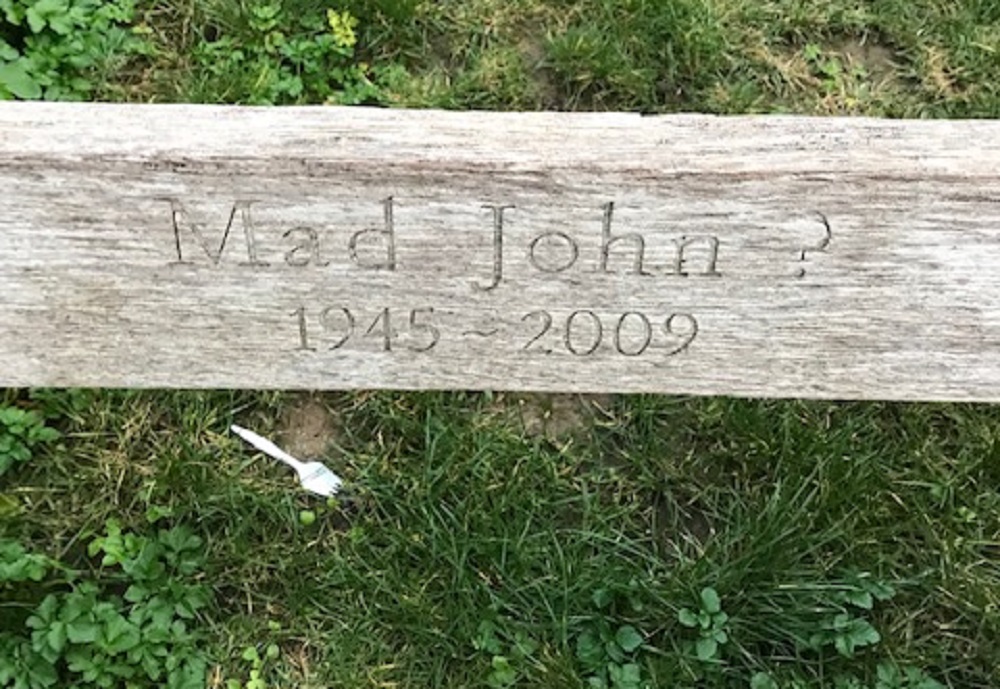
Instead of getting the train back down again, I walk the stepped path back towards town. A bench at the top commemorates someone called ‘Mad John’, who lived from 1945 to 2009. Half way down another bench honour Jim & Trixie Butchers, who were apparently a ‘wonderful Hastings couple’. And finally, at the bottom, a bench commemorates ‘Olly 9 toes Carey’, who expired in October 2005. I pledge to myself that one day I will be celebrated in a cryptic message on a park bench here: ‘Andrew Laughlin – best fish & chips in Hastings 2016’.
Exiting the steps, I stop to enjoy Tamarisk viewing point. Here, you can see outwards onto the fishing beach. The huts line up in squat rows, all built of distinctive wood painted black and weathered elegantly by the sea. On the beach fishing boats are pulled ashore for the day. Around them is a tangle of equipment, stacked and packed up ready for tomorrow’s catch.
Walking down the winding passageways, known in Sussex as twittens, brings a genuine smell of history. It’s the occasional blast of an industrial past, like the choking smell of coal unlit on an open fire. Emerging out onto the front leads you to the Rock-A-Nore road and onto the forecourt leading to the fishing beach. Walking amongst the fishing buildings continues the feeling of stepping into the past. Stands are set up to sell plaice, flounder, huss, mackerel, whiting and dabs (the fish, not the celebratory move).
Some of the buildings have pictures attached to them depicting scenes from Hastings’ fishing past. Most are of gnarled men with beards standing awkwardly for the photo. Not everything here looks back to the past, however. Nestled amongst the buildings is the Jerwood gallery, a sleek and modern building clad in black tile to fit in seamlessly with the fishing buildings. The current exhibit is Nigel Cooke, the British contemporary artist known for magical re-interpretations of real landmarks and places. His Hastings exhibit understandably draws inspiration from the coast.
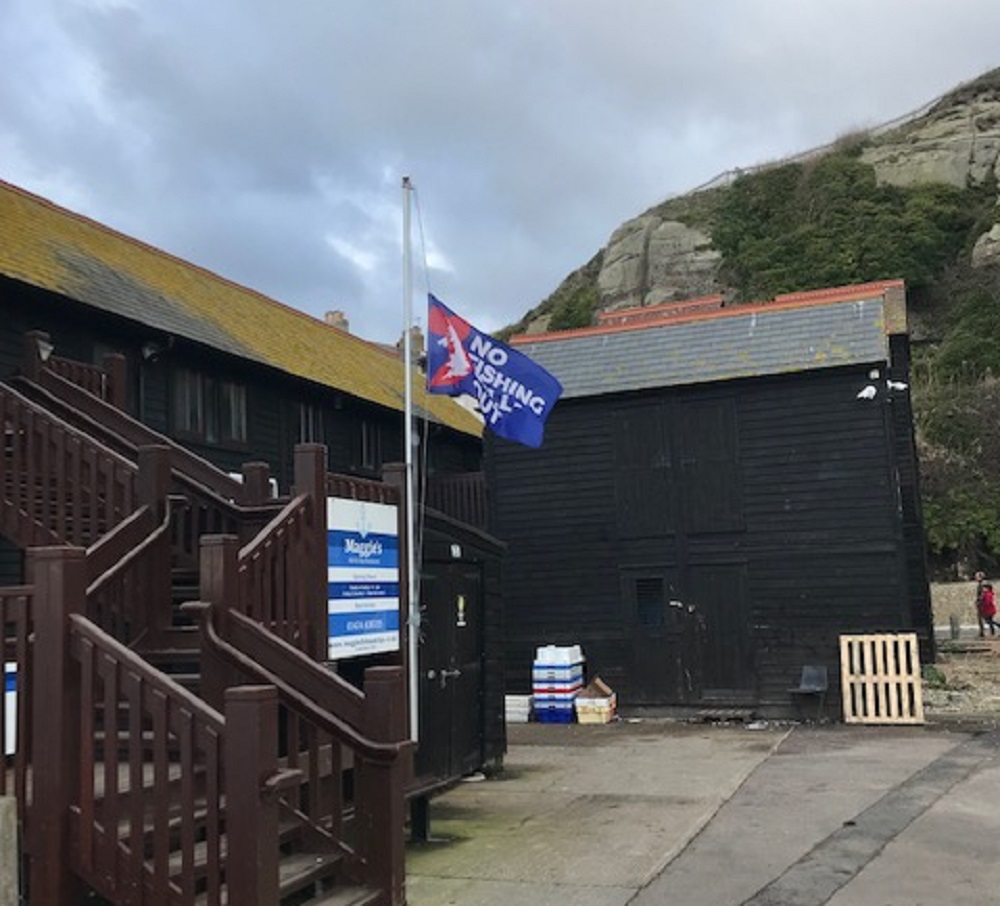
Further up, outside of Maggie’s fish and chip restaurant, a flag flies proclaiming, ‘No fishing selling out’, over a map of Great Britain. The slogan was created by the National Federation of Fisherman’s Organisations, a campaigning group that could sorely do with hiring a copywriter. Fishing continues to be one of the key battle-lines of Brexit, with the fishing industry highly critical of the EU due to the Common Fisheries Policy. They argue that more than 50% of fish taken from around the UK was by non-British boats. Brexit, they argue, would redress that unfair imbalance.
While Brighton and Skegness allude to a fishing heritage that isn’t really there, fishing is a central part of the Hastings DNA. Boats have been bringing their catch into Hastings since the town was founded in the ninth century. In the Hastings Fishermen’s Museum on Rock-a-Nore road, one of the first exhibits depicts the Breeds family, generations of Hastings men who were fishermen and served in the Royal Navy. This includes Thomas Breeds, 1887 to 1943, who has the rather unfortunate middle name of ‘Titt’. There’s a wonderful language to fishing; I look at a model of a ‘Hastings Lugger, elliptical stern with Otter trawl.’ Something clearly so workmanlike has been made to sound so exotic and interesting.
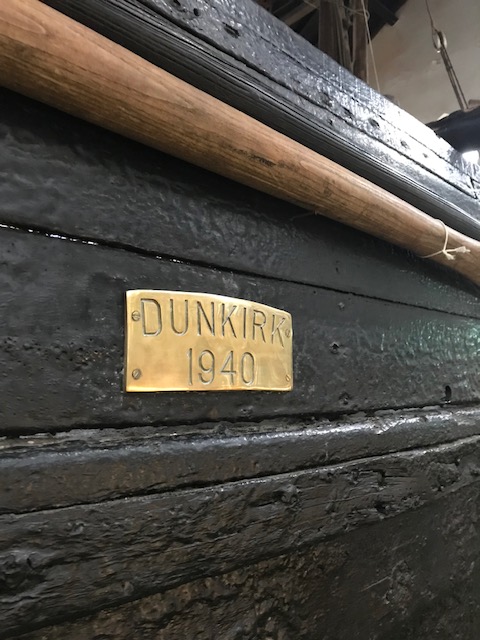
Nearby is a portrait of George Rich, a local fishmonger who appeared to have been quite the celebrity and used to supply many of the local fish and chip shops. Apparently, he never drank alcohol or smoked, but ‘did love the ladies and they seemed to love him back’. Next to him is a picture of a gaggle of drunk fisherman at a wedding, ties half undone and some slumped on each other. In the middle of the museum is the RX 278 Enterprise, a lugger vessel that responded to the call to support troops in Dunkirk during World War II. It went to Dover but was not ultimately dispatched to help pick up the almost 340,000 British and French troops escaping the French beaches from the advancing Nazis.
Just like 1066, the Dunkirk-esque spirit has been sighted as a sign that, ‘we’ve gone through worse before, so we can get through Brexit’. Certainly, some did vote for Brexit to bring back industries such as fishing to former glories. You saw the same with Donald Trump’s support for rust-belt industries, such as coal and steel, in America. However, according to a report from Hastings council, fishing is actually one of many industries actually at threat if the UK were to crash out of the European Union without a deal.
Even those in the industry were expressing concern. Speaking to LBC radio in January 2019, Graeme Sutherland, the director of Whitelink Seafoods, said: “As a company, we export into Europe at a rate of 85-90% of what we produce here. We are working on a next-day delivery into France for distribution into Europe. So if we are delayed in any way in clearing customs, in effect, we are going to lose 24 hours on delivery. We need frictionless borders. It has to be that for our industry to survive.”
Fishing isn’t alone; Hastings council is also worried about the town’s large tourism industry, along with its care homes serving the elderly and its language school, understood to be worth £30m to the local economy. All are potentially at risk if the most negative of Brexit projections were to come true. I leave the fishing museum and head off for a pint. In the Albion pub I meet a couple. In amongst the chaos of barking dogs, rampaging children and plates of Sunday lunch going out of the kitchen, we chat about this and that. They used to live in Brighton and work in London, but gave it up to come to Hastings for a more balanced life. They say that they love the place and happily eulogise how Hastings feels healthier and friendlier and more genuine than anywhere they have previously lived.
They seem nice. He tucks into rabbit pie, she shares some of her fierce political views. They are both very friendly. Then talk turns to Brexit. I don’t ask – it’s rude to ask such a thing as is most terribly British – but you get the feeling that they are not among those that voted Leave in Hastings. They decry the idiocy of the vote and the maddening aftermath of how it has been handled.
“Part of me just wants them to get what they want,” he says. “No deal, we crash out. Everything collapses. Then they can’t complain. They got what they wanted.”
“And the army would be on the streets,” she replies, exasperated.
 On the Road to Revolution