The End of the Line is a 10-part travelogue journey to some of the highest Remain and Leave areas in the United Kingdom’s 2016 Referendum on EU membership. It was written over two years from 2018 to 2020, before Coronavirus made Brexit seem like a spot of man flu.
Brighton & Hove voted 68.6% Remain in the 2016 EU Referendum
Originally written in October 2018
The Sussex pub sits on the corner of St Catherine’s Terrace and Kingsway on Brighton & Hove seafront. It is midday on a Saturday in October 2018 and two women on a table nearby already have multiple empty glasses in front of them. A group of lads noisily play pool. Three old boys chat conspiratorially at the bar. The décor feels like a work in progress. A bland colour palette of greys and greens mixes with cheap wood. There’s bad art on the walls and mismatched bric-a-brac sits gathering dust on shelves. A rusty suit of armour stands near the door for no discernible reason.
The woman serving at the bar remarks that the lager is pouring rather lively today, and asks if I want a flake in my pint. I suggest hundreds and thousands could work better. She agrees. I sit down on one of the large, rather dated tables. The pub is cavernous, with multiple rooms and spaces portioned off from each other. It feels like a sprawling care home. A chemical smell hangs in the air. One of the lads playing pool, a giant tattoo slapped on his neck, heads over to play the fruit machine. In between cracks of balls hitting each other, his acquaintances complain loudly about work.
The Sussex is an unusual sight in Brighton (well, Hove, actually, as has become a rather tedious catchphrase locally). It’s relatively hard to find such a traditional ‘boozer’ here these days. Most pubs have long ago transitioned to filament lightbulbs, exposed brick walls and dove grey paint. A food concession is likely; probably burritos or dirrrty burgers (each extra ‘r’ denoting an increasing unit of cost). Long gone are the days when requesting what wine a pub offered was answered with, ‘red and white’. A range of ‘craft’ beers is a must. In fact, it’s near impossible to find pubs in Brighton that offer just the ‘set menu’ of Carling, Heineken, Guinness plus a cider. That’s not even retro yet.
Just as with a certain infamous big red Brexit bus, our journey to Brighton & Hove starts with an untruth (or maybe an alternative fact?). I travelled to Brighton on 22 September, but that was 16 years ago nearly to this day, and I never left. I was born in Sheffield, moved to Manchester when I was 18, and eventually found my way down here for various reasons. I am neither southern, nor really northern anymore. I am neither a Brighton native nor a visitor. But then, that is common for many people in this city of around 270,000.
I leave the pub and take the short train ride from Hove to Brighton. Brighton station is a handsome beast. Decorated lattice metal arches provide the backbone for an open, airy complex that feels both old and new. You could quite easily imagine steam trains rolling in here alongside the scarlet red Gatwick Express. Exiting the ticket barriers and crossing the concourse, two blue plaques are displayed at the entrance. One is for David Mocatta, who designed the station that opened 167 years ago in September 1841. The railway line linking London to Brighton had officially opened a year earlier. It put Brighton on the map.
The other blue plaque is for John Saxby, a pioneer of railway signalling who lived in Brighton. Such a landmark is probably galling to anyone who regularly commutes to London, as they will experience near daily disruption due to ‘signalling problems’. It would be harsh to pin that on Mr Saxby, however, as he died more than 100 years earlier. Fittingly, all trains to and from London were cancelled on this day due to vague excuse of ‘improvement works’.
The station bustles with activity. While sat on the bench for five minutes, I see three people with brightly coloured hair and four with dreadlocks, including one man with a giant dread that was like a Spanish omelette of hair slapped on his head. All of these people are white. This wealthy seaside city on England’s south coast is not technically diverse, in either race or political standpoint. To say it is left-leaning is a staggering understatement. Here, being alternative, liberal and progressive isn’t uncommon, it is the norm. Most Brightonians exist in an echo chamber, where everyone and every lifestyle should be respected; in words, if not necessarily in practice. The only exception is anyone who votes Tory, advocates animal testing, or, yes, voted for Brexit. They may struggle to get a date.
All seaside resorts have a touch of seediness about them. It’s a barely pulled net curtain. Rooms rented for short stays. Couples sneaking in to B&Bs for a clandestine rendezvous, hats pulled low to hide modesty and restrain passions until safely behind closed doors. Brighton, however, dials such seediness up to 11. There’s an undercurrent of vice to the city, a constant flow of debauchery always rippling beneath the surface. It rises on high tides at the weekends, and then drops to lower ebbs during the week. But it’s always there for whoever wishes to seek it out.
This commitment to nihilistic pursuits collides in Brighton with a militant sense of ethics, like an angry mashing of erogenous zones by two people who love to hate each other. Brightonians agonise over the ethical sustainability of the food they eat, the coffee they drink and the clothes they wear. Yet, they’re perfectly happy to hoover up cocaine on a night out that has no doubt left a trail of bloody destruction from its point of origin. Mass gatherings celebrating some ethical good cause on a sunny day fast turn into sprawling festivals of debauchery, leaving behind a sea of single use plastics after everyone has decamped merrily to their respective after parties.
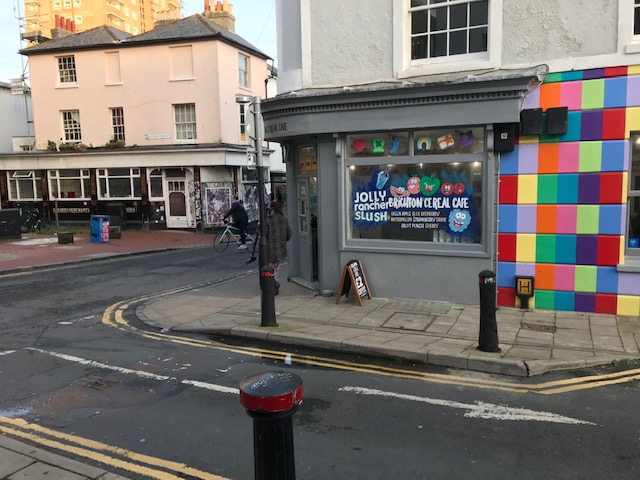
Politically, Brighton sits comfortably in a bubble of the Guardian and the Green Party. If the polling industry does come here, we’d be only representative of ourselves. We have a cafe that exclusively sells breakfast cereals, for Christ’s sake. You would expect a high Remain vote, and at 68.6%, the voting area of Brighton & Hove fits the bill. It was not high enough to rank in the top 10 highest Vote Remain areas, but that was still a pretty unequivocal rejection of leaving the EU.
At the time (October 2018), Brighton had the UK’s only Green MP in Caroline Lucas, and the representative for Hove was Labour’s Peter Kyle, who once co-sponsored a motion to bring a new referendum on membership of the EU. The then Brighton Kemptown MP, Lloyd Russell-Moyle, would later be thrown out of the House of Commons in December 2018 for grabbing the ceremonial mace – the five-foot golden rod that has for more than 500 years represented parliament’s authority by the crown – during a debate on Brexit. The sight of him scampering off with said mace like a smartly-dressed shoplifter says about as much about Brighton’s regard for tradition as you’d care to mention.
Exiting the station leads to the forecourt. It had recently been tarted up but quickly become a favoured haunt for drunks and drug addicts. Visitors, including already-sozzled stag and hen do’s, stumble out of the station and head straight down Queens Road. On sunnier days, it’s like a human river, as fun-seekers take a straight shot down to the seafront. Depending on the time of day, you’ll see every eye-opening depth of well-marinated merriment, like a sewer pipe of happy humanity disgorging effusive effluence straight into the sea.
I head down Queens Road. Albion Kebabs serves up grilled meat in honour of the local Premier League football team. The relatively new Ibis hotel, set up on the site of a former Casino that burned down, already looks worn in. Across the road is the Panda Chinese supermarket and restaurant, catering to the many visiting Chinese students that come to Brighton to study, either at the universities or on an English course. You’re never far from a decent interpretation of Sichuan cuisine. Or, perhaps a Chinese herbal remedy? In cards filling its window, the Chinese Medical Centre a few doors down promises to cure everything from insomnia to impotence, stiff neck to scrotum ache. It also apparently has a cure for something called ‘whoop’, which as I understand, can lead if not treated to a devastating infection of, ‘there it is’.
Looking down North Road, past the functionally ugly Tower Point office block where I used to work for a recruitment company, three giant cranes are working away on the major redevelopment of The Royal Sussex Hospital in far Kemptown. The Kemptown area is well worth a visit, particularly the always-bustling St James Street. Walk this street at any time of day and you’ll see all manner of wonderful oddities. During the Gay Pride celebrations in August the entire street is cordoned off and ticketed. It’s a riot. One year, I walked up there the day after the celebrations and the road was sticky like an old pub carpet. It’s best not to think too much about that…
When I broke up with my girlfriend in January 2019, my sister had relayed the news to one of her friends. The friend had looked back at her, puzzled, and replied, “I thought he was gay.” My sister returned her puzzled expression and asked, “Why would you think that?” To which she said, “Well, he moved to Brighton.”
Although it’s not actually the law to be gay to live here, Brighton is the unofficial gay capital of the United Kingdom. According to data from 2014 released by Brighton & Hove City Council, between 11% and 15% of the city’s population over the age of 16 were lesbian, gay or bisexual. In 2013, Brighton had the highest number of civil partnerships registered outside of London. And if Brighton is the gay capital, Kemptown is its downtown core. It is a vibrant and always bustling neighbourhood, in which party squat houses mix with multi-million pound mansions. Regency architecture peers down on scuzzy pubs. But it’s not where I am heading today.
I cut through Brighthelm Gardens, a nod to Brighton’s former name, Brighthelmstone, in the 1500s. In this decade, the nascent settlement survived being twice attacked by the French to grow into a budding town. Brighton has some semblance of a history of fishing, but that was fast overtaken by tourism. In 1750, a doctor named Richard Russell wrote a book claiming that bathing in seawater was good for the health and wellbeing. This was enough to persuade the rich and well-heeled to come to Brighton for a seaside-based pick-me-up.
Brighton became the place to be and be seen after the Prince of Wales visited in 1783. George IV would eventually build a seaside home here, the Taj Mahal-inspired Pavilion. The place was (and still is) lavish. Do take the tour, it’s worth it. The Music Room, in particular, is luxuriously decorated and intensely opulent, with blue silk curtains and gold leaf dragons embellishing the ceilings. Nine lotus-shaped chandeliers illuminate the space, and the walls are decorated with lustrous canvasses. It’s been twice restored, following an arson attack and damage during The Great Storm in 1987.
Mostly, though, the Prince Regent built himself a seaside folly to indulge his many jollies. The Pavilion was a place where the prince could meet, greet, eat and, predominantly, whore himself into obese oblivion. By his death in 1830, heavy drinking George was chronically obese, with a 50-inch waist. His own doctor, Sir David Willkie, described him, somewhat harshly, as ‘like a great sausage stuffed into the covering’. The King suffered from gout, was near blind and was taking enough laudanum to tranquilise an elephant. Nowadays, in the John Nash landscaped gardens around the Pavilion, you’re likely to find people drinking and smoking marijuana at most times of the day. The Prince would no doubt approve.
Brighthelm Gardens, just a 10 minute walk from the Pavilion, is a functional place. There’s a children’s play area and a vegetable patch. It’s also a regular area for homeless people to congregate. Occasional charities will lay out sandwiches for people to eat, like a vital feast fly tipped for the needy. According to Government data released in January 2018, Brighton and Hove had 178 rough sleepers at a count in November 2017, up 24% on the previous year’s count. The city had the second largest population of rough sleepers, just behind Westminster, but ahead of Camden and the entire city of Manchester.
Exiting Brighthelm Gardens, I re-join Queen’s Road. On the corner a couple stand looking Gallic and cool – she wears a beret, he has a scarf foppishly tossed around his neck. They aren’t actually French. The Brighton Clock Tower lies ahead, built in 1888 to commemorate the Golden Jubilee of Queen Victoria. The noise of a megaphone rings around the surrounding buildings. At the base of the tower flutter Palestinian flags. A banner states, ‘End Israeli Occupation Apartheid’.
Such demonstrations are a regular occurrence in Brighton. A bottle refill business on nearby Western Road, the main strip connecting Brighton and Hove, was boycotted almost every weekend for a period of months due to alleged connections to Soda Stream, a company then owned by a business in Israel. It subsequently changed to a cheap coffee shop, and then a posh refill shop trying to cut down on use of packaging in supermarkets. At the demonstration a buff white man wearing glasses and with a black and white check keffiyeh wrapped around his neck, hands me a leaflet. It says, ‘Apartheid: Wrong in South Africa, Wrong in Palestine’. I take the leaflet and move on.
Head left and you’ll find the Lanes, an often befuddling and usually busy rabble of tight, narrow passages featuring some of Brighton’s oldest shops. There are jewellers – some good, some downright sharks – and historic pubs, such as The Bath Arms or the Cricketers, situated on a site where there has been a pub since 1547. The Greene Room in the Cricketers is named after author Graham Greene, who often drank here and featured it in his novel, Travels with my Aunt. His letters to a former landlord are framed and hung on the walls.
Past the Clock Tower is West Street, known locally as ‘fight street’ for the regular pitched battles between revellers on weekends (or, indeed, any night of the week). There are numerous places to get fuelled up for a scuffle here – Molly Malones, Yates, Bar Revolution. The Bright Helm is a Weatherspoons, the cheap and cheerful pub chain whose chief executive publicly backed Brexit. Inside, a stag party, all dressed in brightly coloured Hawaiian shirts, are fully focused on getting as drunk as possible, as quickly as possible. Outside, an ambulance is parked up ready to go.
Over the road once was Sherry’s. Opened here in the early 1900s, Sherry’s really became a premier Brighton night spot during the Second World War. Allied servicemen and Brighton girls would come together to escape the toils of war for an evening. Sherry’s was hugely popular with Brighton locals and the city’s criminal community, too. It was featured in Graham Greene’s classic novel, Brighton Rock.
As musical tastes began to change, fewer people were interested in the big band and swing music played at Sherrys. It, alongside another venue, the Regent (now a branch of Boots up the road), would later close. Sherry’s was converted back into a roller skating rink in 1949 and then became the Ritz amusement arcade in the 1960s. It later returned as a nightclub in various guises through the ensuing decades, including incarnations as the Pink Coconut, Creation, the Paradox, Tru and most recently, Hed Kandi. Nowadays, the venue at 78 West Street sits rather sad and unloved. Someone had written ‘Join the Party’ in huge graffiti letters on the frontage.
The same curse of dilapidation has afflicted the Hippodrome around the corner. The venue opened in December of 1902 and played host to some major entertainment names over the years, including Sammy Davis Jr, Harry Houdini and Laurel and Hardy. It started off hosting theatre and variety acts, and gave a platform for Brighton resident and comedian, Max Miller, also referred to as ‘the Cheeky Chappie’. In the 1930s, the Hippodrome expanded from the original theatre into the neighbouring buildings, but by then Music Hall was on the way out.
The Hippodrome kept going as a music venue until the 1960s, when it was the venue for concerts by the Beatles and The Rolling Stones, but it closed in 1966. After that, the only thing rolling were bingo balls until 2006, when the building closed for good. Various attempts to resurrect the Grade II* listed building have gone ahead, but to date the venue has remained boarded up, derelict and open only to the pigeons.
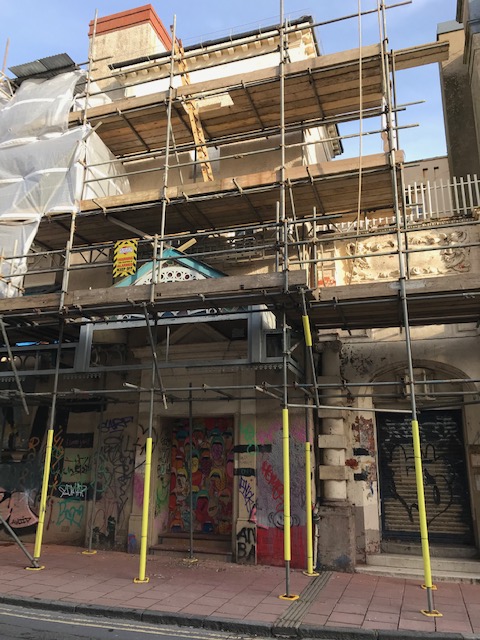
Back on West Street, I pause outside the hulking and ugly entertainment complex housing Prizm nightclub and the Odeon cinema. A wall advertises various Freshers 2018 events catering to Brighton’s large student population, including Dappy, Fatman Scoop and Josh, who has the ignominy of having ‘(from Love Island)’ after his name. I can smell the sea. And so can the investors.
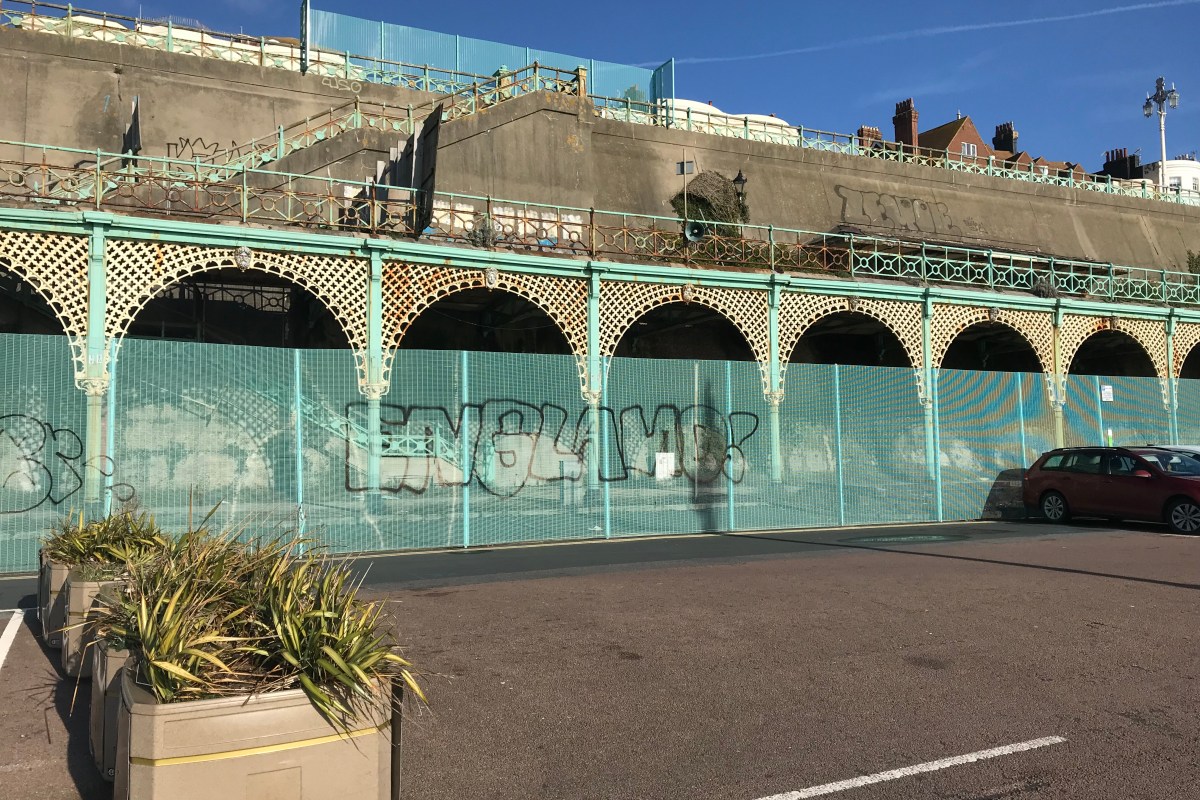
The historic Brighton seafront is in the midst of a major renovation. A total of £46 million was spent on creating the somewhat divisive British Airways i360 attraction, a 170-metre giant stripper pole ejecting out of the beach, up which a circular viewing platform periodically ascends and descends, like it’s a phallus being masturbated by a giant ring doughnut (if you can think of it, someone somewhere has tried it). An additional £1.5m was spent landscaping the area around the i360 to make it more attractive (well, something’s got to keep that thing erect). A further £5m was spent on demolishing and rebuilding the King’s Road Arches under the A259 road and upper promenade. It hosts attractive shops ranging from The Hat Hut to Banana Louis Hair Studio.
Shelter Hall was built in the late 1880s as a retail space on Kings Road Arches. Despite being partially listed, it had fallen derelict and the gym below was closed over fears of structural weakness. Alongside completely shoring up the structure, the entire building will eventually be fully restored with a new rotunda on the prom housing a café and restaurant. Below there will be a 1500-square metre commercial space (yes, I read the marketing material). Rebuilding of Shelter Hall had been paid for by a £9m grant from the Department of Transport’s Challenge Fund, along with £1.7m from Brighton and Hove Council.
Further up, the Sea Lanes outdoor swimming complex had been granted £4.5m to create a 50m, eight-lane open water swimming complex complete with supporting leisure complex with shops, offices and studios. The historic Volks railway received £1.85m in lottery funding to develop a purpose-built station and heritage visitor centre to bring the attraction back to former glories. A £1.7m, 300m long zipwire attraction had already opened past the Palace Pier in a spot formerly occupied by Brighton’s observation wheel.
Other projects planned included more than £250m to develop 11 new buildings at Brighton Marina, just past Kemptown, housing 853 new flats, along with retail and commercial facilities. Some £540m was potentially to be invested in the regeneration of the Brighton Centre, Churchill Square and Black Rock areas. Architects had been selected to regenerate the site around the King Alfred Leisure Centre. in Hove Alongside improving the sports centre this would in theory create a new 560 flat complex. The cost had not yet been announced, but considering the scale of the plans, you can safely assume it would be in the hundreds of millions.
A further redevelopment was being considered for the Marina arches around the Concorde2 venue, including a proposal from Boxpark, which makes retail spaces out of old shipping containers. Not all of this would come off, of course, and some would potentially fail or prove to be a complete eyesore like so many ill-advised regeneration schemes. But this potentially represented close to £1 billion of investment in Brighton & Hove seafront.
This contrasts starkly with the experience of other coastal locations in Britain. In data reported by the ONS in 2015, Skegness was in the top 20% most deprived areas in the UK (read more about my journey to Skegness here). Blackpool, an almost direct competitor to Brighton in the English seaside resort stakes, had eight of the 10 most deprived areas in England in 2019. Proximity to London could be argued as Brighton’s strength, yet Jaywick, a seaside village close to Clacton-on-Sea in Essex, had been named the most deprived area in the UK three times in a row since 2010, according to government data. It takes virtually the same time to travel to Clacton and Jaywick from London as it does to get from the capital to Brighton.
Magnet for makers
Brighton has always had something about it; something that elevates it above being a relatively mundane Sussex seaside city. In part, that has been because it always acted as a beacon, a siren song for those looking to be different; for those wanting to check in, and check out. Those seeking to shake shit up, for whatever reason, or just no reason at all.
The mods and rockers battled here in the 1960s, throwing deckchairs and terrifying the establishment with their youthful rebellions. More than 250,000 people descended on Brighton beach in 2002 for Big Beach Boutique II, set up by Brighton native Norman Cook, AKA Fat Boy Slim. Only around a fifth of that crowd had been expected, yet it was like Norman had posted a party invite on Facebook while his mum and dad were away. Local amenities and authorities soon tumbled into chaos, and the train station was a borderline riot. Nothing gets between Brighton and a party.
The story of the Mods and Rockers has since transcended into folklore (and a film in Quadrophenia), while Cook remains a popular local Brighton celebrity and returned with various follow up live events. Such cultural reverence, however, probably isn’t going to be applied to the regular visits to Brighton seafront of the English Defence League. For a number of years, the EDL staged a march here, dubbed locally as ‘racists’ big day out’. Bald heads, tracksuits, tattoos and St. Georges flags were usually just about visible behind a sea of bright yellow police jackets as the march made a slow shuffle down the front.
‘What are they bothered about now?’ I overheard someone ask as they stopped to watch the march in the summer of 2017.
‘Some bollocks about immigrants,’ another voice answered.
The march tends to rile up the local anti-fascists, often skinny and wiry young white men in black hooded tops and sporting wispy beards. They shout abuse, but always at a safe distance. Each year, the merry band of the EDL rolls on. Their broiled anger ejects in floods of spittle, but they are never remotely close enough for it to count as spitting distance. It’s almost tragic, in a way. There is a certain comic nature to the EDL. The group’s march in Liverpool one year ended with them being driven out of the city to the sound of the Benny Hill theme tune. What they represent, however, is no laughing matter.
The group, popularised by Far Right poster boy Tommy Robinson, has stirred the dark heart of racism and Islamophobia in England. The EDL motto, ‘In hoc signo vinces’, rough translates as, ‘In this sign thou shalt conquer’, and has nasty references back to the Crusades. Groups such as the EDL once gnashed teeth at the fringes of popular discourse, but now they move increasingly into the spotlight. Their messages of nationalism and ethno-nationalism are more effectively landing home beyond the fringes, and now reaching ordinary people frustrated with the country in which they live.
On the route of their Brighton march, the EDL have to pass the ‘kiss wall’, a seafront sculpture by Brighton artist, Bruce Williams. It depicts six photographs of people, all ages, genders and sexual orientations, kissing. The faces are recreated using punched holes in aluminium, so the light behind reveals the picture. If the EDL hopes to recruit new members when marching in Brighton, you’d hope they’ve brought some strong shoes.
I head over to Brighton Pier, also known as the Palace Pier. It was actually the third pier to be built in Brighton when it opened in 1899, after the Royal Suspension Chain Pier and West Pier. It’s the only one still going. Heading onto the wooden boarded platform there’s an abundance of fish and chip restaurants and kiosks, a veritable bounty of sugary snacks and treats, and a smattering of dreadful-looking seaside jewellery and nick-knack stalls. People move from stall to stall, as a Hitchcock-esque hovering crowd of hungry seagulls circles ominously above.
As it’s a warm October day, the pier is packed. People take group selfies, eat chips from polystyrene trays on benches and frantically herd rabbles of children from one attraction to the next. Inside a converted Gypsy caravan is Ivor the Tarot Consultant. He has a large hoarding trumpeting his corporate credentials, including endorsements from Ericsson, Guinness and Tate & Lyle (another high profile Brexit backer). He has apparently featured on BBC One and ITV 2. A basic reading is £15 – I resist the urge to ask for odds on a no-deal Brexit.
Music blares out from all sides. Horatios Karaoke bar looks like an industrial bunker. The Horror Hotel seems to be better than some hotels I have actually stayed in. The Turbo rollercoaster zips around to the expected screams of delight. I stop to watch a hen party batter each other senseless on the dodgems. A young boy has a meltdown as his mother tries to placate him with doughnuts. It’s time to leave.
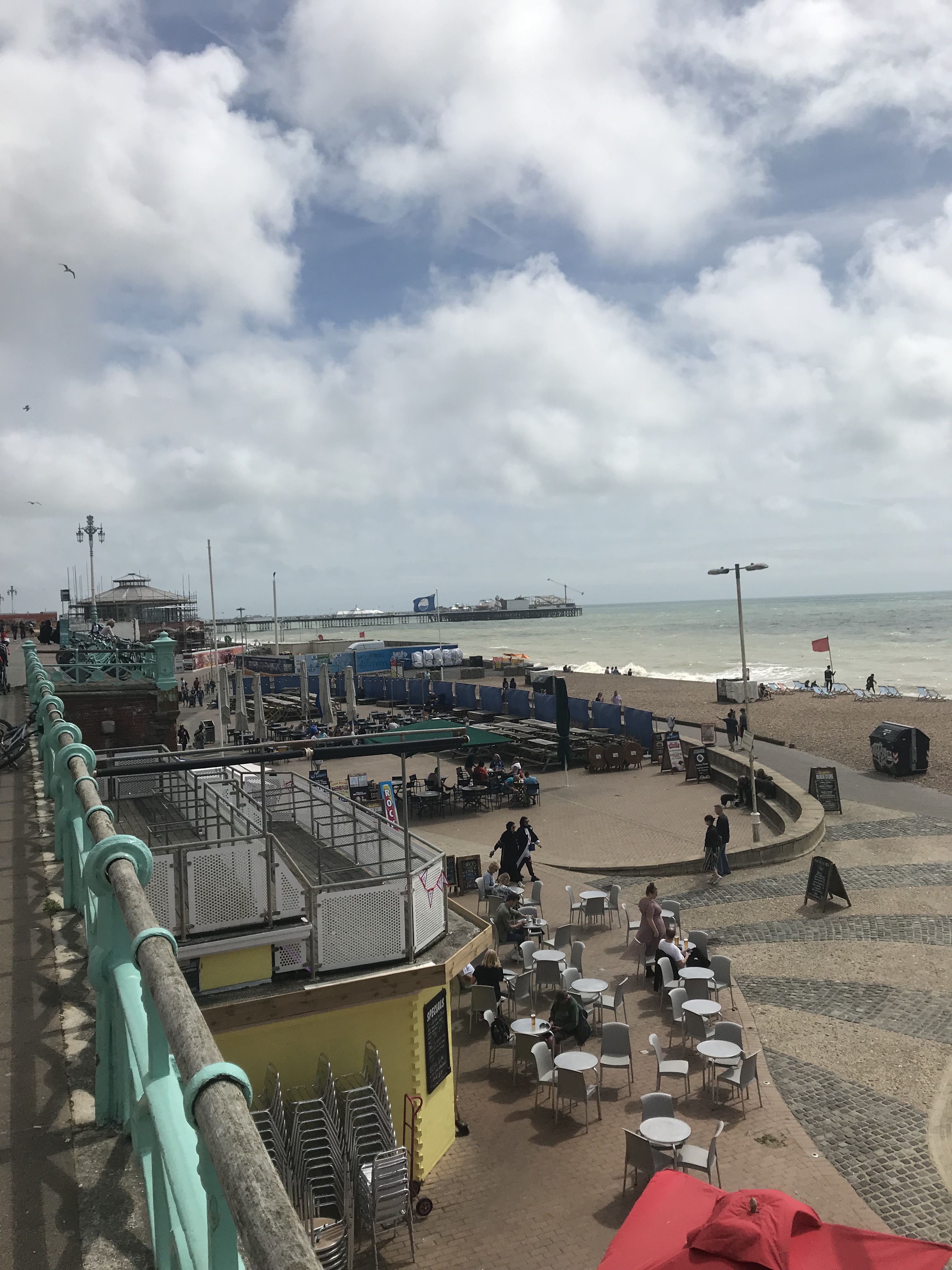
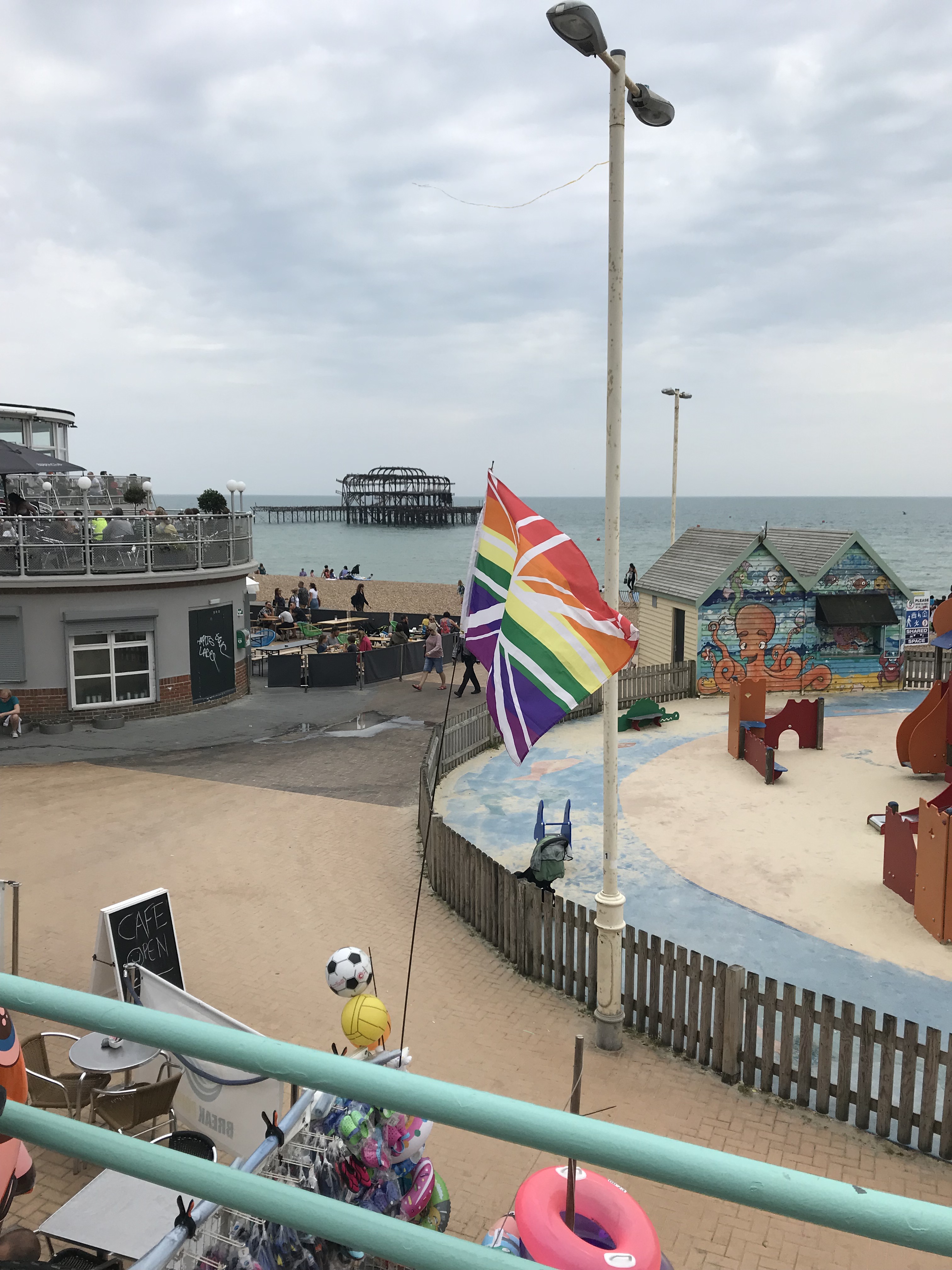
Brighton’s other pier (the Chain Pier was destroyed by a storm in 1896) is the West Pier. The Eugenius Birch-designed attraction’s heyday was immediately after World War 1, when thousands flocked to walk the boards. Despite being Grade 1 listed, the pier closed in 1975 and never reopened. Devastating fires in March and May of 2013 finished off any slight hopes of restoring the pier to its former glory and it has now been declared as unsalvageable by English Heritage. The West Pier Trust, which owns the relic, plans to restore the original octagonal entry kiosk, opened in 1866, to its former glory but that’s about all that can be saved. The West Pier now sits as just a metal skeletal of what it once was, a sculptural edifice always threatening to be consumed forever by the sea. There’s a metaphor in there somewhere – answers on a postcard…
I look up at The Grand, a handsome vintage hotel that saw its facia completely devastated in 1984, when the Provisional IRA detonated a bomb. It was intended to assassinate the then Prime Minister Margaret Thatcher and her cabinet attending the party conference. It failed, but five people were killed in the blast. Across the road is on the recently-renovated i360 forecourt, where I peruse an exhibition for the Brighton Photo Fringe. One set of images is affecting, showing how homeless people live, eat, love and stay clean. Another is more abstract. One picture depicts a woman cuddling up to a beef roasting joint. It is entitled ‘Dear Meat’. I am not sure I get it, but with other people close by, I give a knowing, nodding expression that I do. The noise of another megaphone rings out.
On Regency Square, a GMB union rally was being staged to protect the NHS from privatisation. A giant rainbow flag with Green Party written on it is held aloft by two people. A stand sells books on Marxism. A woman carries a placard saying, ‘stop profiting from healthcare’. A banner says, ‘It’s a matter of life and death’. The man with a megaphone is being drowned out by a woman with a pushchair nearby berating her child for not having a wee when he had the chance.
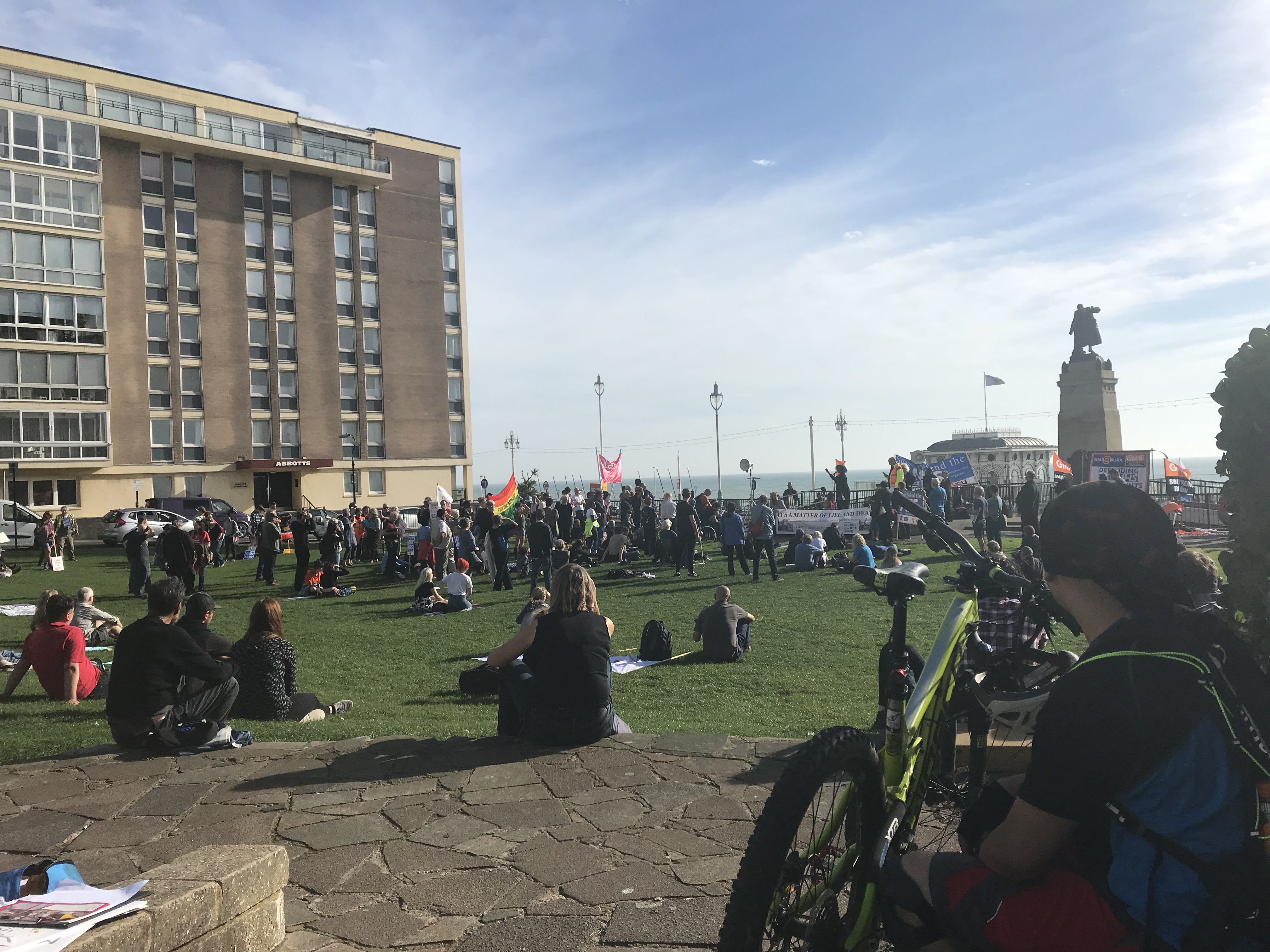
‘Socialist worker?’ a man asks me as I head through the crowd. Bit presumptive, I think, but buy a copy of the newspaper anyway. It is £1, but I only have a £2 coin. I tell him to keep the change. Was that a bourgeois act? He seemed happy enough. I sit down as a new speaker starts to address the crowd, and open the paper. There’s surprisingly little on Brexit, instead most ire is aimed at Conservative austerity policies and the ongoing government cuts. On page 4 the lead article is titled, ‘Mass march shows the mood for an independent Scotland’. It sits next to a rather grim piece titled, ‘Stockpiles of body parts are just the latest failure of privatisation’.
I close my £2 paper and head off to get some fish and chips in the nearby Regency Restaurant. Most tables are occupied by Chinese students. The woman with the pushchair can still be heard telling off her child for his toilet-based decision making. Across the road, a Ford Excursion stretch limo pulls up and a hen party tumbles out, carrying suitcases and half-finished bottles of various alcohols.
After a serviceable plate of fish and chips in the Regency (do stop to check out the ‘wall of fame’, featuring pictures of celebrities who have eaten there), I head on towards Hove’s part of the front. A year earlier, in September 2017, a #stopbrexit rally made a similar journey on its way from the Labour Party conference in the Brighton Centre down Brighton & Hove seafront. Led by a Boris Johnson impersonator, the march culminated with a rally on the lush Hove Lawns. EU flags were flown alongside a scattering of Union Jacks as speakers, including Brighton Green Party MP Caroline Lucas and former Labour spin doctor Alistair Campbell, addressed the hundreds of people in attendance.

In October 2018, all that was being protested on the lawns was a drunk man arguing with himself. I leave him to it, and walk on to deepest, darkest Hove. The tall Regency buildings look impressive as they stoutly stare out to sea. Closer inspection, though, reveals peeling paint, rusted metal and lashings of faded glamour. They’re like a grand dame of the theatre, staring out to sea through badly applied make up, dreaming of more illustrious days long gone. Just like the actress, these buildings have clearly seen plenty in their long and occasionally glamorous lives.
The further you go away from central Brighton, the more visibly you come to the edges of gentrification, like the outermost ripple on the prosperity pond. Further away from the sea, walk down Portland Road in West Hove and you’ll see this phenomenon most sharply. Some pubs have transitioned from decrepit boozers to artisan alehouses. The Aldrington pub had gone from stomach-churning cheap lager and an abundance of pool tables to dove grey paint, reclaimed furniture and a wide range of craft beers. It’s now called the Westbourne.
The once vibrantly edgy Portland pub is now the Stoneham. The drug dealers and craggy drinkers had been replaced by more children than your average crèche. The 2005 smoking ban forced a lot of these old drinking houses to change, but shifting tastes and attitudes towards what a pub should be did the rest. Now, most are borderline restaurants.
As you go further and further down Portland Road, the swell of gentrification starts to lose steam. The cafes become old fashioned but without the irony. The Three Graces has remained steadfast as a pub’s pub, for now at least. A tattered and tangled St Georges flag hangs outside a glass fitting shop. A large sticker proudly states ‘Made in Britain’ on the window. An old man dressed in a musty suit and anorak walks down the street drinking a super strength can of lager. A homeless woman stops begging outside Sainsburys to stride in a wonky but purposeful march towards somewhere.
Further down Portland Road you get to suburban sprawl. The houses are mostly 1930s semis alongside a scattering of ugly flat blocks and new builds. Vans nip in and out of the industrial park, home to giant branches of Toolstation, Screwfix and Yes Electrical. The office of French energy-company EDF looks like it was designed in Soviet Russia and the architect was mercifully shot immediately after completion. Some fancy flats have been built next door with a lovely view of Le Sandwich café over the road.
Eventually, you hit Portslade station and turn down Boundary Road back towards the sea. Fast food takeaways sit cheek by jowl with betting shops, tanning salons and pawnbrokers. The £1 Zone promises bargains. The United Reformed Church promises salvation. A man sits sunning himself on a chair outside Polish grocery shop, Vitaminka. Henry’s Meat Market is presumably not a euphemism.
Portslade’s high street was named as the 20th worst out of 1,000 retail locations as ranked by property consultancy Harper Dennis Hobbs in March 2019. As with many down-at-heel high streets, there’s an abundance of predatory services; gambling, smoking, vaping, calorific carb loading, and various businesses covertly urging poor financial decision making. A minefield is laid out in such a place, teasing and taunting people to bleed from their hard earned pay packets.
While in many places the poverty trap is permanently snared, Brighton & Hove is always lifted by the wealth pouring in. According to the latest available Office of National Statistics data as of October 2018, the average property in the area sold for £360,166, compared to the national average of £226,906. The gentrification clock was most definitely ticking for West Hove and Portslade. The ripple would reach here eventually. It was just a matter of time.
*
Six months later in Spring 2019, Brighton had been braced for Brexit Day on 29 March. Britain was supposed to leave the European Union on this day, but that was before MP’s voted against then prime minister Theresa May’s Brexit deal by 344 to 286. Brexit was officially delayed, much to the contentment of most of Brighton. I walk along Marine Parade. Bikers clad in leathers noisily rode hog bikes past me, farting along the road like they’d just eaten a big meal at a Toby Carvery. I watch the Volks railway trundle along the seafront, and look in puzzlement as a man in the back carriage oddly manhandled his wife’s face (well, I presume that was his wife…). Bright sunshine beams down onto my face through blue skies.
A day earlier, I was walking to my home in central Brighton. As I passed the generic Churchill Square shopping centre a group of protestors strode past. They held a banner reading that they were with the Extinction Rebellion group that had recently brought some parts of London to a standstill. The group had been set up to do direct action protests against climate change apathy. They chanted slogans and waved placards as they passed the line of shops on Churchill Square and onto Western Road. It was time for us to wake up and smell the CO2, they declared.
Inspired by the actions of Swedish teenager Greta Thurnberg, a new generation of young people were standing up to call for action on climate change. They were understandably fed up with the dismissive attitude of older generations, who will most likely only see the slight tremors of global warming. By contrast, these young people knew it would be them hit with the full force of the coming quake. So, they had decided to demand more of their politicians, businesses, elders, and to be fair, of themselves, too.
Climate change has gone from science claimed by some as fiction, to science universally viewed as fact, even among the most regressive in society. Whether that transfers into action of any meaningful nature was what many worried about. Shoppers stopped and stared as the march went past. Some cars honked their horns in support. People came out of cafes to look at the colourful ensemble, blaring music from loud speakers and chanting, ‘Extinction. Rebellion’ as they went. As the tail end of the group passed me, a young man with pink hair and halfway through eating a Zinger towner burger, shouted after them, “No one gives a fuck.”
 On the Road to Revolution