The End of the Line: Gibraltar

The End of the Line is a 10-part travelogue journey to some of the highest Remain and Leave areas in the United Kingdom’s 2016 Referendum on EU membership. It was written over two years from 2018 to 2020, before Coronavirus made Brexit seem like a spot of man flu.

Gibraltar voted 95.9% Remain in the EU Referendum

Originally written in October 2019

There’s a place in the UK: it voted to remain in the European Union, it has a historically problematic land border with a European country and strong views on abortion. It’s not Northern Ireland, however. It is, in fact, 1,815 miles away from Britain in the Mediterranean Sea. It is Gibraltar. On 21 October, 2019 – Brexit Day (at least, at that time) minus 10 days – I made my way to the Rock.

At Gatwick airport I trudge through mile after mile of Duty Free shopping aisles, bombarded by perfume smells and assaulted with shiny images of carefree models and celebrities. Eventually I emerge, bewildered, and head to get coffee and charge my phone. I watch as a seated mother heroically ignores her child as he repeatedly tries to balance a paper cup on her head. A man, also charging his phone near me, extravagantly bops away to Sisqo’s Thong Song bellowing out of his leaky headphones. He seems way too young to even be aware of the 1999-released hit song.

At gate 35 for my British Airways flight to Gibraltar, an American couple remark how a six minute walk was ‘long’ from the main terminal. On the plane the inevitable round of luggage Tetris ensues, with various horse-trading agreements forged and foiled over space and positioning. I read the paper. New Conservative leader Boris Johnson, freshly minted after defeating Jeremy Hunt (a middle manager, at best) is in the headlines again. The Financial Times’ front page lead states ‘Johnson Sticks to Brexit deal as faith rises in Westminster victory’. By contrast, a comment piece trailed on the paper’s masthead states, ‘Little England: Johnson’s Brexit deal could break the union.’

I flip to p23 and read the piece from Johnathan Powell, Tony Blair’s chief of staff from 1995 to 2007. He heralds a nightmarish future in which Brexit leads to turbulence in Northern Ireland and Scotland, raising the prospect of a ‘Little England government’ being left with just a ‘little England’ to govern. As the call goes out that boarding of the packed flight is complete, I realise with sheer delight that the seat next to me is free and immediately spread out. It feels like the greatest of joys.

The plane takes off on the two and a half hour journey to Gibraltar. We climb and climb over the Sussex countryside until all around us is just a hazy white, tinged with sky blue. The man in front of me shifts in his seat like a bear scratching on a tree. A member of the cabin crew staff, who appears as though she has got dressed for Instagram, leans over and patiently attends to someone complaining irritably about the lack of leg room. I relish, unashmedly, my two seat luxury.

The world comes back into view when we reach Spain, passing over Madrid and then taking a vertical path down towards Granada, with the peaks of the Sierra Nevada National Park in the far distance. The plane begins to descend slowly and I can make out the coast of southern Spain. Holiday hotspots of Malaga, Estepona and Marbella line the coast. The view from the plane window is then filled with blue. The vast azure of the Mediterranean merges with the powdery sky at the horizon. Giant ships and tankers appear as though they are floating on thin air, leaving rippled tracks in the sky like the hazy air ejected by jet engines.

The plane banks and then rights itself ready for the descent. I’m sat at the back of the craft and the movement feels brutal. A pensioner sitting behind me returns to her seat from a visit to the toilet and remarks to the nervous flyer next to her, “As long as we don’t crash backwards, we should be alright.” Outside, the ailerons wobble precariously in the turbulent air stream. The sun is setting slowly over distant islands dotted about in the sea like tossed rocks. It illuminates the clouds above in a nicotine glow. Then, the Rock emerges into view.
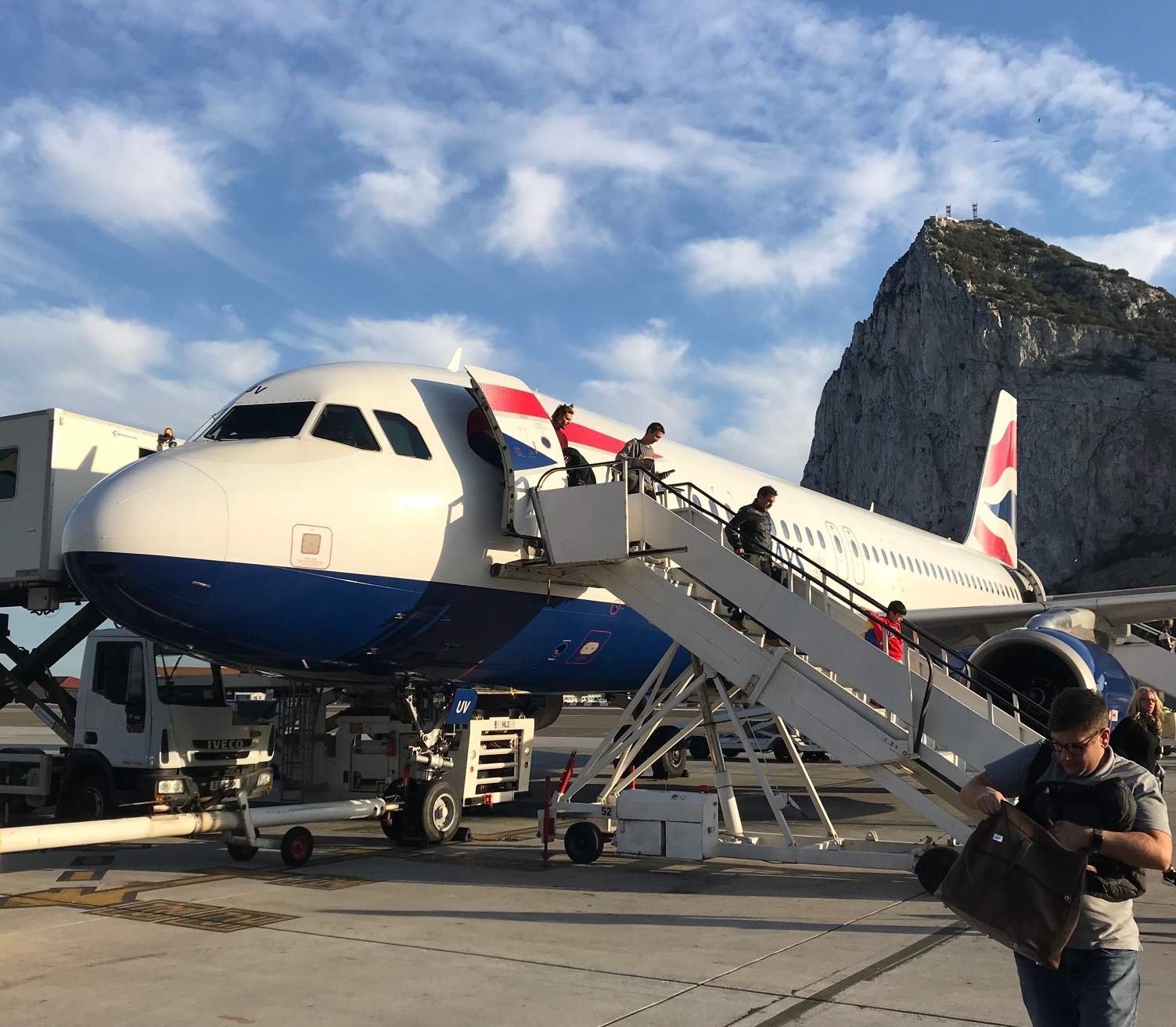
The plane starts to judder in the changing air. Buildings and apartment blocks shuffle into view. I can feel the nervous flyer behind me getting tenser as the plane shakes up and down like a car driving on an old dirt road. Down and down and down, it descends, and then it connects with the runway like a not particularly proficient BMX rider landing a jump. The brakes are sharply slammed on and the craft pitches and shifts as it rapidly sheds its momentum until reaching a crunching stop.
“Has he been here before?” the pensioner remarks to the cabin crew as they admit that this probably won’t go on the pilot’s ‘best landings’ show-reel. An explanation comes – something about cross-winds. The man behind has gone very quiet. He probably won’t be flying to Gibraltar again any time soon.

It is 7pm local time when I exit the airport and walk the short distance to get the number 10 bus to my hotel. The number 5 is sat waiting, but Google has told me to get the number 10 and I wouldn’t want to be subordinate to the digital overlords. The bus driver is smoking while he waits to go and so I ask him how much is a single to town. He tells me, just as I realise he is standing next a big sign saying the price. I make a joke of it. He smiles but clearly thinks I am an idiot.

Eventually, the number 10 heads off down Sir Winston Churchill Avenue, cutting across the runway, and towards town. Gibraltar – also known as The Rock, but referred more commonly to those familiar with the island by the shortened name, Gib – is a peninsula that jabs out like an infected thumb from the bottom of Spain. It is like an appendage that has been apprehended from the body, and as we will explore ahead, the itchy infection remains to this day.

On the bus we pass the Rock of Gibraltar on the left and the Victoria football ground to the right. The sun still shines down and it’s warm. Old school British red phone boxes sit on the pavement. The road signs are the British type. The traffic lights, too. It’s an odd, rather jarring mix. We pass a petrol station selling the rather unfortunately named, Gib Oil. Then Notre Dame School, which has long since disgorged its children for the day. Commuters whizz around on micro scooters on their way home from work.

The first of many thick stone walls of the old defensive reinforcements comes into view, leading here to the Waterport Casements area lightly filled with early evening drinkers. Onwards we go, past the quiet Khan’s Indian restaurant. Further up a group of Jehova’s Witnesses are packing up for the day. They appear jovial after a good shift’s soul saving, although there appear a lot of untaken copies of Watchtower still left on the stand.

Gleaming blocks of flats and offices line the route, eventually giving way to tight streets with houses and the odd restaurant. I am booked in at The Rock Hotel, a rather grand old hostelry perched on the hill so that most rooms are guaranteed a view out to sea. It has welcomed the great and the good over the years. Winston Churchill stayed here, as did Errol Flynn. Dwight Eisenhower was resident here while planning the invasion of North Africa in World War II. Sean Connery was a guest in 1962 after getting married to Diane Cilento in Gibraltar. And, from the celebrity photo gallery near the lifts, other ‘famous’ former customers include Chris Tarrant and someone who I think is a singer and maybe won The X Factor, or something?
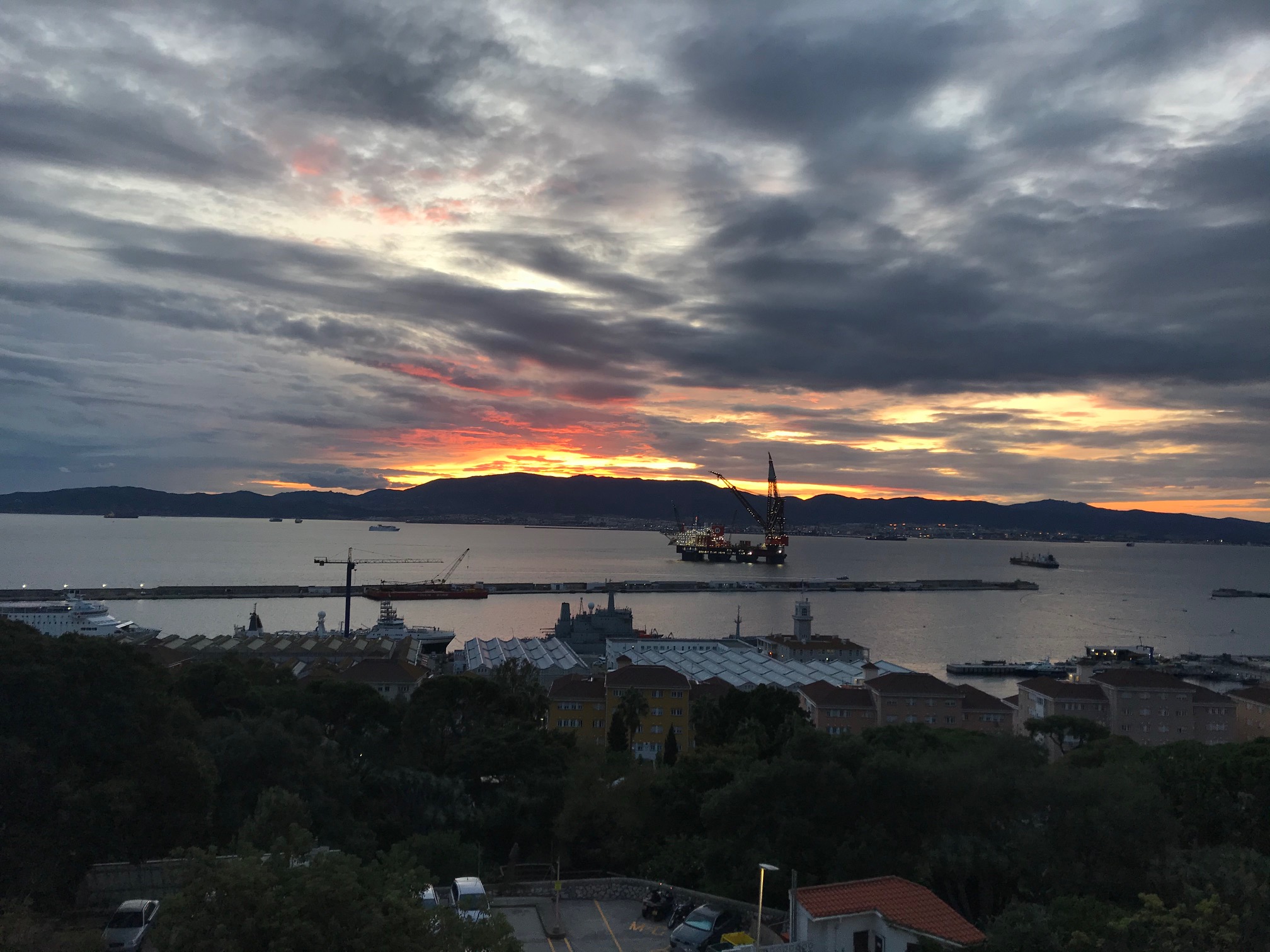
The man on reception judges me instantly as obvious riff raff and gives a polite but brusque welcome as I check in. The room is nice enough, but it’s really all about the view. A balcony with chairs gives way to a sweeping panorama from the cliff side to the left, round via the port and over to the main town to the right. The sun is now setting and across the Bay of Gibraltar you can see Algeciras in Spain. Small boats zip in and out of the harbour. A giant superyacht is moored further down, shaped like a missile made of money. It’s all pretty idyllic, like a scene in a movie.

I sit on the balcony and watch as the evening turns to night. Lights start flicking on in the buildings and streets. The Heerema ‘Sleipnir’ semi-submersible crane vessel fixed in the bay suddenly switches on tens of lights dotted down its frame and crane, making it look like an industrial Christmas tree. The atmosphere is quiet and peaceful, with only the occasional noise of a car rumbling down Europa Road. My stomach gurgles. Like a prehistoric man with access to Google Maps, it is time to hunt down some dinner.

The pretty west side of Gibraltar is where the majority of its 32,194 population live. Little winding streets host boutique style shops. A few people are out and about. It feels safe and welcoming. Old boys in suits shuffle into wine bars. A group of tourists explore a souvenir shop selling British themed tatt. Two young Jewish boys walk ahead of me. One of them sings ‘God Save the Queen’ to the other. Familiar brands such as Debenhams, Holland & Barratt and Marks & Spencer line the street. A group of Spanish workers try to get a seriously long lorry around a corner despite it seemingly being impossible. Their motorbike police escort has dismounted and is looking on equally puzzled at the conundrum. I don’t wait to see how they manage it, but they pass me further down the way.

I eventually plump for Jury’s bar, a hybrid of pub and wine bar that has nice tables spilling into the street. They are all full, so instead I sit inside by the window. Jazz plays on the stereo. As soon as I sit down, a man called John strikes up a conversation with me. He’s friendly and animated, with his wispy hair vibrating with excitement as he talks. I barely have time to open the menu before I am locked into a conversation.

John was born in Gibraltar and has lived here his whole life, barring a short stint in England in the 1950s. He returned to Gibraltar just after the border between Gibraltar and La Linea in Spain was closed in 1969 by Francisco Franco, the Spanish dictator. That ushered in 13 years of isolation for The Rock that split families apart across the border, impoverished the area and even led to vital medicines becoming scarce at the hospital.
“I hated that as I wanted to come and go to Spain whenever I wanted. I liked the freedom,” John says, as I order the fish and chips and a glass of wine from the waitress.

As his wife comes to the table after ordering drinks, John tells a story from when he was studying art in Kingston Upon Thames. He explains that he did an Ouji board with an ‘African girl’ and was possessed by a demon from the experience. His wife is now holding her hand over his eyes at a migraine, real or imaginary.
“You got any kids?” I ask, hastily changing the subject. Mercifully, he does. Their ages range from 28 to 42. The oldest is a journalist, who writes for a local paper, The Olive Press. I remark that I am a journalist, too. He asks what I write about and I reply technology, doing a mental countdown in my head until he asks me how to fix his printer.
“So the problem, John, is that your printer’s using too much ink cleaning its heads. Most likely the absorber is full and that’s why it’s going through ink in no time,” I say. He appears captivated. I resist the urge to hold my hand over my eyes.

My food arrives and John takes that as his cue to end our conversation. He wishes me bon appetite. He seems a nice guy and I am relieved to hear that his demon was exorcised by someone in a market some years ago. He fetches me a copy of The Olive Press and points to a piece on page four written by his son. I read it as I eat. Headlined ‘Electoral Breakdown’ and published before the election on 17 October, it details the three main parties that contested it: Fabian Picardo’s incumbent Gibraltar Socialist Labour Party (GLSP), the Gibraltar Social Democrats (GSD) and newcomers, Together Gibraltar. Among its policy agenda, Together Gibraltar has pledged to legalise abortion – a concept that is as controversial in Gibraltar as it is Northern Ireland.

While from midnight on 22 October 2019, Northern Ireland would make abortion legal and start preparations for providing services in the principality, it’s a different story in Gibraltar. Under section 162 of the 2011 Crimes Act, having an abortion at the time of my visit was punishable by life imprisonment. Many women instead cross the border into Spain to have the procedure. Together Gibraltar, which also campaigned to legalise cannabis and give young people more of a say in public life and had a slogan of ‘vote with hope, not with fear’, managed to secure just one of 17 seats available, compared to 10 for the GLSP-Liberal alliance. Although, as The Olive Press reports, that may have been down to them alienating the unions with a supposed pro-business stance on various issues. The Gibraltar Social Democrats, who actively campaigned to keep life prison terms for abortion, secured six seats in the election.

Brexit was also a major issue in the election. Despite Picardo previously supporting Theresa May’s Brexit deal, some had accused him of trying to “halt the Brexit process”. Over the coming four year term, he pledged to lead Gibraltar through whatever comes next. In a speech to mark the victory, he said: “Our main role in these coming four years will be to sail this nation of ours safely through the uncharted waters of our departure from the European Union. We will sail our people securely through every potential variation of that process even its potential cancellation.”
I take a sip of my wine and think about John’s demon.
Be gone thy imperial shackles

“It’s another big day in Brexit,” the BBC news presenter says with a mix of excitement, tiredness and weary acceptance that this would most likely not be the only time that they would say that even this week. It’s 22 October 2019, and later today the government planned to stage a vote on its European Union (Withdrawal Agreement) Bill – referred to by some as the ‘WAB’. Vote for the deal and then the deadbeat Dad that is the UK could then try to wangle a half decent divorce agreement with its ex, MPs were being told (well, sort of).

As I wait for the cheap hotel kettle to boil so I could make a cup of instant coffee, the BBC reporter states that Johnson might have enough votes to get it through. However, it is expected to be much tighter when MP’s vote on the ‘programme motion’, a parliamentary term that essentially in this case means the right to ram the legislation through the Commons in just a matter of days.

Robert Jenrick, the Secretary of State for Housing, Communities and Local Government, was the sacrificial lamb who’d been sent on the BBC to sell the 110-page act and its passage through Parliament. As a fair amount of the deal was reheated leftovers of Theresa May’s deal (with nothing new for Gibraltar) he says that MPs’ have had enough time to consider it. They’ve moved quickly before with legislation, he argues. With barely a week to go to ‘B-Day’ on Halloween, however, it’s already proving a hard sell.

As a way of contrast, MPs had around a month to evaluate the Wild Animals in Circuses Act 2019 earlier in the year before it even went to the House of Lords. It’s easy to see why Parliamentarians were rather sceptical when they were afforded more time to debate whether Dumbo should be allowed in the circus than consider what is essentially legislation to shape the UK’s near, medium and long-term future.

As the morning burns away the last remnants of night outside the window, I switch off the news and head down to breakfast. Already underway is the sleepy yet chaotic gala of buffet-based gluttony. A waiter has a back-and-forth with a family in a tone rather too loud for this time in the morning. They seem to enjoy it, though. A man gets up from his table, goes to the buffet, comes back again, and then repeats the process seemingly 30 times in a row. Is he assembling his breakfast one item at a time? I drink coffee and try to ignore it.

Picking up my phone, I give the news another go. Jacob Rees-Mogg is repeating government doubts over objections about limited time to debate the deal.
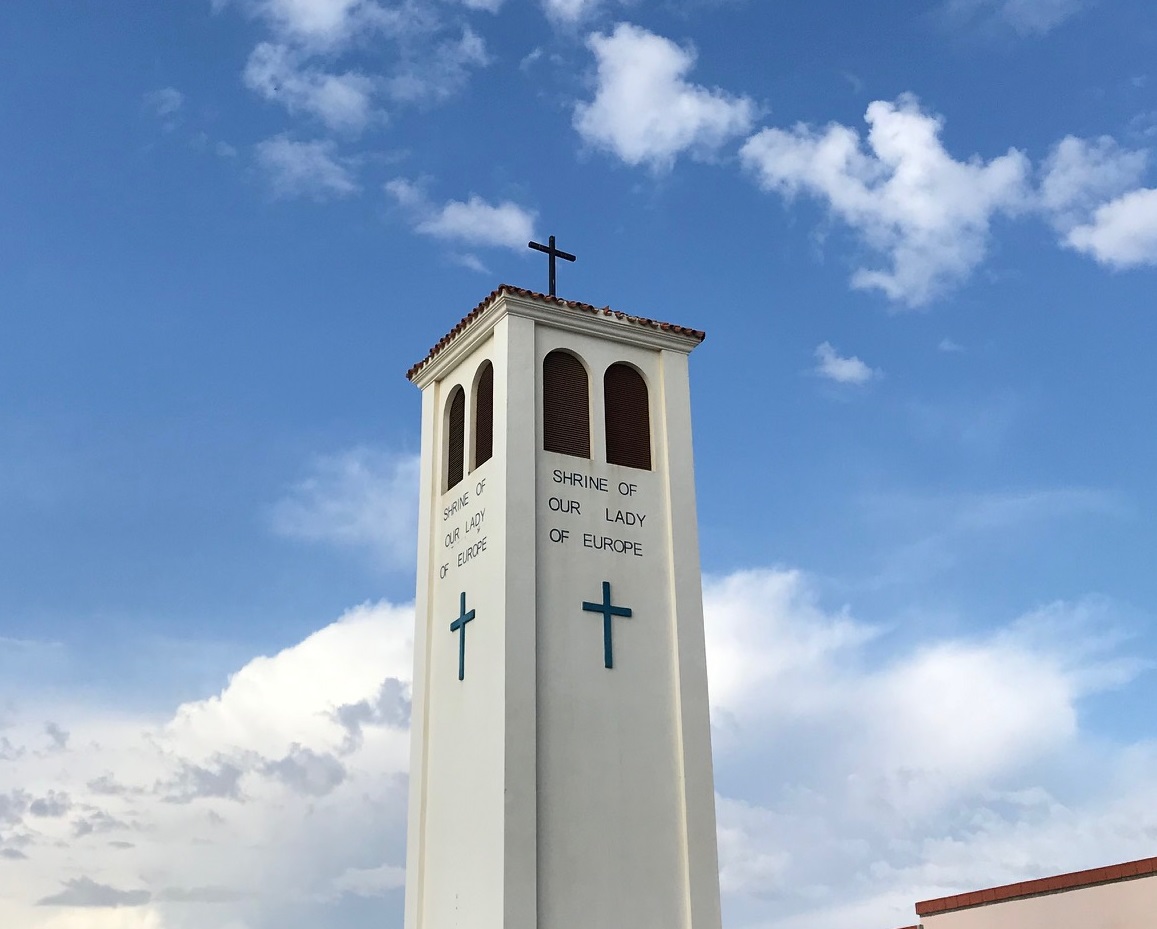
“A king emperor left in 24 hours and we are removing an imperial yoke in over a week,” he says. The phone goes off. It’s time to leave. I exit the Rock Hotel into the chill of the morning air, tugging my collar around my neck for warmth. I head down Europa Road towards the southern tip of Gibraltar. The road winds along the cliff side until it reaches a fork that enables passage to either The Shrine of Our Lady of Europe or a 100 tonne gun. Sorry, Our Lady, but that’s no contest.

Tight streets form a network of capillaries feeding into the sea. A grand muse house has its black shutters swung open. Inside, a woman polishes an extensive collection of silver. I swing around past the South District Senior Citizens Club, a white box on Naval Hospital road, and then around the corner children’s voices gurgle out of the Loreto Convent School. Further on I go down to the coast. Housekeepers come and go from large blocks of flats, while gardeners tend to expansive gardens hidden behind high walls. The smell of fresh flowers fills the air. Few people working here actually live here. This is a wealthy part of town, and it exudes money from the streets like sweat from the pores.
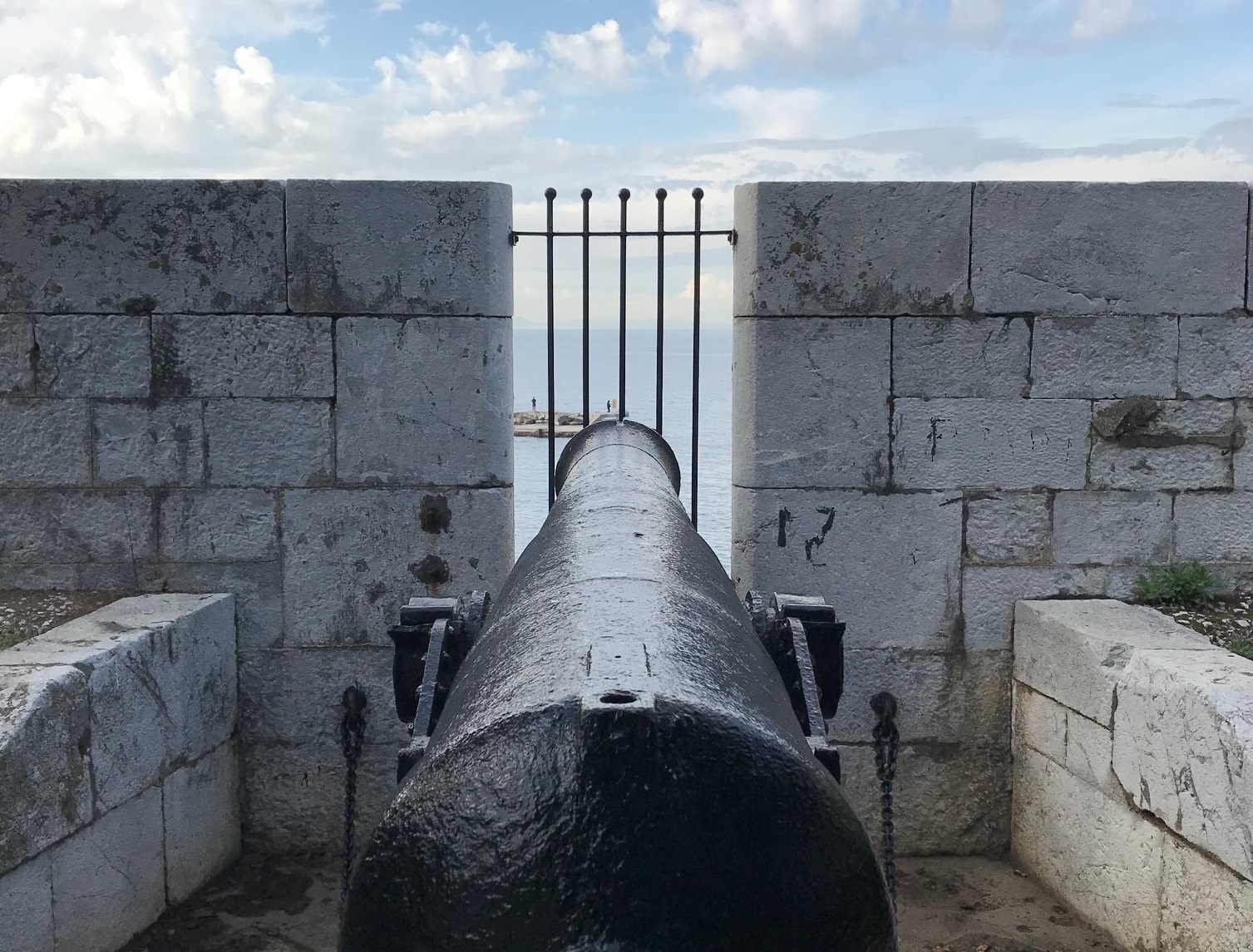
This is a big gun, but not the 100 tonne gun. Sorry.

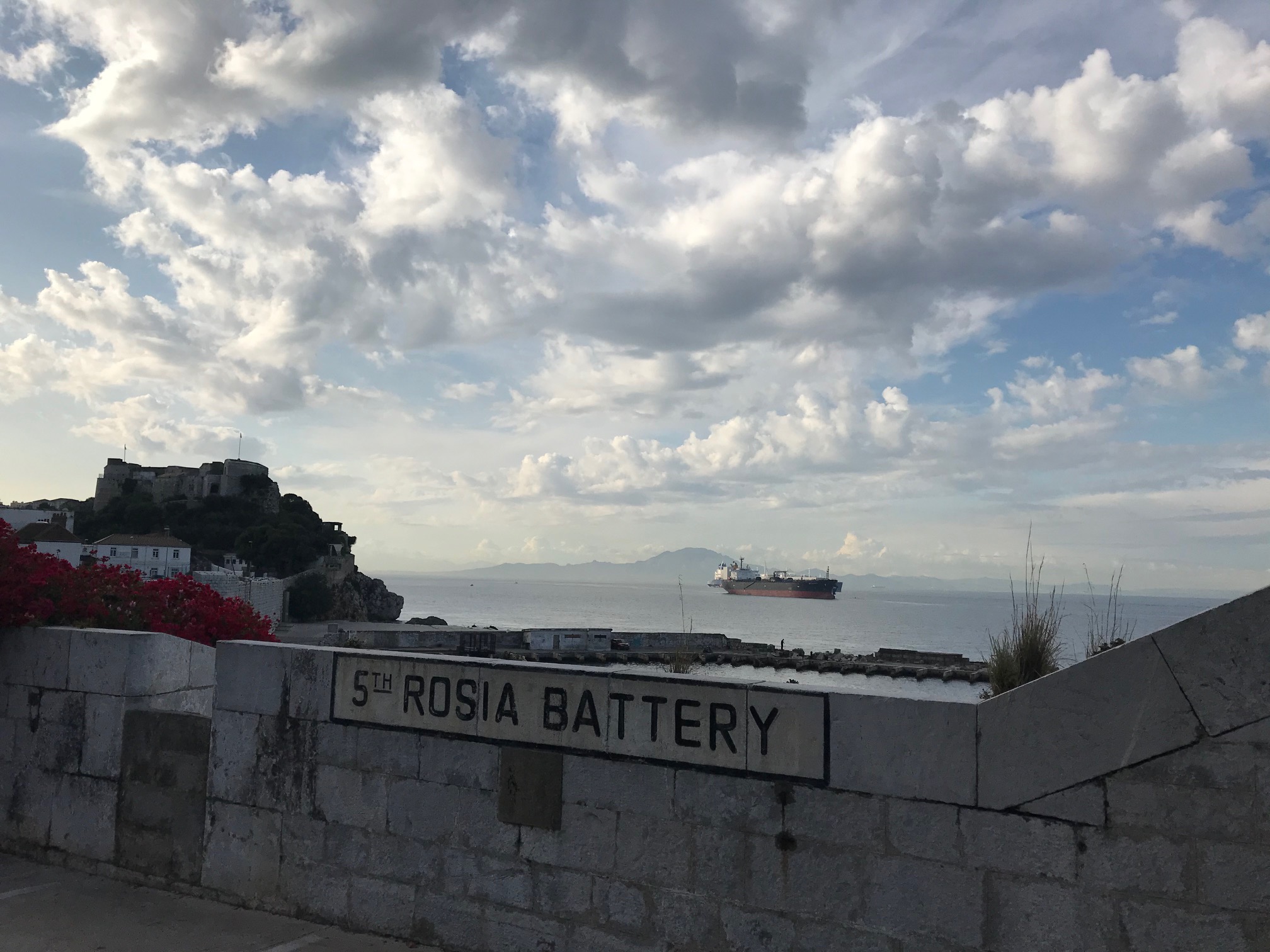
At the 5th Rosia battery I stop and look through defensive slots in the thick walls. Fisherman stand on a pier made of rock jutting out into the sea. A canon nearby to me could blow them out of the water if it was still active. Gibraltar has a thing about fortifications. Further up the way is the previously mentioned Armstrong 100-ton Gun. I walk up there to take a look at it. What’s more to say? It’s just a really massive gun.

I return to my peregrination to the south of Gibraltar, Europa Point. Hugging the coastal road south in the still chilly morning air, I head through tunnels crudely hacked out of the rock so cars and people can pass through. I stop again at a recreation park, sitting on a concrete seat and looking out to sea at the giant tankers beyond, seemingly going nowhere in any sort of hurry. Walking onwards through the eerily quiet Keightley Way tunnel, I eventually emerge at Europa Point, just in time for the sun to come out and make me feel uncomfortably hot. I catch a moment to cool down as ‘Instructor Vinny’ swings his Vauxhall Corsa in a 180 degree turn while giving a nervous-looking youngster a driving lesson. The youngster takes over, and they drive off again: this time, very, very slowly.

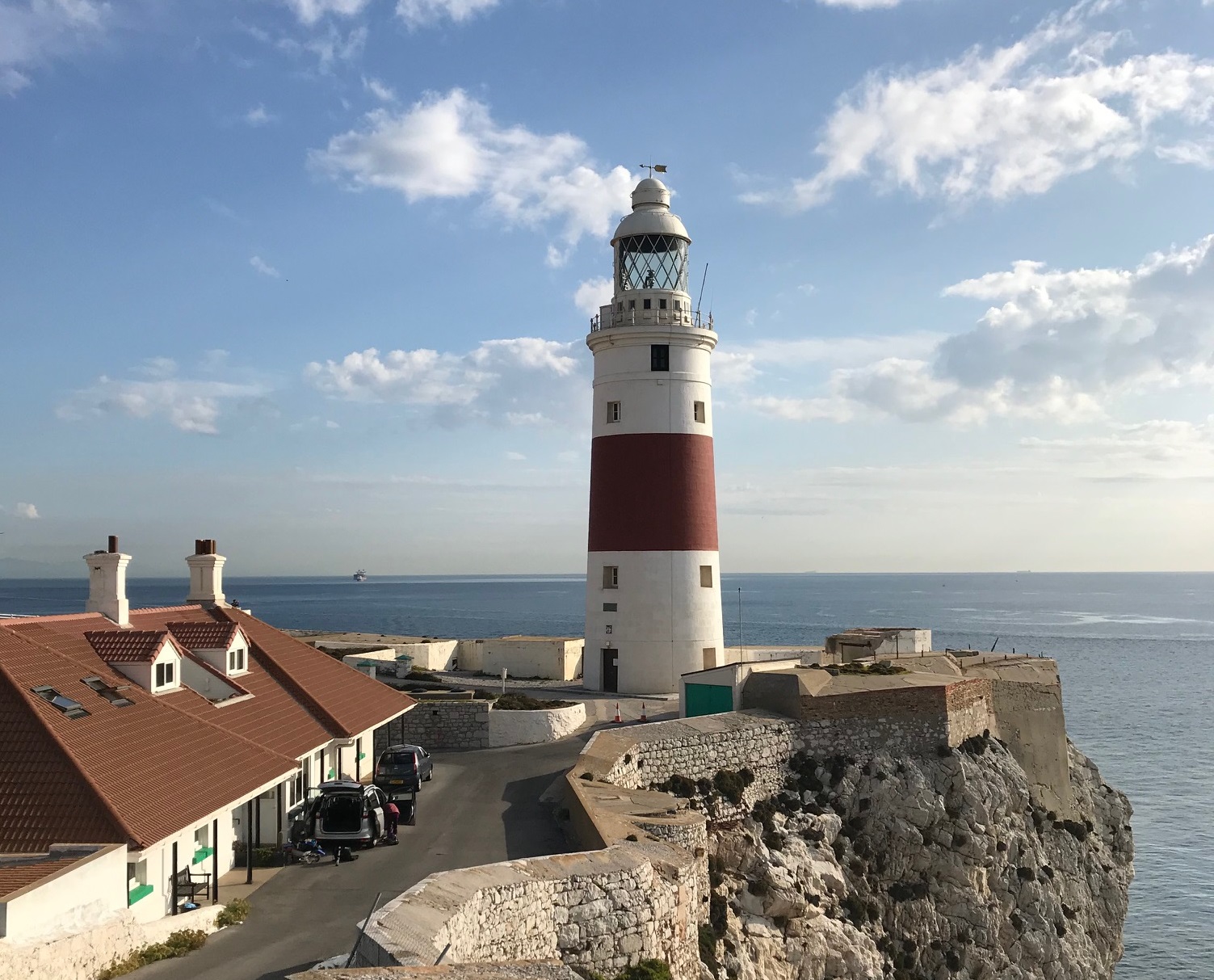
The beautiful Trinity House lighthouse stands at the southernmost tip of Gibraltar, ever watchful over the Strait of Gibraltar. It casts a myopic gaze over to Cueta, a Spanish city on the north coast or Africa, and neighbouring Morocco. Control over the Strait was historically a highly coveted prize for naval powers. It was contested by the Kingdoms of Castile, Morocco and Granada in the 13th and 14th centuries. In 1704 the ‘grand alliance’ of England, the Dutch Republic and the Archduchy of Austria took the Rock as an Iberian outpost in the ongoing naval battle with France. It has remained under British control ever since.
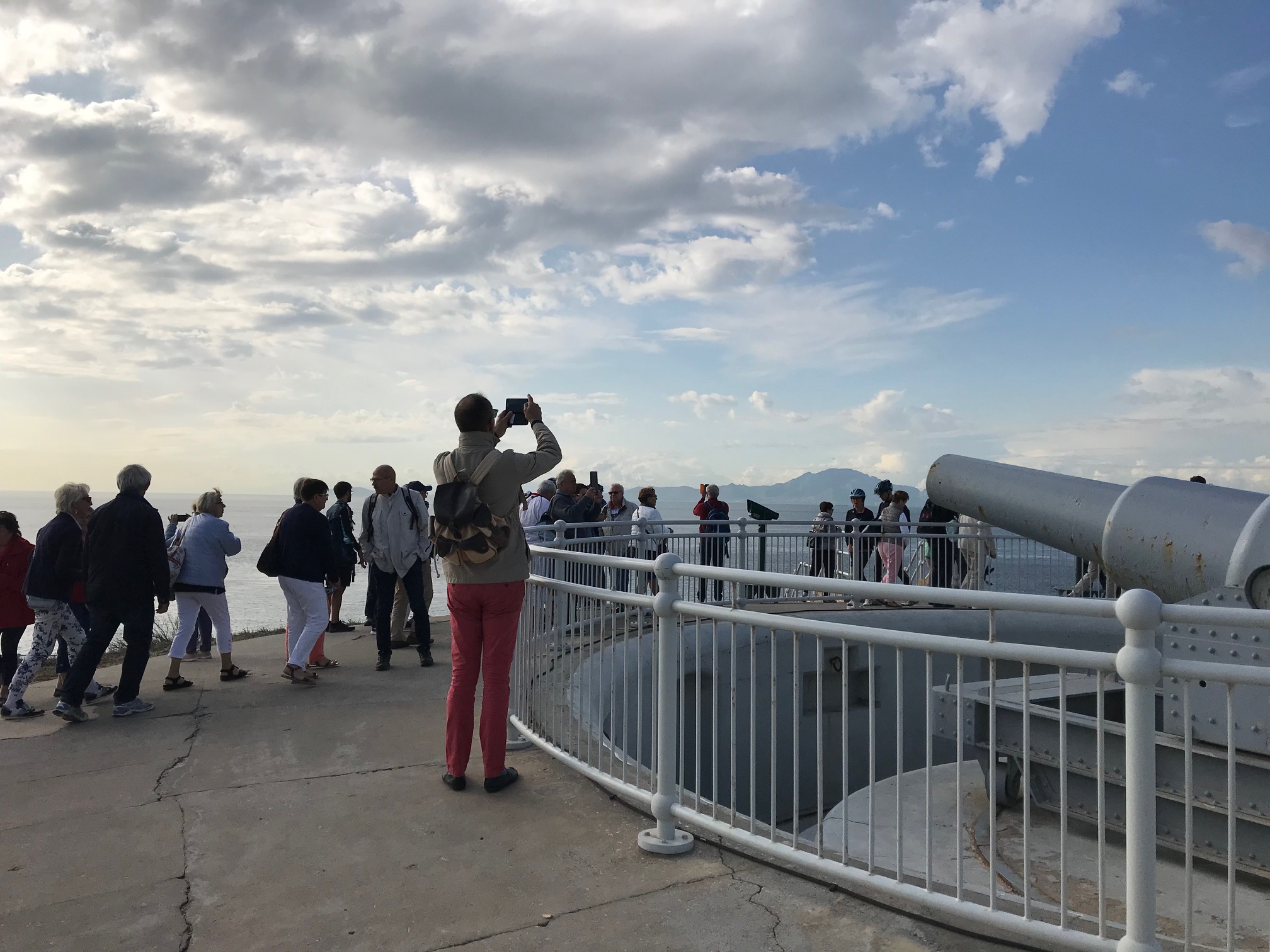
Taking Gibraltar was a shrewd move, as the opening of the Suez Canal in 1869 would increase shipping traffic through the Strait and enrich the Rock. It soon became a gateway to the whole world. Alongside the continued flow of shipping tankers in the Strait, Orcas have also been spotted here revelling in the rich feeding grounds. Black kites and honey buzzards are common visitors to Europa Point, along with the occasional Griffon Vulture and Short-toed Eagle. Yet, I’m more interested in the chattering flock of tourists that have just disgorged from six mini-buses at the point.

The buses are marked with Parody Tours, a somewhat ill-advised brand that was apparently established in 1941. The tourists, mostly from China, amble aimlessly towards the viewing platform to take enough photos that would break the average cloud storage solution. The area in front of Harding’s gun battery becomes a speed dating event for the view. Snacks are consumed, guides are read and endless selfies are taken. Then the tourists all pack up and move off in a vaguely coordinated procession.
Their next destination may be the Gotham Cave Complex, declared a UNESCO World Heritage Site in July 2016, becoming the UK’s 30th such location. Or maybe they fancy going to The Shrine of Our Lady of Europe just around the corner. I walk there, passing the seemingly brand new Gibraltar Rugby stadium, ideally hoping that she doesn’t judge me too harshly for blowing her out for a big gun earlier.

The continent of Europe was dedicated to Our Lady of Europe in 1309, when a limestone stature of the Virgin was placed at this shrine. It was removed in 1333 after the Rock was taken by the Moors, but the Christian Shrine was returned in 1462 with a statue of Madonna and her child brought to the location. It would stand happily until 1704, when the British took the island and promptly decapitated both statues. Charming. The site would only return as the Shrine of Our Lady of Europe in 1961.

I head back towards the north of Gibraltar. On my way I pass a white Ford Transit van run by a removals and house clearance operator called Jean-Claude Van Man, a riff on the Belgian action star, Jean-Claude Van Damme. There’s a sillhoette of a man in a karate outfit performing a mid-air kick. It’s a perplexing image: does Jean-Claude karate kick all your stuff into the van? Or does he ring your doorbell, immediately kick you in the head and say, ‘that’ll be £50, mate.’? Either way, I think I’ll pass.
At a dry dock around the bay, the MN Pelican ship is in for maintenance. Not much seems to be going on, but a ‘ship spotter’ near me is eagerly taking photographs from the road. I wander onwards, past the Royal Gibraltar police headquarters. If you’re a fan of ‘bobbies on the beat’, you’ll like Gibraltar. Over a period of just three hours, I spot five police cars, two police bikes, a van and a police boat patrolling this territory of only around 32,000 people. According to the UK government’s own advice, violence and street crime are rare in Gibraltar. More incidents are reported involving people walking between La Linea and Gibraltar at night to cross the border. But despite these incidents, police presence on the border seems rather light.

Official figures in October 2019 indicated that just 33 people out of a population of around 32,000 in Gibraltar were out of work. Yet the reality is that most people who work in Gibraltar can’t actually afford to live here. Opposite the Lions FC football club of Gibraltar, with a bar fittingly called The Den, is Quay 31. This brand new block of flats will join others on Kings Wharf Quay. A one bed flat in Quay 31 would set you back more than £450,000. That would give central London a run for its money. All units in Quay 31 have apparently sold out before the building is even finished. Further up into town, the roads are clean and regularly maintained. Green spaces are watered and delicately manicured. Swish office blocks gleam in the afternoon sun. Designer goods are on sale in the boutiques. A police bike hits the ‘blues and twos’, speeding off to no doubt fetch a cat down from a tree.

At the north end of Line Wall Road, I drop down through the American memorial gate gifted to mark naval battles in World War I, and towards Queensway. Instead of going to one of the pretty cafes and bars around the area, I instead head straight for the Morrison’s megastore. It is 2pm and absolute chaos inside the supermarket. Shoppers appear to be stocking up for the apocalypse, but an Armageddon that will be catered with chocolate and alcohol. The café appears to be part building site, but undeterred I venture in. A harassed mother pushes a trolley, drags a high chair, holds a baby and shepherds a toddler at the same time. I marvel at the feat, and then offer to push the trolley for her. She gratefully accepts.

Around the corner is the port of Gibraltar. The giant Mein Schiff 2 cruise ship, operated by tour operator Tui, is moored up. Hundreds of cabins with glass windows and balconies line the flank of the craft. It’s a floating hotel sailing a culinary crusade over the seven seas, an all-inclusive yet ultimately exclusive orgy of excursions and excess. The century class Mein Schiff 2 weighs 77,000 tonnes, has 12 decks and can hold 1,912 passengers. It will depart at 6pm, but tomorrow the P&O Oceana will take its place. It can hold 2,016 people.
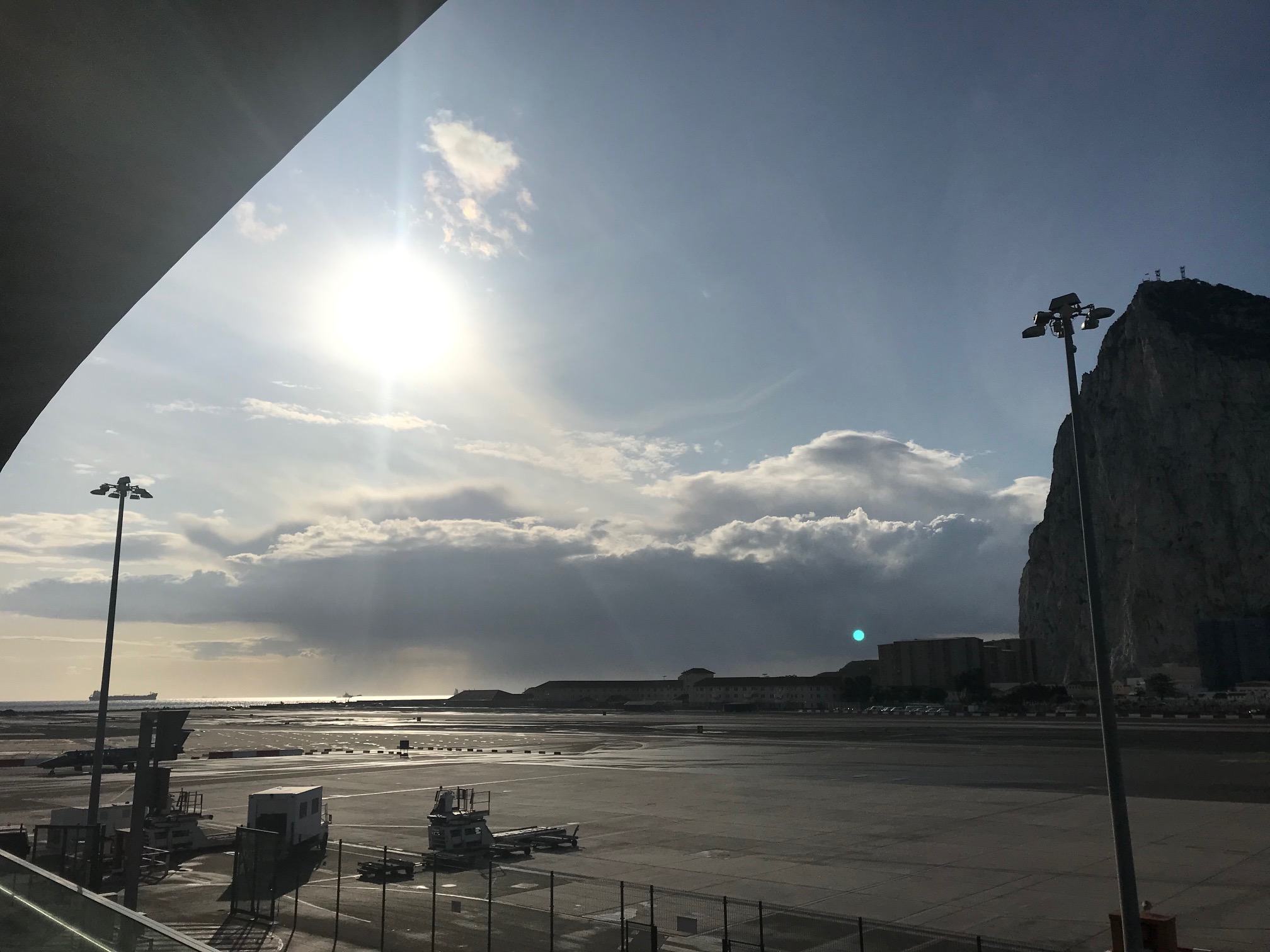
Around the corner from the port, the bottom of the airport runway comes into view. Nervous flyers are advised never to come here as there’s nothing but ocean after the runway ends. I cut up through the flat blocks to go to the airport. At the Albert Russo block a pet songbird can be heard serenading the afternoon sun. A first floor flat has flowers in earthenware pots placed rather precariously on a balcony. I walk past a flat on the ground floor with a ships wheel attached to the wall. I think it says ‘Welcome Abroad’ in a message on the wheel, but doubling back I realise it actually says ‘Welcome Aboard’. I can’t stop thinking about it.

The sleepy marina is ahead, with chain restaurants such as Pizza Express and Wagamama inside permanently moored boats on jetties. Further up the swish Sunborn cruise ship has been floated in and attached to the marina as a fixed, five-star hotel. You wonder if it watches in the near distance as the Oceana’s and Mein Schiffs of this world get to explore the seven seas, while it remains shackled to its permanent home. I exit the North District, past the Gibraltar World Trade Centre and over Winston Churchill Avenue once more, cutting directly across the airport runway. Traffic is held at either side when a plane takes off or lands, but otherwise it is just a steady stream of people, bikes and cars rolling either way.

As I reach the airport side, I see a faded and tatty billboard saying ‘Thank you for visiting Gibraltar’. It’s for Monarch airlines, which was the biggest airline to collapse in UK history when it went into administration in 2017. Around 100,000 passengers and holidaymakers were left stranded when the company fell, but that has since been surpassed by the around 150,000 who were left high and dry when Thomas Cook went out of business in September 2019.

Most people come to Gibraltar to see the sights – the Rock of Gibraltar, St Michael’s Cave, the Barbary macaques at the Ape’s Den. But I’m here to see the border (can you believe that I am single at the time of this visit?!?). Much Brexit focus has been on the border on the island of Ireland, but little has been said about the land border between Gibraltar and Spain. And that’s despite Gibraltarians being firmly against two things: Brexit and being part of Spain. Although the territory wasn’t able to vote in the 1975 UK European Communities membership referendum, legislation passed in 2002 allowed it to take part in European elections (somewhat bizarrely, as part of a constituency in the south west of England) and the 2016 referendum.

To say Gibraltarians didn’t sit on the fence would be an understatement. Remain was backed by 19,322 voters, some 95.91% of those who voted on a turnout of 83.64%. Large queues were reported at polling stations on the day of the vote. The UK area with the second highest remain vote was Lambeth, at a relatively indecisive 78.6%. In recent European elections the anti-Brexit Liberal Democrats won 77% of the vote in Gibraltar.

Gibraltarians are equally unequivocal on switching sovereignty to Spain. On 10 September 1967, Gibraltar had a referendum on whether to stay as a British overseas territory. An overwhelming 12,138 voters said ‘yes’ against just 44 who said ‘no’. The day is now marked as Gibraltar’s national day. In another ballot on 7 November, 2002, 98.97% voted to reject the prospect of Britain sharing sovereignty with Spain.

As a British Overseas Territory, Gibraltar would leave the EU in parallel with the rest of the United Kingdom. The Gibraltar border is outside the Schengen visa area and the European Customs Union, so in theory little should change for the Rock. However, many here fear that such a move would result in Spain attempting to gain control. And in that case, the battle line would be drawn at the border.

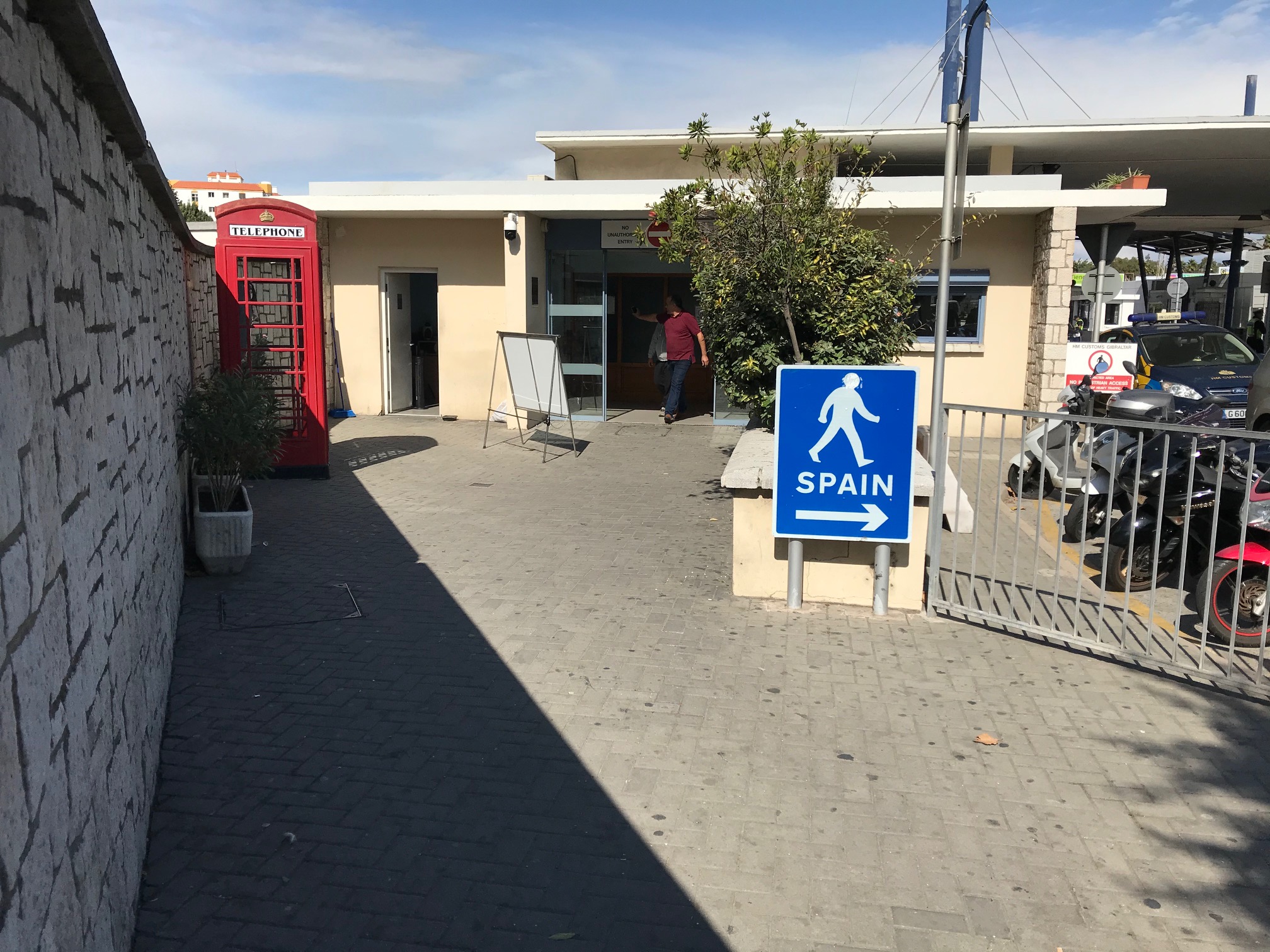
The Gibraltar border, close to the airport and looking a bit like a petrol station, would be the demarcation line between a new Brexit Britain and the European Union. When I visit, flags of the United Kingdom and the European Union flutter on the Gibraltar side of the border, with the flag of Spain visible over the other side in La Linea (along with the golden arches of McDonalds). There’s no inspection point for goods, instead they’re scrutinised at the port in Algeciras. A hard Brexit could mean that perishable goods would need to be inspected at the border. Smuggling could be an issue, but the geographic limitation is always present of how those goods would get back to the UK considering it is a long flight away. Rather, the bigger concern rests on whether greater checks would impact the movement of people.

Each day, 28,500 people on average cross the border, including 15,000 workers making the daily journey to Gibraltar for work. More than 9,000 of them are Spanish, according to estimates by Gibraltar’s authorities, but around 2,000 are understood to be British nationals in Spain for the cheaper standard of living. Currently, people are just waved through, but a no-deal Brexit, or even an unfavourable deal, could lead to long delays and a significant impact on both people and local Gibraltar businesses.

The comparisons to Northern Ireland are obvious, but actually Gibraltar is a very different scenario. Around double the number of workers cross the Irish border each day, but that is 500km long with around 200 known crossing points. By contrast, the border between Gibraltar and Spain is just 1.8km with a single narrow crossing point. People currently breeze through on bikes, in cars, on foot, even on microscooters. Most would be passing back the other way at the end of the day so you’d imagine they will be familiar to the guards that work here. There’s a free flow of traffic both ways. It’s about as friction free as you can get.

Some in government were keen to limit free movement over the border post-Brexit. The notorious ‘Operation Yellowhammer’ planning document for a no-deal Brexit outcome indicated that people on Gibraltar could face a four hour delay getting over the border. Gibraltar understandably wanted to avoid this. There have even been tensions between Mr Picardo and UK government ministers in the past, with some accusing him of trying to derail the Brexit process. After the government had a sly dig at Gibraltar’s allegedly poor preparation for a no-deal Brexit, Picardo fired back: “It is a bit rich for those who are getting us into this mess to tell us that we are not ready to face the worst eventualities of what they told us would never materialise.”

At the time of my visit in late 2019, border-crossing workers were already reeling from a sharp fall of the pound against the Euro, which had led to a relative drop in wages. Those old enough could also remember back to when the border was last closed in 1969 and the damage that caused. No one realistically wants more years of isolation. Spain has a veto in place that any future relationship between the UK and EU will only apply to Gibraltar if Spain and the UK agree. But equally, Spain would like to regain sovereignty over Gibraltar after it last held it more than 300 years ago.

The Spanish government has said that a no-deal Brexit would hurt Gibraltar, but it would also no doubt hurt its own La Linea. It was reported that during the closure of the border in the 1960s and 70s, around 40,000 people migrated away from the town. On Sunday 20 October 2019, more than 2,000 expats staged a protest at La Línea de la Concepción – near the border with Gibraltar – over Boris Johnson’s withdrawal deal agreed with the EU. They called for a second referendum to give the public another say. The march was attended by the mayors of La Linea, Los Barrios and San Roque, and more than 2,000 British ex-pats. The still waters of the Bay of Gibraltar run deep.
Brexit for breakfast

“We just need to get this thing through. What are they playing at?” a man fires over the breakfast table at his companion while the other man tries to apply more butter to a butter croissant. “They’ve had three years. Three years!” He holds a hand in the air in incredulity.
They both agree that Boris Johnson is a liar and then head off to the buffet to restock on breakfast items.
Across from me a couple are also talking about Brexit. He is of the ‘let’s just get out now’ school of thought. She’s the ‘think of the children’ variety. The waiter comes over with coffee and, like the good British people that they are, they stop and are all smiles yet total silence as the waiter does his job. As soon as he is out of the ear shot the argument resumes.

It’s Wednesday, 22 October, and I’m back in the dining room of the Rock Hotel. Apparently Churchill dined here…oh wait, I already said that. It’s just after 8am. The blueish bruise of dawn is still throbbing away from the previous night’s action. It’s cold outside and the patio doors are closed to keep out the chill. At around 7pm UK time the previous evening, the government finally won a vote on getting a Brexit deal agreed by Parliament. The commons voted in favour of the deal with a majority of 30, but the win % breakdown was: yes, you guessed it – 52% yes to 48% no. For Number 10, though, a win is a win. However, like a stumbling drunk first locating his house keys and then tripping over the cat and going over head first into a bush, the government then lost the ‘programme motion’ vote within minutes. This effectively meant getting Brexit done by 31 October this year was nigh on impossible.

Talk of the latest development in the process buzzes around the elegant dining room. An old boy enters and is seated. The waiters make a fuss of him, but he barely makes eye contact. They know his usual order, he’s clearly a regular. Gibraltar is a wealthy place, but its prosperity appears to come from assets more than income. Like Guernsey, Jersey and other locations in Britain’s still expansive territorial web, it’s a place where wealth comes to reside and be served.

As with many British ex-patriots, those in Gibraltar at the time had the best of both worlds: they escape the rotten British weather, but retain the rights of the European Union, including free access to Spain. They are European, but also British. They can bask in the sunshine, but also keep using Sterling, shopping in Marks & Spencer and singing God Save the Queen. And that means residents of this spit of land jutting into the Mediterranean have a lot to lose from Brexit, and little now to gain.

Leaving the Rock Hotel with its faintly stuffy old world charm I head out into the morning chill. I put my headphones on and play the latest episode of the BBC’s Brexitcast. I listen as the presenters entertainingly break down the latest developments. I wonder how long it will be before one or all of Laura Kuenssberg, Katya Adler, Adam Fleming and Chris Mason end up on Celebrity Masterchef, Strictly Come Dancing or some other reality TV show. Maybe a version of Homes Under the Hammer in which Laura berates some MPs for buying a small bit of land on the coast of Spain without reading the 110-page legal pack (if you got that joke, you clearly watch as much daytime TV as I do).
I curl my path around Europa Road, past a small cemetery holding the remains of those who died during the Battle of Trafalgar, and onto Main Street. It’s only just past 9am but it’s busy on the street. A woman is sweeping up outside her café as a delivery arrives. She chats to the delivery driver, gesticulating wildly as I approach.
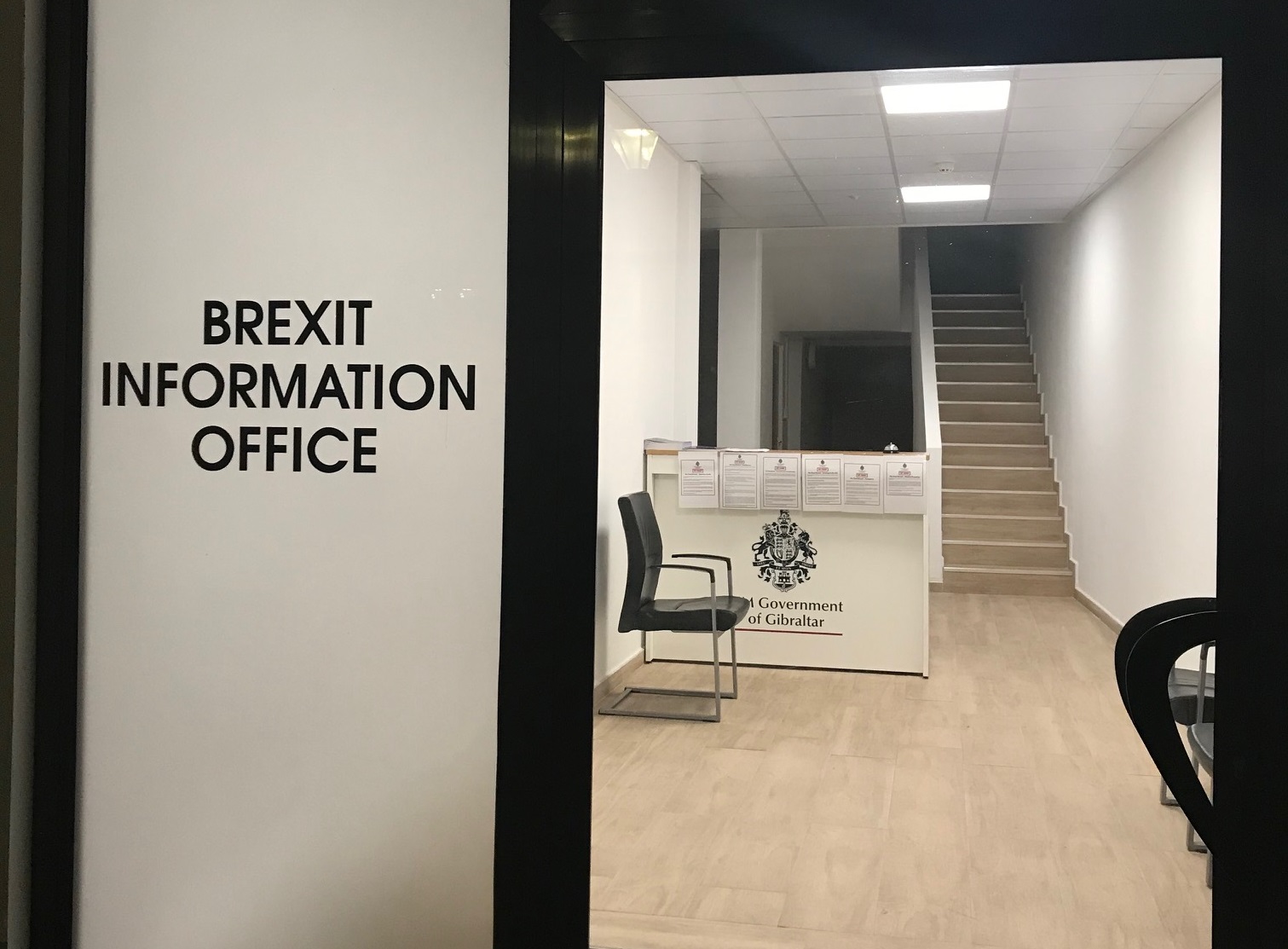
“We had the certainty and now this? Why would they do this?” she says. The man shrugs in resignation, and starts unloading the delivery. Further ahead I pass the Brexit information centre on 323 Main Street opposite John Mackintosh Hall. It’s stamped with a big red sign saying GET READY on the window, like a final warning on an electricity bill. The door of the office is open and the lights are on, but the place is deserted.

On Winston Churchill Avenue the traffic is mostly people heading into Gibraltar. I walk the other way from the flow of cars, motorbikes, bicycles and people on foot pouring steadily into the Rock for work. My flight is at 11.35am and I arrive at around 10am, so I take the time to watch the border. Cyclists barely slow down as they flash their passport or ID card to the checkpoint as they go past. I reflect on the fact that clogging this up with bureaucracy could be devastating. These are people just trying to live their lives, to get to work, to earn a living, to exist. Even the tiniest of friction could negatively impact them and make their lives harder. No one really wants a no-deal Brexit, but it feels impossible at this moment in late 2019 to rule anything out. If such a scenario did transpire, then people in Gibraltar might find themselves stuck between the Rock and a hard place.
Next up, our final stop (coming soon, lockdown depending…)

The End of the Line: Hastings

The End of the Line is a 10-part travelogue journey to some of the highest Remain and Leave areas in the United Kingdom’s 2016 Referendum on EU membership. It was written over two years from 2018 to 2020, before Coronavirus made Brexit seem like a spot of man flu.  

Hastings voted 54.7% Leave in the 2016 EU Referendum

Originally written in February 2019

The last time I visited Hastings was in 2007. I had been sent to the Sussex seaside town to do ‘vox pops’ for a magazine I was working for at the time. On that chilly autumnal Saturday, I wandered around Hastings town centre, periodically accosting some unfortunate person who was out shopping. I’d shove a Dictaphone under their nose and then ask the confused individual a series of questions on the effects of privatisation of public industries (yes, I really did this). Then, my photographer would take a portrait of the person’s still puzzled expression, before I shuffled off to the next victim.

I was a staff writer on the magazine (which shall remain nameless), writing and editing a variety of pages on various topics, from pop music to politics. I can say with a good degree of confidence that the magazine’s editor (who shall also remain nameless) would have viewed leaving the European Union as a thoroughly decent idea. I was blissfully ignorant at the time, but the indicators were more than glaring. He commissioned me to do an interview with Brendan O’Neill, the controversial columnist and editor of Spiked Online, the libertarian online magazine. He sent me to see Matthew Elliott, then of the conservative lobbying group, the Tax Payers Alliance, but latterly the chief executive of Vote Leave, the official group campaigning for Britain to leave the European Union. I had absolutely no idea who Mr Elliott was and most likely asked him a set of truly inane questions at the time.

My editor saved his most aggressive editing for any left-leaning interview or subject I conducted or commissioned myself. A feature on climate change I put together was ordered for a near complete re-write as I apparently hadn’t come at it from a ‘critical perspective’ or reflected how climate science was apparently ‘a bit iffy’. To be fair, I was hideously hungover during the interview and had to pause proceedings while I went to discreetly empty the contents of my stomach in the toilet, but that’s another story. I was young and desperate for work at the time. Hell, I would probably have written a positive review of Mein Kampf if the price-per-word had been competitive

In both Brexit and Donald Trump’s rise to power in the US, the media and its practices have come under the spotlight. Critics claim that the so-called ‘mainstream media’ is guided by liberal bleeding hearts, cruelly robbing valiant right-wingers of the fair platform they deserve. In fact, the opposite is more than often true. At many times the media is pushed towards ‘small c’ conservatism, either overtly or with more subtle gait, akin to someone walking with one leg slightly shorter than the other. Whether media outlets are chasing revenue, pleasing some distant wealthy owner or striving towards some illusionary ‘balance’, the effect can be a completely imbalanced, impartial and distorted view of the world. The viewer, reader or Twitterer is left with a meal in which true fact is an ingredient they can only taste intermittently. And regardless of your chosen diet, that cannot be healthy.

On another Saturday, this time in February 2019, I again travel to Hastings on the train from Brighton. The two places are only an hour apart, yet they voted very differently in the EU Referendum (read more about Brighton here). Hastings wanted out by a decent margin, and that was despite the local Hastings MP at the time being Amber Rudd, the then secretary of state for work and pensions, who campaigned for the UK to remain. Rudd would also later call for a second referendum on leaving the European Union, against the wishes her own prime minister (again, at the time).

Sat on the train, I observe two young boys near me chatting away. Their plummy, posh voices jar with their urban streetwear outfits. They discuss their upcoming work experiences, both for some local creative media companies. One says, ‘it’s nice just to sit down for a bit, isn’t it.’ The other one agrees that it has been a really busy week. They can’t be more than 15 years old. I resist the urge to scream, ‘It’s all downhill from here!’.

The train rumbles onwards through the Sussex countryside. The trees outside are stripped and bare, giving everything a dulled colour palette, like Chernobyl on a good day. The sky hangs in a hazy grey. Hopeful patches of powder blue are few and far between. We roll through Lewes, the pretty town just outside of Brighton where property prices would make even a Londoner blush. Onwards we go, through the rolling hills of Sussex. A plump set of Hillocks puncture the horizon, like the upturned buttocks of a drunk, passed out face first.

The boys exchange vaguely braggy conversation about people they know who are making films, recording hit albums, or something like that. It’s probably 80% bullshit, but that would no doubt stand them in a very good stead for their future media careers. One of the boys gets off at Berwick, presumably heading home to an enormous country pile owned by his parents, whom he resented for some unclear reason.

Onwards. The scrub brush becomes thicker, the fields greener, the sky more flecked and brushed, as though freshly painted by Turner. A man in a blue puffer jacket, who had already been to the toilet twice in half an hour, eyes me suspiciously from a few rows ahead. I stop typing until he judges that I had learned my lesson, and looks away. We arrive into Polegate, with its boxy, 1970s buildings constructed in an architectural style that could best be described as ‘functional holiday camp’. A Union Jack flag flies limply on top of a shed in a back garden. Brighton & Hove Albion fans wait on the opposite platform, heading to Falmer to watch the Seagull’s 3pm FA Cup clash with West Bromwich Albion.

As the train rolls through Hamden Park I peer into the back gardens of people living beside the train line. Each passing property gives a little flash of insight into someone’s private world. A mad scattering of toys across a lawn in one, a carefully placed regiment of gardening tools in another. Empty chairs arranged around a fire. A well-kept shed placed far away from the house, with a solitary path towards it well-worn into the grass. My mind buzzes with each mini soap opera unfurling before my eyes.
‘Pat and John, married for 30 years, two kids, Paul and Anne, now grown up. Paul works in insurance and is going through a messy divorce from a childless marriage. Anne conformed to her parent’s wishes and found herself a mildly successful man to marry and set about pumping out three kids. John’s got high blood pressure, so Pat got him a Fitbit for Christmas…’
And then onto the next garden and the imagined stories held within.

We eventually arrive into Eastbourne. The sign at the station welcomes you to the Sunshine Coast, although today must be its day off. Eastbourne is an end of the line location. It too voted to leave the European Union, by 57.3% to 42.7%, virtually the same ratio as Hastings, and higher than the national average of 52% for leave. Eastbourne also defied its local MP, Lib Dem Stephen Lloyd, who campaigned for the Remain side. Like Rudd, he broke ranks with his party, although it was to vote for Theresa May’s disastrous withdrawal agreement. That’s the one that was voted down in Parliament by the biggest margin in history. Like Lazarus, the bill would later make a dramatic comeback from the parliamentary ooze as Boris Johnson’s reheated ready meal, just waiting for the bing.

As the train waits in Eastbourne station, I watch as a man in a deerstalker hat walks along the platform beside my window chatting away to himself about something. Nearby a ginormous teenager, about six foot five and 20 stone, stands like a towering colossus on the platform. His trousers aren’t quite long enough and they expose the crisp white socks he’s wearing. An elderly couple slowly board the train. Like rodeo riders, they calm rippling waves of various aches and pains to eventually settle themselves into a pair or seats. The train backs out the way it came, and I’m now facing backwards as we head off towards Hastings.

More back gardens to inspect. A tattered flag of St Georges flutters in the wind on a shed. Shed flags are popular around here. It’s now nearly impossible to have the national flag of England displayed on your property without it being automatically assumed that a racist lives there. So co-opted has the English flag become as a symbol that it’s hard to see a way it could be reclaimed as a national symbol. Maybe post-Brexit some bright spark will suggest a rebranding exercise involving Instagram influencers and then we can all go and immediately kill ourselves.

Despite the dulled colour palette, the countryside around the train line is pretty. Walkers are out in force due to the weather being quite mild today after the recent frost. The train line skirts the coast, heading through the rather bleak Normans Bay and onwards towards Cooden Beach. The line becomes so close to the sea that you can almost reach out and touch the salty waves. Regardless of the location, a coastal train line always feels glamorous and full of mystery. Although, the mystery most often on Southern-run trains is, ‘what exactly is that smell?’.

Alongside the coast the beach huts stand in proud lines. Dull suburban homes contrast jarringly with an occasional, outlandishly fancy-looking property that no doubt featured on TV show, Grand Designs, at some point. We arrive into Bexhill-on-Sea, a fairly standard Sussex seaside town elevated by the excellent De La Warr Pavilion. This Grade 1 listed, Art Deco-style building was extensively renovated in 2005 and is well worth a visit to see a range of art exhibits in one of the largest galleries on the south coast of England. You can catch an eclectic mix of performances in the theatre or just sit with a drink and look out towards the English Channel.

Onwards, the train strides besides the beach like a lumbering version of Chariots of Fire. Husks of old boats sit rotting on the sand. More beach huts, endless rows of them, all lined up on the front ready to defend a sea-borne invasion. Then the urban world returns. An enormous warehouse roves into view, housing megastores for TK Maxx, Carpet Right and Poundstretcher chains, just before St Leonards Warrior Square. This exchange station was previously called St Leonards on Sea, but adding Warriors Square makes it sound much more butch. It’s a bit like a wrestler called Kevin Willis becoming Kevin ‘The Reaper’ Willis. Ooo, scary. I can’t want to see his brutal takedowns and hear extensively how he doesn’t like talking about his charity work.

Finally, the train rolls into Hastings as the gloomy sky darkens. I quietly pray it isn’t an omen. Ok, technically I am stretching the ‘end of the line’ shtick with Hastings. It isn’t actually the end of the train line. Nearby Ore isn’t really either, although it is the end of the line from London Victoria, so that kinda counts, right? Let’s have a vote on it – oh wait, maybe not…

Exiting the train station, I walk towards Hastings town centre. Down Station Road I pass Mr Poppers jacket potato shack.. A woman wearing a fluffy pink jacket and a hat with pom-pom ears tucks into a jacket potato from a polystyrene foam tray. Further on a large square is ringed by shops in the Priory Meadow Shopping Centre. All the usual chains are here, some having just come out of administration, others just commencing the proceedings.

In the middle of the square stands a statue of a cricketer, caught in mid slog of a ball. The plaque indicates that this was unveiled by the Queen at the opening of the shopping centre and marks that the site was previously a cricket ground before it was sacrificed to the gods of commerce. I head inside the Priory Meadow, side-stepping two boys wrestling on the smooth floor. It’s lightly busy considering today’s a Saturday, but January is always the retail graveyard shift. Idle desperation exudes from the stores. Some cling to life by a razor-thin grip, hoping desperately not to join ‘the fallen’. Woolworths, Comet, and Toys R Us; just a few names lost to the big retail park in the sky (turn off at Junction 25 and follow the signs).

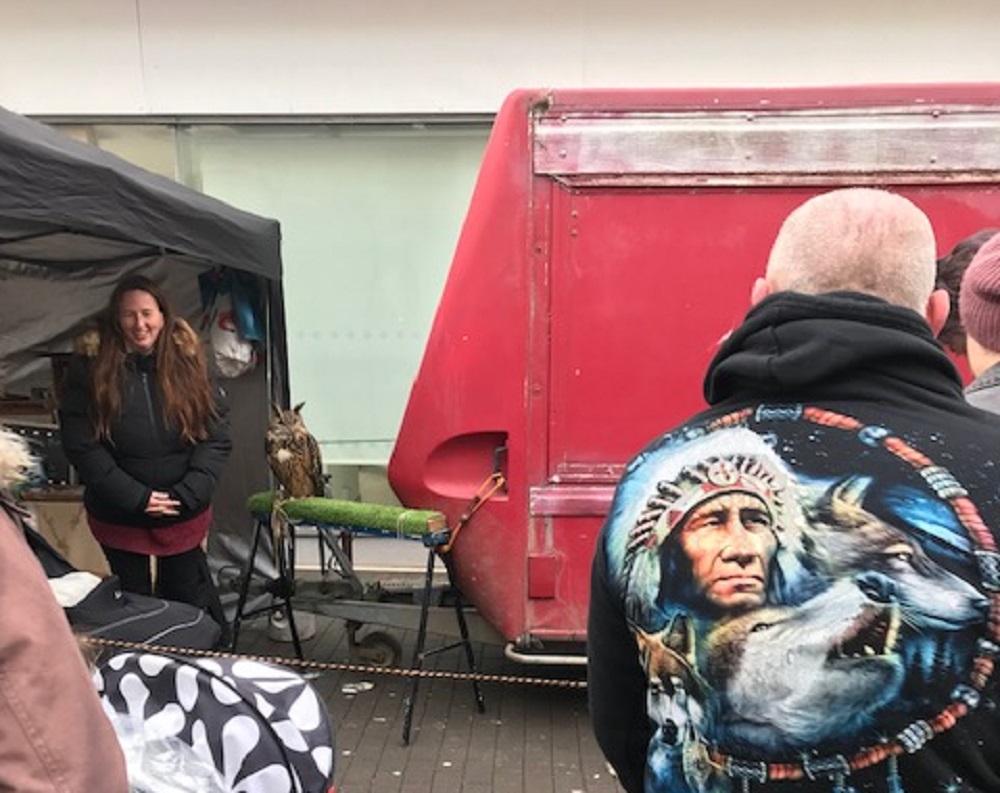
I join a gaggle of pensioners taking a break on the benches. They must be seriously worn out as there’s a sale on at Holland & Barratt. Outside of Priory Meadow, on Wellington Place, it is market day. There’s a fairly typical range of stalls selling a variety of tatt, but one catches my eye. A red trailer provides the backdrop for a makeshift owlery, with five different owls sat on perches eyeing the Saturday shoppers with bemused suspicion. A stall sells owl-related products, including memorabilia and owl-rearing equipment.

I have always been fascinated with owls. At times I’ve even considered whether it was possible to have one as a pet. Reluctantly, though, I resist the urge to ask the woman running the stand for more information. It was not beyond the imagination that I would be on the train home wondering how the hell I was going to look after Timmy the Tawny Owl, going absolutely bonkers on the seat next to me. Some dreams are best left unfulfilled…

As the market ebbs away and regular shops take over, I notice a free Palestine demonstration outside of Lloyds Bank (it doesn’t appear to be a protest against the bank, rather that this was a good place to put the stand). A man in an oversized US ice hockey jersey hands out leaflets calling for an end to the occupation of the disputed areas. He appears rather despondent at the lack of interest, but perks up when his colleague appears with a bag of savoury treats from Greggs for lunch.

An underpass leads towards Hastings old town. On either side of the passageway are murals to the town’s real claim to fame; the Battle of Hastings in 1066. This crucial event in British history was, and not many people know this, the first attempt at laser eye surgery (it didn’t go well, if you’re wondering). What happened here more than 950 years ago, when Duke William arrived from Normandy to take the throne and boot out the Anglo-Saxon elite, obviously has great resonance for the events of today.

The symbol of 1066 has been co-opted by both those supporting and opposing Brexit. While many see it as a symbol of fighting European invasion, others view it as showing actually how close we are to our European neighbours. On 14 December 2018, an anti-Brexit march, led by the European Movement 1066 branch, walked through Hastings and held a rally next to the Odeon cinema. The held a banner proclaiming ‘Hastings Loves Europe Since 1066’ and were entertained by Faux Bo Jo, a comedian parodying former Foreign Secretary Boris Johnson, who would later ascend to his own throne (with both eyes intact).

Two weeks before my visit, Tim Martin, the founder and chief executive of the cheap and occasionally cheerful Wetherspoons pub chain, was at the John Logie Baird branch of his empire in Hastings at 11am to talk to the locals about Brexit. The prominent Vote Leave supporter was on a tour of pubs in his chain to rally support for getting out of Europe without any sort of deal. According to the Hastings Observer, the bar was packed with hundreds of people, “most of whom seemed to be over the age of 55”. Somewhat bizarrely, a French television crew even turned up to cover the event.

The Observer reported that Leave supporters raised Union Jack flags and shouted down any Remain saboteurs. It sounded similar to the Nuremburg rallies but with an ample breakfast buffet. The biggest cheer was reserved for when Mr Martin claimed that leaving the EU would enable Britain to take back control of its fishing waters (more on that later). He claimed that instead of being a disastrous hammer blow to Britain as some commentators claimed, leaving without a deal would in fact be a blessing.

In an effort to practice what he preached, Mr Martin had already stopped various European drinks, like champagne, from being sold in his pubs. If you like that foreign muck, you aren’t really British, he possibly believed. “The volume of shooters we sell has actually gone up since we replaced German Jagermeister with Strika, an alternative made in Chorley,” Mr Martin said in Hastings, as quoted by the Hastings Observer. “The principal is that anything you can buy from the EU you can buy from elsewhere.” Well, with Chorley’s No 1 Herbal Liqueur already in the bag, who wouldn’t want to leave without a deal?

I emerge from the underpass and reach a forecourt dominated by a giant Argos. Across the way are boarded up shops, including the Crafty Vapes free house, billed as ‘the home of beer and vape’. It is unbelievable that such a concept had failed to take off and now sat empty. Some ideas are just way before their time. A little further ahead I reach the seafront. A large car park sits squat in front of the pebble beach, and then beyond it the sea. The water undulates in grey, choppy waves as the cold wind whips across the Channel.

I stop to have a brief text message exchange with my now ex-girlfriend. She wishes me well. She was supposed to come on this trip, but didn’t because we had just split up, and possibly because she didn’t want to spend her Saturday wandering around Hastings and trying not to buy an owl. One or the other. I’m still living at her flat. It’s rather messy, but manageable. I am on the way to be technically without a home, but not technically homeless. Unlike many people, I have the luxury of options when things go wrong.

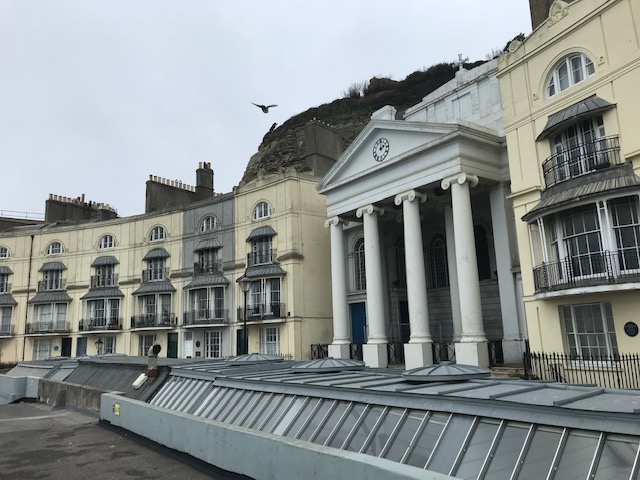
I head down Pelham Place, as the faint sound of amusement arcades rings out ahead. Pelham Crescent was clearly a grand sight in its day. Three blue plaques denote people of note once lived in these elegant buildings. You could see why, with the sweeping curve of the close enabling all buildings to look out to sea. They now appear down-at-heel and the imposing St Mary Church is boarded up. I stand and take it all in, before noticing that a pigeon lies dead at my feet, flat on its back as though it had passed out drunk. I wonder if it is too early for a pint.

Around the front of the crescent an old fish bar sits closed up, so I head into the pleasant St Mary’s in the Castle café and shop. I get a coffee, and take a seat to watch the world go by. On a table next to me two elderly women analyse the oven cleaner that one of them has just purchased. They bear concerned expressions as they read through the instructions. Upon finishing, one woman carefully puts the cleaner away, but concern remains etched on her face, as though some great evil would be unleashed when she comes to use it.

Despite it being a cold January day, Hastings bustles with activity. A steady stream of people pass by the window to distract my gaze from the sea beyond. A woman stops to readjust her dog in its pram. A young couple walk past; they couldn’t be more than 16 years old but are dressed as though they had just come from the set of drama, Peaky Blinders. They’re closely followed by two well-dressed men, both wearing felt trilby hats – one British racing green, the other a striking mustard yellow. A boy racer revs his over-tuned engine, and then the garishly-coloured car farts its way down the strip. Groups of kids hang around together, stuck in the limbo years before one of them appears old enough to get served alcohol.

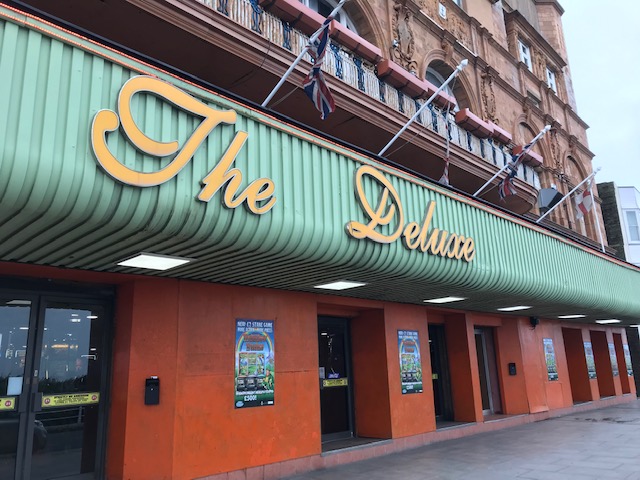
After finishing my coffee, I head out to explore. The Deluxe is a huge, vintage amusement arcade, filled with machines buzzing and bleeping away. Inside, people are mostly gambling, laboriously feeding money into the machines as though on the production line. Further up Old Town amusement arcade is equally vast, yet lacking such a vintage charm. A passageway from the sea leads to George Street, a pretty winding way with boutique shops, bistros and ‘olde-worldy’ pubs (some of which are actually olde-worldy). The pleasant place busies with people out for the day to shop, eat or drink, or all three.

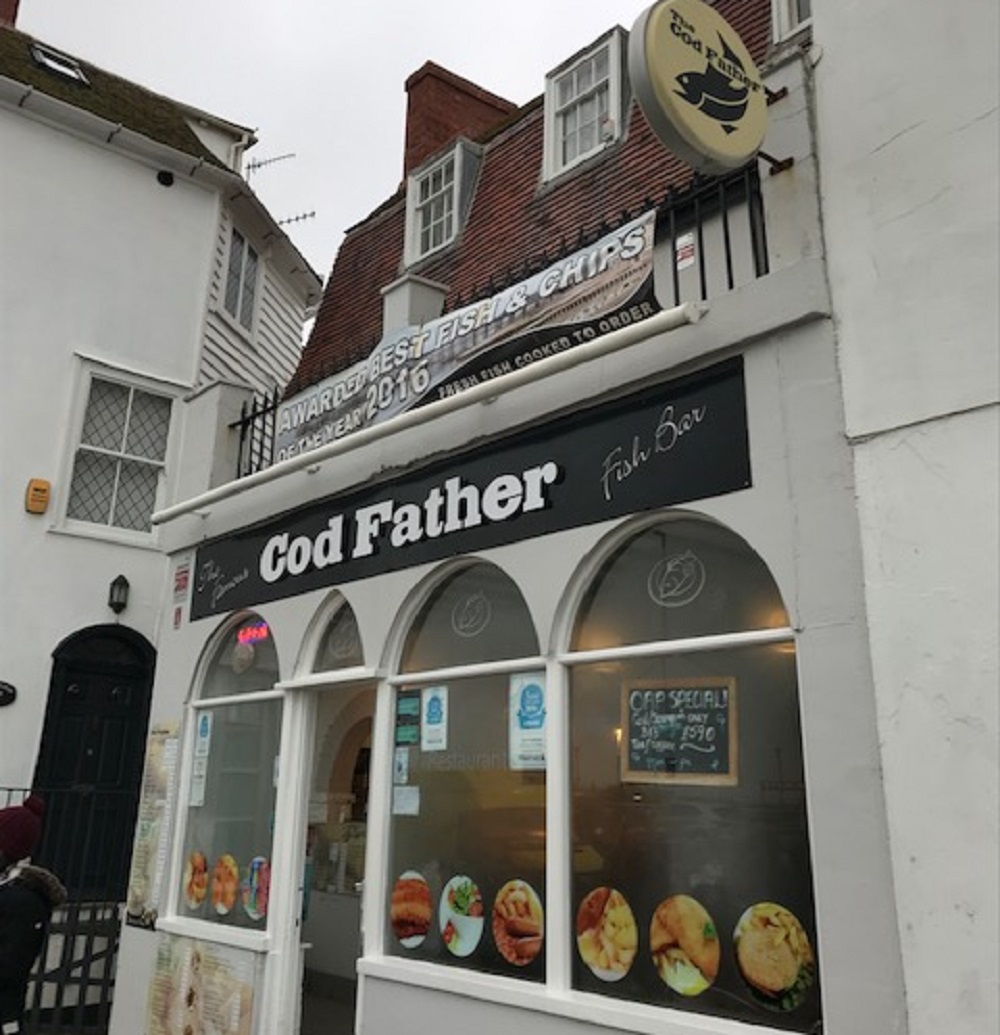
Although there are plenty of places at which to indulge in fish and chips, I choose the Cod Father, because, well, why wouldn’t you? According to a large banner above the shop, it was apparently voted ‘best fish and chips of the year in 2016’. Not only is this accolade now three years old, but it’s not particularly clear who awarded such an honour. A board advertises an OAP Special of cod or scampi with a cup of tea for £5.90. Damn you, youth.

As I sit on a bench and eat my 2016 award-winning chips, the clouds begin to darken above me. The seagulls flock and squall. Rain is on the way. Anticipating a deluge I move on, passing a group of teenagers who smell strongly of skunk weed. I head back down George street and into the Ye Olde Pub for a drink. Decor-wise, it combines genuine history with a modern interpretation in a somewhat jarring mix. Just like many places in Hastings it leans on the piracy theme, although the wi-fi password, Jacksparrow, rather limits any historical credibility to be had.

Speaking of pirates, I am due to stay in Rye that evening. It’s 20 minutes from Hastings and I’m booked in at the Mermaid Inn. This Grade II* listed hostelry dates back to 1156 and was once a favoured haunt of pirate gangs (some of whom no doubt left a positive review on Trip Advisor). Rye is in the district of Rother, which also voted to leave by 58.5% to 41.5% (you can see a pattern emerging here). Before heading there for the night, I pop into the Crowley pub by Hastings station for a final drink. It’s virtually empty, but clearly set to get lively later on. The noise of the band sound-checking can be heard upstairs, with the strumming of guitars and the plodding thud of bass.

The barman chats to a man, presumably in his late 30s or early 40s, with dreadlocks. His elegant dog sits attentive at his feet. The dreadlocked man discusses how expensive life has become, particularly for someone living on their own.
‘It’s just not affordable,’ he says, before changing tact. ‘Like going on holiday; it used to be that you could go camping to Wales and it would be a cheap holiday. Now, you got your petrol to drive to Wales, camping stuff, wood for a fire, it all adds up. It’s cheaper to go to Spain. What’s all that about? How can it be cheaper to go to Spain?”
The barman gives a snort of agreement and then returns to cleaning glasses.
“Madness,” the dreadlock man says, before ducking down to coo his dog. “Madness.”

‘No fishing selling out’

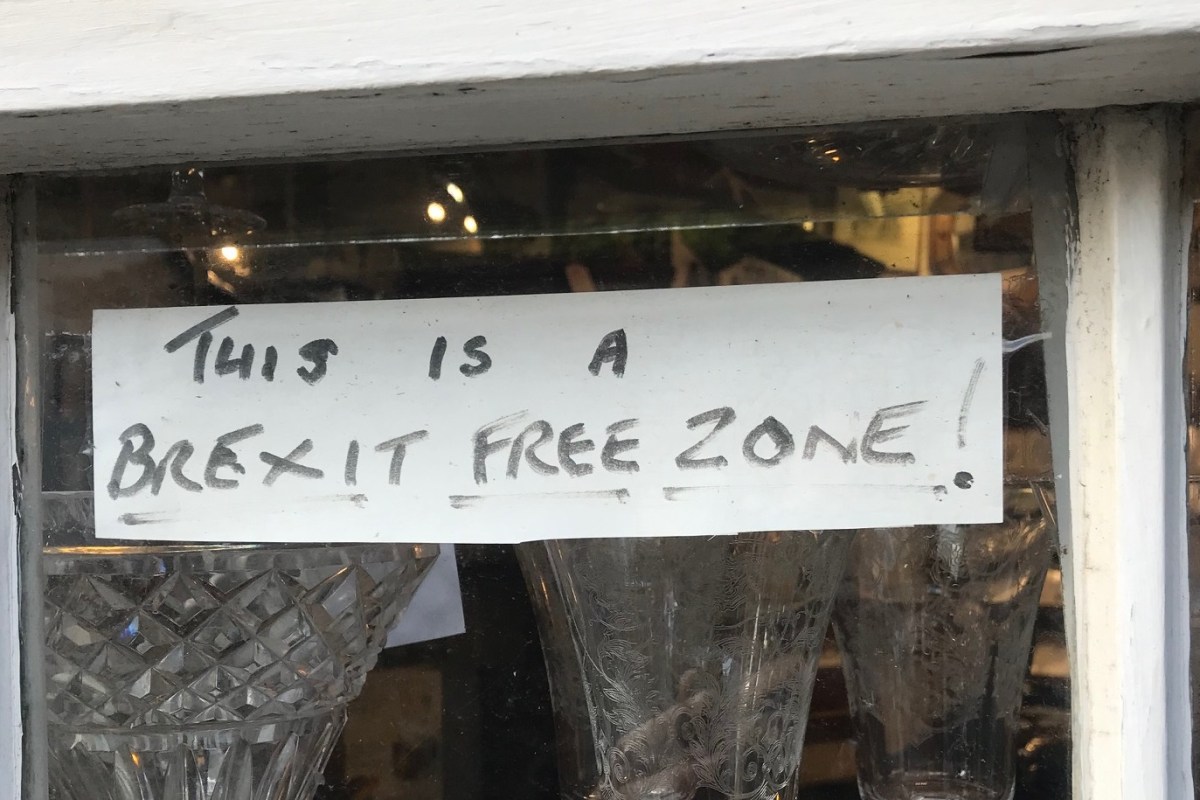
The following morning, I prompt mild panic in the hotel staff by turning up towards the end of the alloted time slot for breakfast and promptly ordering a full English. As I eat and browse the headlines on my phone, the dining room is dismantled around me, as though I am the last (and least aware) passenger on the Titanic. After eating, I exit the hotel and walk towards the station, taking a route up the slight incline of The Mint in order to work off the calorific breakfast. I notice a hand-written sign in the window of an antiques shop. It warns that the shop is a ‘Brexit-free zone’. I’ll take my business elsewhere, then.

There are few strings of words that strike greater fear into the Sunday traveller than ‘rail replacement bus’. It’s the weekend, so must be time to summarily punish anyone ambitious enough to consider an excursion on their two days of allotted leisure time. I clamber on the near empty double-decker sitting outside Rye station, and wait for the driver to finish vaping, before we roll off back towards Hastings. Despite the brisk and energising start to the morning, it now feels suddenly bleak. My mood starts to sink. It reminds of the moment in an episode of sitcom Father Ted when a rejuvenated Father Kevin forgets about his depression for a few delicious moments before boarding a bus and fatefully requesting the driver to put on the radio, only for the Radiohead song Exit Music (For a film) to come on. The world sluices of all colour as the father slumps into his chair, despondent once more.

The bus trundles through the Sussex countryside, only stopping for 10 minutes somewhere random while the driver sends a very important text message. He peers at his phone as though trying to re-programme the Hadron Collider. Each button press is carefully considered until he had finally reaches a coherent memorandum for whatever lucky soul is intended to receive it, and our amiable peregrination can therefore continue. Eventually, we arrive into Ore, a sprawling mass of identikit suburban homes, banking up a hillside. The bus waits in the station, which appears similar to a military checkpoint, but with a One Stop Shop for refreshments. No one gets off, so the bus proceeds onwards to Hastings.

Exiting the bus at Hastings station, I take the same route towards town as the previous day, once more ducking into the Priory Meadow shopping centre. More Radio 106-108 M had set up a Crystal Maze style tube with a fan inside, waiting for someone to grab as many floating bits of paper as possible towards the prospect of winning £1,000. I stop and watch a woman waft at the task like a demented seal, but move on quickly to avoid catching the eye of a More Radio employee roving expectedly with a clipboard for victims.

Despite it being just before midday, more than 10 street drinkers pass me on my walk through town. Clutching cans of super strength lager, they either bellow loudly at each other, or talk quietly to themselves. It’s bitterly cold today, so a couple huddle up for warmth. The reasons why someone ends up on the street are usually complex and difficult to generalise. But Britain, at the time the sixth biggest economy in the world, can and should be reasonably expected to be able to house everyone who lives here.

A heavily tattooed man walks past me, vaping furiously. Another giant man goes the other way talking loudly on the phone, ‘£50!’ he shouts, ‘Why the fuck should I pay that? She’s done fuck all.’ Two traffic wardens follow behind exchanging rolled-eye glances. I move a bit quicker towards the salvation of the beach. The air feels clean and clear as I hit the promenade. Here, the pebble beach is punctuated by orange-yellow sand. Dogs chase tennis balls thrown by their humans.

Hastings pier is closed at the time, but looks nice through the locked gates. It might seem strange to come to a seaside town in the middle of winter. From living in Brighton, however, I know that you only see the reality of such a place when it is out of season. You understand more about a place’s character when the screaming stops. The sea is calmer today and the sky lighter. At Warrior Square, old Regency buildings form a ring around the space with a good sense of majesty. But the clouds soon darken again and it starts to rain.

In the drizzle I head back into town, passing The Carlisle pub, where in February 2016 a fight between bikers, one of whom was understood to be in the Hells Angels, left one man with badly damaged sight in both eyes. I soon find myself once more in the Old Town, including the pretty West Hill and East Hill residential areas. You can catch the East Hill lift, a funicular that takes you up to the Hastings Country Park nature reserve at the top. You get a fantastic view, able to see a panorama of the beachfront up to the surrounding hills.

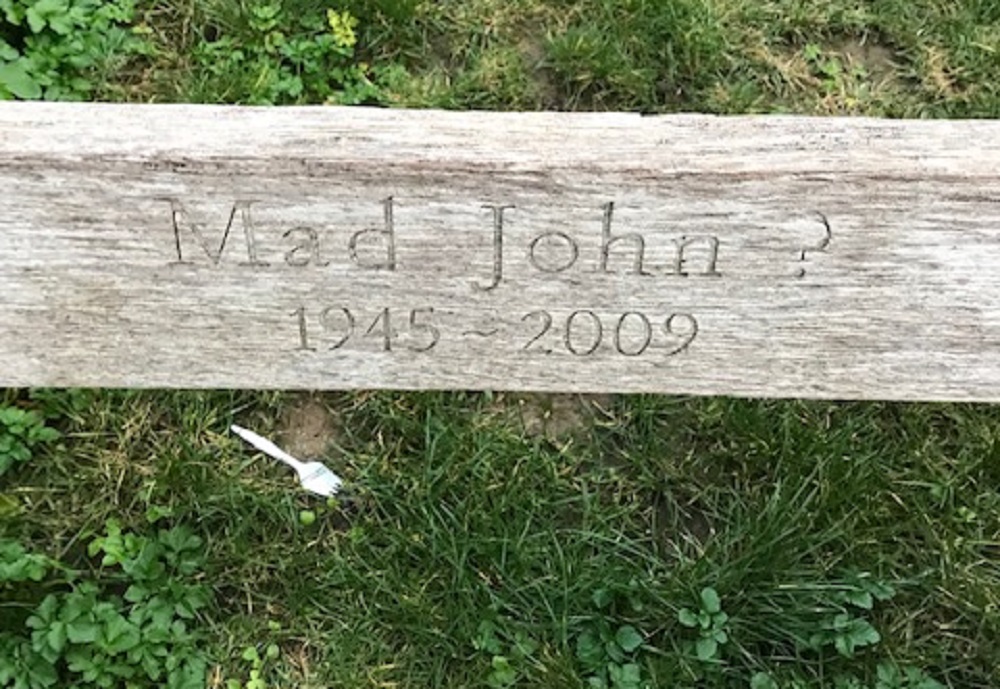
Instead of getting the train back down again, I walk the stepped path back towards town. A bench at the top commemorates someone called ‘Mad John’, who lived from 1945 to 2009. Half way down another bench honour Jim & Trixie Butchers, who were apparently a ‘wonderful Hastings couple’. And finally, at the bottom, a bench commemorates ‘Olly 9 toes Carey’, who expired in October 2005. I pledge to myself that one day I will be celebrated in a cryptic message on a park bench here: ‘Andrew Laughlin – best fish & chips in Hastings 2016’.

Exiting the steps, I stop to enjoy Tamarisk viewing point. Here, you can see outwards onto the fishing beach. The huts line up in squat rows, all built of distinctive wood painted black and weathered elegantly by the sea. On the beach fishing boats are pulled ashore for the day. Around them is a tangle of equipment, stacked and packed up ready for tomorrow’s catch.

Walking down the winding passageways, known in Sussex as twittens, brings a genuine smell of history. It’s the occasional blast of an industrial past, like the choking smell of coal unlit on an open fire. Emerging out onto the front leads you to the Rock-A-Nore road and onto the forecourt leading to the fishing beach. Walking amongst the fishing buildings continues the feeling of stepping into the past. Stands are set up to sell plaice, flounder, huss, mackerel, whiting and dabs (the fish, not the celebratory move).

Some of the buildings have pictures attached to them depicting scenes from Hastings’ fishing past. Most are of gnarled men with beards standing awkwardly for the photo. Not everything here looks back to the past, however. Nestled amongst the buildings is the Jerwood gallery, a sleek and modern building clad in black tile to fit in seamlessly with the fishing buildings. The current exhibit is Nigel Cooke, the British contemporary artist known for magical re-interpretations of real landmarks and places. His Hastings exhibit understandably draws inspiration from the coast.

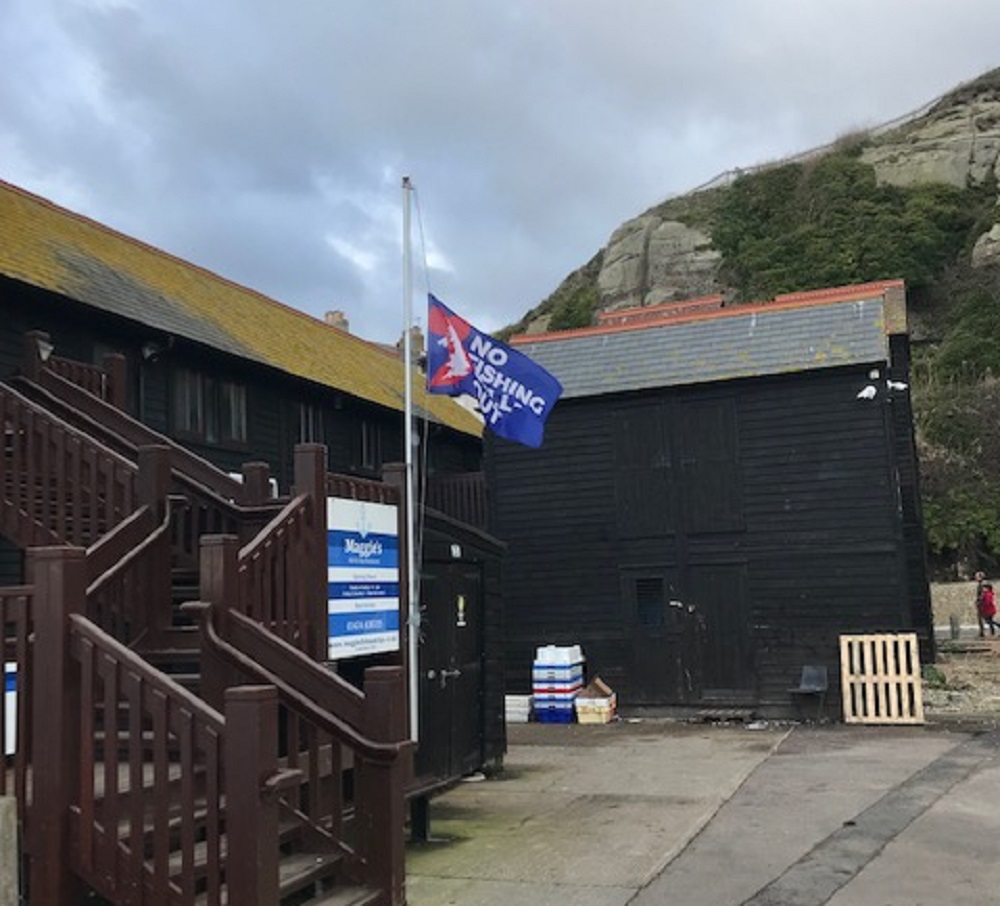
Further up, outside of Maggie’s fish and chip restaurant, a flag flies proclaiming, ‘No fishing selling out’, over a map of Great Britain. The slogan was created by the National Federation of Fisherman’s Organisations, a campaigning group that could sorely do with hiring a copywriter. Fishing continues to be one of the key battle-lines of Brexit, with the fishing industry highly critical of the EU due to the Common Fisheries Policy. They argue that more than 50% of fish taken from around the UK was by non-British boats. Brexit, they argue, would redress that unfair imbalance.

While Brighton and Skegness allude to a fishing heritage that isn’t really there, fishing is a central part of the Hastings DNA. Boats have been bringing their catch into Hastings since the town was founded in the ninth century. In the Hastings Fishermen’s Museum on Rock-a-Nore road, one of the first exhibits depicts the Breeds family, generations of Hastings men who were fishermen and served in the Royal Navy. This includes Thomas Breeds, 1887 to 1943, who has the rather unfortunate middle name of ‘Titt’. There’s a wonderful language to fishing; I look at a model of a ‘Hastings Lugger, elliptical stern with Otter trawl.’ Something clearly so workmanlike has been made to sound so exotic and interesting.

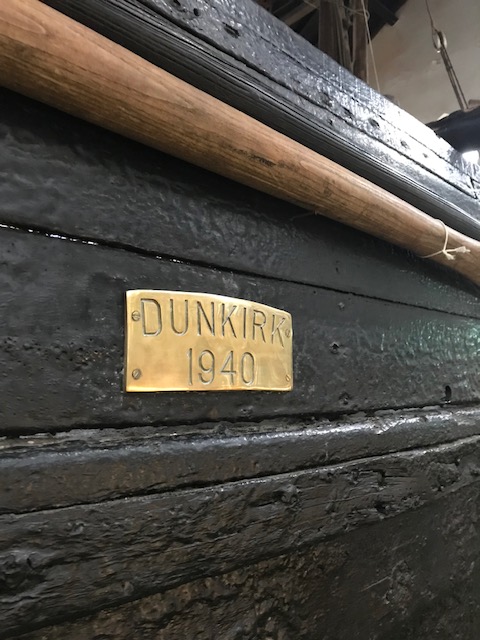
Nearby is a portrait of George Rich, a local fishmonger who appeared to have been quite the celebrity and used to supply many of the local fish and chip shops. Apparently, he never drank alcohol or smoked, but ‘did love the ladies and they seemed to love him back’. Next to him is a picture of a gaggle of drunk fisherman at a wedding, ties half undone and some slumped on each other. In the middle of the museum is the RX 278 Enterprise, a lugger vessel that responded to the call to support troops in Dunkirk during World War II. It went to Dover but was not ultimately dispatched to help pick up the almost 340,000 British and French troops escaping the French beaches from the advancing Nazis.

Just like 1066, the Dunkirk-esque spirit has been sighted as a sign that, ‘we’ve gone through worse before, so we can get through Brexit’. Certainly, some did vote for Brexit to bring back industries such as fishing to former glories. You saw the same with Donald Trump’s support for rust-belt industries, such as coal and steel, in America. However, according to a report from Hastings council, fishing is actually one of many industries actually at threat if the UK were to crash out of the European Union without a deal.

Even those in the industry were expressing concern. Speaking to LBC radio in January 2019, Graeme Sutherland, the director of Whitelink Seafoods, said: “As a company, we export into Europe at a rate of 85-90% of what we produce here. We are working on a next-day delivery into France for distribution into Europe. So if we are delayed in any way in clearing customs, in effect, we are going to lose 24 hours on delivery. We need frictionless borders. It has to be that for our industry to survive.”

Fishing isn’t alone; Hastings council is also worried about the town’s large tourism industry, along with its care homes serving the elderly and its language school, understood to be worth £30m to the local economy. All are potentially at risk if the most negative of Brexit projections were to come true. I leave the fishing museum and head off for a pint. In the Albion pub I meet a couple. In amongst the chaos of barking dogs, rampaging children and plates of Sunday lunch going out of the kitchen, we chat about this and that. They used to live in Brighton and work in London, but gave it up to come to Hastings for a more balanced life. They say that they love the place and happily eulogise how Hastings feels healthier and friendlier and more genuine than anywhere they have previously lived.

They seem nice. He tucks into rabbit pie, she shares some of her fierce political views. They are both very friendly. Then talk turns to Brexit. I don’t ask – it’s rude to ask such a thing as is most terribly British – but you get the feeling that they are not among those that voted Leave in Hastings. They decry the idiocy of the vote and the maddening aftermath of how it has been handled.

“Part of me just wants them to get what they want,” he says. “No deal, we crash out. Everything collapses. Then they can’t complain. They got what they wanted.”
“And the army would be on the streets,” she replies, exasperated.

Next stop on our journey, Bristol

The End of the Line: Skegness

The End of the Line is a 10-part travelogue journey to some of the highest Remain and Leave areas in the United Kingdom’s 2016 Referendum on EU membership. It was written over two years from 2018 to 2020, before Coronavirus made Brexit seem like a spot of man flu.  

East Lindsay voted 70.7% Leave in the 2016 EU Referendum

Originally written in October 2018

On a boring train journey from London to Grantham, where we were due to change for a connection to Skegness, my girlfriend (still in post at the time) and I watch a terrible film. We half listen as two young men, all gangly limbs and charity shop chic clothing, planned their new events business. They were called Miles and Casper, but also had a business partner called Xander. Casper bristled with irritation as the important phone call he had left to make on a train kept cutting out, because, well, he was on a train. Presumably ‘for a thing’, they dissected the latest radio listening figures, expressing bemusement at how many people listened to popular radio networks, such as Heart FM.

We arrive into Grantham station conveniently as the connection we were supposed to get to Skegness rolls out of the station. An almost daily calamity somewhere on Britain’s modern rail network orbits a galaxy of guaranteed smaller inconveniences. A missed connection, an overly packed carriage, nowhere to sit, flooded toilets, and carriages more worn-in than a regional commuter service in Siberia. There’s always either a robotic apology, a weary apology, or, sod it, no apology at all. Overcrowded, overloaded, miserable; but at least our rail fares are reliably expensive.

On the platform at Grantham station two old crones eyed our still creaking train with docile expressions. They smiled at the new arrivals, revealing a mini Stonehenge of brown teeth inside their half-gaping mouths. One was under a blanket, the other seemingly melting slowly into the bench where they sat. It’s unclear whether they are waiting for a train, or just waiting.

With an hour to kill until the next connection, we hole up in the waiting room. A pretty stain-glass window depicts the glory days of steam trains in a rather stirring image. Around the edges are various destinations: Edinburgh, London, Durham, Doncaster. Coloured light shines through the windows, illuminating a vending machine in an ethereal light. A young man in a tracksuit ranges around it, wondering why his selected Monster energy was staying so steadfast in its original position.

Outside, trains whizz by with a ‘heee-hawnk’. The red and white livery of LNER blurs past, followed by the orange and blue of East Midlands. A towering woman enters the waiting room, peroxide blonde curls mounded on her head like a Mr Whippy ice cream. Leopard skin leggings cling to her for dear life. And then emerges a ginormous pink suitcase, like a veritable rolling wardrobe, pushed by her wiry husband, out of breath in a grey sports tracksuit.

We sit down on the scooped plastic of the waiting room chairs and idly take in the atmosphere. Two young women enter, all dressed for a night out, despite it being 3.30pm. They sit opposite to us and each retrieve a can of Bacardi Breezer alcopop from a bag.
‘Can we drink these here?’ one asks the other.
They shrug, crack them open and tuck in. The next train to Nottingham rolls in on the platform behind us. The women get up.
‘Easy to drink this,’ one says to the other, ‘Like fizzy pop.’

We watch as people got on and off the train. Two other women enjoy one last vape before heading off to Nottingham. They’re also dressed to the nines, cleavage raised up proud like IKEA shelving. They wear tight jeans with rips in them, as appears to be trendy again. Through slashed holes peek ridged rolls, like orange bread dough baking in a denim mould. They finish vaping and board the train for the 30 minutes-ish journey to Nottingham.

A man wearing a baseball cap, a giant spidery tattoo on his neck and drinking a pint can of energy drink, barrells down the platform trying to keep up with his girlfriend. Another man walks into the waiting room wearing a curious combo of a bobble hat and shorts. ‘Is it warm or is it hot? I just can’t decide’, he didn’t say. He squints up at the screen displaying train information. After looking away, the squint remains, suggesting that is actually his normal expression. A heavy-set man enters the room and body slams himself down heavily on a seat. He talks on the phone loudly, but it is impossible to understand anything apart from periodic expletives. Outside, a boy rides his bike down the platform. It starts to drizzle.

Eventually, the crawling passage of time does its work and the 2.27pm East Midlands train to Skegness rolls into the station. It was already half full with people coming from Nottingham. After everyone gets on and settles into their seats, the train creaks slowly out of Grantham and heads out through the usual industrial sprawl that tends to congregate around railway stations. Like unruly teenagers, dirty warehouses loiter in the area, while giant mega-stores are ringed by sprawling car parks. From a distance we see St Wulframs church, with its pretty, towering Medieval spire.

We first arrive into the market town of Sleaford. The attractively station’s tile mosaics add a splash of colour to the Yorkshire stone buildings. A woman boards the train. She walks on match stick legs, her face a blotchy nicotine colour. She appears twitchy, eyes darting hither and yon. She’s followed by an older woman, laden down with bags. She sits on a chair with the effort of someone who has just climbed Mount Everest. The train rolls out of the station as the drizzle thickens.

Onwards, through Heckington: an even prettier station, with rich red brick buildings, lead roofs and draping greenery. And then, the time has come – we arrive into Boston. This was the place with the highest percentage of the local population to vote for the Leave side in the EU Referendum, at 75.6%. The writing had been on the wall. According to the 2011 Census, Boston had the highest proportion of immigrants from Eastern Europe than anywhere else in England and Wales. Just over 10% of the town’s population of 65,000 hailed from old Eastern bloc countries, mostly Poland, earning Boston the unimaginative nickname, ‘little Poland’.

A Policy Exchange report from January 2016 described Boston as the least integrated place in England and Wales. In the research, Boston ranked lowest of all 160 towns and cities assessed based on how minorities were integrated on identity and structure, and how well they mixed with other ethnic groups in the town. An enclave of Tsykie and pierogi, it seemed, surrounded by a sea of Lincoln Lager and haslet pies. While Boston may have been dubbed ‘little Poland’, most of its population, in part at least, seemingly wished it wasn’t.

Boston station isn’t draped in St. George’s flags and burnished with ‘foreigners out’ signs. It’s just a station. Vending machine filled with overpriced snacks, staff looking bored, trains parading listlessly past and the only splash of colour being a large advert for a local Thai restaurant. A scrapheap sits by the trainlines on the way in, but it’s just a scrapheap. Not a smart-arse metaphor.

Rolling out of Boston station, the train passes by the river Whitham. A man eyes me suspiciously from a few seats ahead as I made some notes. I discreetly put my notebook away. New build bungalows and cookie-cutter homes pass by the window in a blur of mundane mediocrity. We arrive at Wanfleet and a barrelous man with high-waist trousers gets off. The male passenger down the carriage still fixes me with a stare. I try not to think how much he looks like a Brexit voter.

At just before 4pm, we arrive into Skegness station. It had stopped drizzling and there was even a hint of sun peeking through the grey clouds. We gather our things and head for the train door, careful to go the opposite way to the Brexit voter. The man, I mean, the man. As we exit the train, a gaggle of drunken women of varying ages chant, ‘oo are ya, oo are ya’, at no one in particular.

Skegness. Or, as it’s also variously known; Skeg, Skeggy, Costa Del Skeg, or possibly most optimistically, Skegvegas. This seaside town sits in the East Lindsey district of the Lincolnshire coast. It had a population of around 20,000 at the time of our visit in September 2018, many of whom worked in the seasonal tourism industry. The name Skegness may derive from the word Skegg in Norse language, dating back to the Danish period of settlement in Britain. Skegg meant ‘bearded one’, possibly referring to the beard-shaped headland on the banks of the coast. However, this could also be one of those historical ‘facts’ that is, in fact, total bollocks.

Outside the station is the Jolly Fisherman, a symbol of Skegness. At the time, the rotund fella was ringed by bright orange workman’s tape. It was unclear what, if any, work was actually being done. Skegness did start life as a fishing village, and it would be easy draw comparisons with disputes over fishing quotas that, for some, played a role in the EU Referendum. However, the Jolly Fisherman has little to do with actual fishing.

The development of Skegness as a seaside resort started in the early 1870s, led by the Earl of Scarborough. This culminated in the railway line opening in July 1873, effectively putting the small town on the tourism map. In 1908, Great Northern Railway wanted to turn Skegness into a premier seaside get-away. It needed an eye-catching advertising campaign and so turned to the work of an obscure painter called John Hassell. Hassell depicted the rotund Jolly Fisherman skipping with gay abandon down Skegness beach in a classic railway tourism painting. The slogan accompanying it noted, ‘Skegness is SO bracing’.

OK, the bitter North Sea wind is face-burningly cold, but do you really want to highlight that? It would be like Manchester saying on a poster, ‘It rains all the time’, or London going with, ‘watch out for your valuables’. The slogan stuck, though, and became somewhat of a badge of honour for the town. The poster worked, too. In 1913, 750,000 visitors flocked to Skegness. John Hassell apparently died penniless if reports are to be believed.

Tuck in, kids!

Oh, to be by the seaside

Despite growing up in the North of England, this was actually my first visit to Skegness. The place was instantly familiar to me, though. I used to holiday frequently further up this part of the English coast, including to Robin Hoods Bay in the North York Moors, along with Whitby and Scarborough. I have fond-ish memories of spending time in a Haven holiday camp in Primrose Valley when I was young. My mum, sister and I stayed in a static caravan. I can recall wearing shorts and a t-shirt, going to the camp disco with my mum and sitting with a styrofoam cup of slimy prawns listening to ‘So Macho’ by Sinitta. Ah, good times.

Haven was not the first British holiday camp. That was created in Ingoldmells, a parish north of Skegness, by Sir William Heygate Edumund Colborne Butlin, more widely known as Billy Butlin. Butlin was a South Africa-born entrepreneur who had escaped a troubled early life to build a tourism empire in Britain. He had originally opened a static fairground in Skegness in 1927. He was making a good living, but realised that the real cash was to be made by also offering accommodation. He opened Butlins Skegness in 1936, followed by his second site in Clacton in 1938. During the Second World War Butlins was occupied by the Royal Navy, renamed as HMS Royal Arthur, and used for training. There were up to 4,500 personnel barracked there and it was bombed by the Germans in 1942.

Butlins enjoyed huge success in the immediate post-War period, but fortunes changed in the 1970s as the rise of cheap package holidays to Spain decimated the UK seaside towns. Alongside being affordable, Costa Del Sun also wasn’t face-meltingly cold for most of the year. Butlins Skegness remains in operation to this day, but has diversified to music events and festivals to broaden its appeal. As of 2018, it attracted a reported 4m visitors a year and generates millions for the local economy.

Skegness has been twinned with the chocolate box German town of Bad Gandershien since 1979. Yet, Skegness’s local council in 2018 was majority UKIP. At the time of our visit, it had nine UK Independence Party councillors to eight Conservatives, two Labour and one Independent. Vote Leave blanketed Skegness around the referendum. Posters littered the roads with big promises about ‘taking our country back’. It worked; East Lindsey voted to leave the European Union by 70.7%, just a touch behind neighbouring Boston.

On Sunday, 26 June 2016, three days after the vote, at around 6am Matthew Lewis White strung a makeshift border across Sea View road in Skegness made of wheelie bins, bits of fencing and a pushchair. The man, in his early 20s who was allegedly still intoxicated from the night before, took it upon himself to enforce the not yet agreed border to our European neighbours. When Adrian Carrington-Hunt approached the unofficial barricade at 6.55am, White demanded to see his passport in order to let him pass.

Carrington-Hunt insisted that he didn’t have a passport with him (or, possibly, pointed out that he didn’t actually need one to go down a road in Skegness), but White was insistent. After Carrington-Hunt attempted to break the wheelie-bin barrier down, White head-butted him, exulting: “Now what are you going to do?” After pleading guilty White was given 12 months conditional discharge and ordered to pay £100 in compensation.

We exit the station and walk towards town. High Street is a narrow, near pedestrianised street with faded shops boxing you in. A few branded chains have set up in Skegness but mostly you’ll see local shops with names like Flippers, Spall’s and Peter’s. Vape shops sit next to fish and chip bars. Sweet smells combine together in an intoxicating mix. Many people rove around in mobility scooters, wheelchairs or have some kind of mobility aid. Some look way too young to be in such a situation. As we walk down the High Street news of the latest Brexit debacle sounds out on a radio. No one seems bothered.

Why didn’t I book the Quorn hotel?

Onwards we head to our hotel, located on the main seaside strip. We head down the promenade past the bingo calling arcades and what must be one of the biggest Yates’s Wine Bars in Britain. We pass people enjoying the afternoon Skegness fun. Tribe-like families bounce from attraction to attraction, with mothers and fathers herding children like angry shepherds. An irate father tries to calm his daughter’s volcanic meltdown by lifting her up by her pony tail. All around rings the orchestra of the seaside; the bleep of machines, the lyrical chime of announcements, the thunder of music systems competing against each other, and groups of people shouting their approval for everything and nothing. And in the far distance, you can just about make out the hushed tones of the North Sea lapping against the sandy Skegness beach.

The Grand Hotel is a dusky peach and maroon guesthouse nestled in a row of seaside hotels. Close by is the Quorn Hotel, presumably hoping to hook in the vegetarian crowd. I rebuke myself for not booking just to see if the meat substitute theme continues within. As with most regional hotels in England, The Grand Hotel has a whiff of Fawlty Towers about it. There’s an atmosphere; an uptight tension so delicately restrained. Andreas checks us in. It’s a brisk process enabled by booking online in advance, as is the norm these days. We head up to the room, eyeing the Stannah Stairlift runners on every staircase as we go.

After spending a few moments checking out a basic but functional room, we venture back out to explore Skegness. We head straight to an arcade, with the blast of noise almost as bracing as the North Sea air outside. Inside, it’s mostly gambling machines; slots, bandits, electronic casino terminals. Many are themed to the Deal or No Deal Channel 4 game show. Noel Edmund’s well-worn face beams out, always on the phone to the banker, goading me to make a Brexit analogy. Be gone you bearded harpy.

After some searching we find a shooting game themed to the rather dreadful Terminator Salvation movie (the one in which Christian Bale allegedly had a meltdown that was leaked on the internet. Seriously, Google it). We grab plastic assault rifles and posture like cocksure twats on a stag do. While spending a rather disappointingly short time battling the tyranny of Skynet, bafflingly we attract a small crowd. A family group hover around watching as we try in vain to have decent reaction speeds. When the resistance truly was futile, we turn for the inevitable small talk.

‘Can we have a picture?’ the dad of the family says. He motions to my girlfriend’s Aircast boot that was doing a pretty poor job of correcting a problem with her ankle.
‘He’s got one, too,’ the dad adds, motioning to what we assumed was his brother, who was in a mobility scooter but was awkwardly getting up to show off his own Aircast boot.
‘Twins,’ the dad says, beaming. We smile. My girlfriend poses for the photo. We exchange pleasantries and shuffle off.
Walking Dead, Jurassic Park, Transformers; all the games follow a similar pattern of shooting the hell out of something as fast as possible until the game decides that, like a weary landlord facing the last regular on a Friday night, ’you’ve had enough, son’. It was fun, but also a very fast way to blitz through a tenner.

Around the corner is the Tower Cinema, a building rather loosely described as ‘art deco’ and showing various blockbuster films. A giant banner constantly beams out adverts for what’s on. At the time, it says, ‘Come to Skeggy and see ama Mia..’, crucially mangling the actual name of the film. A couple, both in mobility scooters, zip across the road and into the Marine Boat House Bar, a functional corner pub that had clearly seen some action over the years. Downstairs a sprawling bar has the feel of being on a ferry to France. Instead, we head upstairs for a view over the road.

The place is mildly busy, with some drinking, but most eating. A hulking man in sweat pants, sandals and socks hovers over a table like a silverback gorilla. He appears pensive, concerned, awaiting his partner’s return with a plate of carvery that it would be an understatement to describe as heaped. He beams at the mound of roast potatoes, Yorkshire puddings, meat and a scattering of vegetables. It sits on the plate like a food hillock, soon to be dismantled like a thousand years of wind erosion in fast forward. This was truly an impressive sight to behold as we sat and drank our fizzy lager.

It was time for Churchills. If you Googled ‘Brexit pub’, Churchills would no doubt pop-up. There’s a parade of St Georges flags outside and a statue of Winston almost as big as the one on Parliament Square in London. (In reality, it’s arguable whether Sir Winston would have approved of Brexit. A united Europe was one of his greatest ambitions, and on September 19, 1946, he even publicly advocated for a United States of Europe as a way to ensure the horror of World War II was never repeated). Churchills is the kind of pub that you creep into, expecting an O.K. Coral intake of breath. As is often the case, however, the reality is very different.

In fact, Churchills is a standard British pub. It serves beer, it serves wine, it serves spirits, and it serves food. It isn’t covered in pretentious dove grey paint with filament light bulbs. Aside patriotic accoutrement draped wherever possible, Churchill’s idea of decoration is dusty fairy lights in the shape of wine grapes. Everything isn’t preceded with the word artisan as an excuse to add a 30% premium to the price. There’s a shirt and shoes dress code on Saturday nights. The bar staff uniforms oddly look like they were borrowed from a Beijing bordello. Oh, and screens; screens everywhere showing sport. Tiny little tellies installed on the beer pumps so you can watch while you wait is clearly a touch of genius.

Churchills isn’t intimidating in the slightest and you’ll only find trouble if you seek it out. We sit on that grey Saturday afternoon and enjoy a drink, while watching Brighton lose 2-1 to Tottenham Hotspur on one television, and the undercard of Anthony Joshua’s heavyweight championship fight against Aleksander Povetkin on another. One television threatens to go into a stand-by, prompting protests from the locals until the non-plussed barmaid finds the remote control and puts them out of their misery. In another room, a group of people play oversized Jenga on a table. The chunky bricks topple over to mild cheers.

We get another drink and watch a truly dire boxing match on the Joshua Wembley bout. Two men appear to hug each other for an entire 36 minutes, yet neither seems to have an emotional revelation of some sort. Two ladies arrive in the pub dressed up for a night out. From some polite eavesdropping it appears they are a mother-daughter combo out on the town looking for love. It’s like the plot of a movie, but it’s probably best not to think of the genre. They sit at the bar and order mixing bowls of gin and tonic. As the pub fills with people arriving to get prime spots for the boxing, we take it as our cue to move on.

Googling ‘best restaurants in Skegness’ brings up a myriad of steak houses, burger joints and fish & chip restaurants. However, we opt for Saffron, the highest-rated Indian restaurant in Skegness at the time. At 8pm it’s absolutely heaving. A table opens up but it’s already booked. We slink away like rejected suitors. Thankfully, the second highest-rated Indian restaurant, Ghandi’s, is just a few minutes’ walk. It’s packed, too. A group of men we recognised from earlier in Churchills are lining their stomachs. They talk loudly and the staff politely but quickly take their orders. We sit and wait in what is loosely billed as a bar area. Leather banquettes surround a heavily carpeted floor. The walls are lacquered in black. The usual art you’d expect from an Indian restaurant bedecks the walls.

Staff buzz in and out attending to the tables. On one of the banquettes sprawls the young daughter presumably of someone who works there. She’s in her pyjamas, watching YouTube videos on a phone held about an inch from her face. We hear occasional buzzes and bleeps. So intently interested in the phone is she that others waiting wonder what she is watching. They observe her with head-tilted smiles, but the girl isn’t interested in the slightest, nor does she bother to move when new people arrive. They instead have to shuffle in and sit in a space getting ever smaller. After consuming what was clearly the second best Indian meal in Skegness, the young girl was still there in the same place watching videos on her phone at past 10pm when we left.

We head back to the Marine Boat House Bar to watch what was left of the fight. In just a handful of stadium bouts, more than 400,000 people have gone to watch Anthony Oluwafemi Joshua fight. He has become a phenomenon in a sport that can still heavily polarise opinion. His opponent that night, Povetkin, is a Russian who appeared to have some very powerful backers. But this was no Drago vs Stallone. The Russian was too polite and ordinary for that. And besides, Joshua didn’t need a story to sell a fight. He is the story.

On the upper part of Joshua’s right arm is tattooed a map of Africa, the nation of Nigeria pulled out in honour of his mother, Yeta. Joshua was born in the UK, but lived in Nigeria until he was 12, when he moved back to live in Watford. He could even have represented Nigeria at the 2008 Olympics had he not been reportedly turned down by the country’s selectors. Instead, he would go on to win Super Heavyweight Gold at the London 2012 Olympics, marked by the lion tattoo on his back. He’s now a multi-belt world champion, a multi-millionaire and a household name.

The male-heavy customer base of the bar show periodic interest in the fight. In-between trips to the toilets to snort cocaine, they shout and bay at the TV screens; ‘Kill ‘im’ and ‘knock im aht’ (Joshua eventually obliges in the seventh round – knocking Povetkin out, that is). What they did not appear to do is pay any interest to the tribes of females, dressed beyond the nines, ever hopeful that someone, anyone, will take an interest.

Even in the murky gloom of the bar, the glow of fake tan was at radioactive levels. The women wafted gusts of perfume as strong as napalm, and it mixed with the men’s vinegary sweat into an unholy fog. At some point, you’d imagine, these tribes would collide, as though on some warrior battleground, muscle-bound limbs and hair extensions torn asunder. We had no intention of being there when it happened, so we retire to Fawlty Towers for sleep.

A golden beach extends

When we woke at 8am, it was already drizzling. Hotels in the north of England tend to kick out early, and we needed to be gone by 10 o’clock. It is always intriguing to see the other guests at a hotel at breakfast. It’s a bit like the morning after a house party, at which things went on that no one wants to acknowledge. Best just to keep your head down and mouth shut until it’s all over.

A buffet breakfast unfurls before us. The scrambled eggs appeared to have been around since last week, but everything else was fine enough. I get coffee and regret it. Across from our table sits a hulking man with a bald head, wearing a t-shirt with ‘unleash the monster’ emblazoned on it. He devours a plate of breakfast goods, as his female companion stares into the distance. From what you could divine, he appeared to be in the thralls of a fitness mid-life crises that some men tend to experience. They go from smoking, drinking and doing drugs to at some point deciding to get fit. It starts with the occasional jog and then, in an alarmingly short period of time, ‘yes, why shouldn’t I tackle a triathlon?’ Then in an equally short period of time, a major injury, because, well, you know.

Behind the mini hulk sit a group of four men, dressed in vintage Mod/punk outfits. The bands on their wrists indicate that they were in town for a Ska weekender. We ate our breakfast and the room gradually thinned out until it was just us and the punks. Skegness is a regular haunt for alternative music lovers, often travelling up from the Midlands. In a few weeks’ time from our visit, Butlins was due to host The Great British Alternative Music Festival 2018 (ticking all the boxes with that name), with a line-up including The Boomtown Rats, Bad Manners and Sham 69.

That’s a stark contrast to most other live music in Skegness, which tend to host an elaborate, multi-venue version of Stars in their Eyes. Shirley Bassey, Luther Vandross, Whitney Houston; they all have and haven’t played in the town. We look up and see that we were now alone in the breakfast room, with just a bored-looking waitress waiting for us to go.

Checking out I share some small talk with Andreas, a German from just outside Hamburg, who opened the Grand Hotel in 2014 and now runs it with his wife. He explains that running the hotel is so busy that he didn’t have any time recently to get back to Germany for his father’s funeral. It was the same when his mother died shortly after he opened the place. He tells me that soon he will close the hotel for the winter season, when the wind gets so cold off the North Sea that it costs him a fortune to heat the place.

We depart the hotel and wince at the icy morning air. The drizzle hits our faces in lightly stinging drops. There were no trains out of Skegness on that Sunday until 2.10pm. Just the previous week the timetable had been slashed down to the bare bones. Everyone was having such a good time that they wouldn’t want to leave, we presume. We head out to explore the town. There’s a unique bleakness to an English seaside town on a cold, rainy morning. Equally, it’s not without its charms, particularly when you have time to kill.

Across from the hotel is the Arnold Palmer Putting Course. It was unclear whether it had an official endorsement from the seven-time golf Major winner, but he would no doubt have approved of people honing their skills by getting a ball under a fibre glass rocket. We walk onwards away from town and then pause at an intriguing medieval castle. A knight in a suit of armour stands proudly atop the battle ramparts. Next to him flutters the flag of Lincolnshire – a yellow cross mirrored the St Georges, with green and blue quarters representing the land and sea respectively. In the middle a yellow fleur-de-lis represented the city of Lincoln.

On closer inspection, this fortified structure in fact turned out to be a pub. Known as Suncastle, this alehouse boasts the enticing prospect of ‘castle themed rooms’ available for parties of up to 500 people. As it was too early to drink the £2-a-pint Carlsberg beer on offer, we move on. A bowling green is behind the pub and some old boys are already playing an early game. We stop for a moment and watch, until the bracing cold becomes too bracing to remain stationary.

To keep warm we head for a walk behind the bowling green and alongside a river. Greeting us is a sizeable mound of dog excrement at the entrance. Undeterred, we take a walk down the path as the water slowly flows alongside, a glistening oily slick on its surface, punctuated by the occasional carrier bag or piece of litter. You can take a boat down here in the summer, when the bright sunshine is probably somewhat kinder on the surroundings than a cold, wet and grey autumnal morning.

Down a sweeping curve of the boating stream, looking out onto the sea from the other side, are beach huts. As it was out of season, they’re mostly boarded up at the time. The sky hangs in a gloomy grey as we head onto the pier. These old wooden board piers are always a treat. We walk to the far end and look out to sea. The wind farms on the horizon are now a familiar part of British coastal economies. This moment feels satisfying; bracing, but satisfying.

This golden beach, holder of a Blue Flag since 2011, extends either side of us. The sand is thick, clean and welcoming. Peer over and you could just about make out the lovely Gibralter Point Nature Reserve on the northern limit of the Wash. In 2017, parts of the Skegness foreshore gained ‘registered park and garden status’, effectively making the area Grade II listed. Skegness has so much going for it.

We head back past the scattering of rather sad looking stalls at the base of the pier, trying not to make eye contact for fear of a guilt purchase. A muddy looking pool promises some kind of fun for all the family (and presumably some kind of infection). A speaker belts out a pop-dance number that’s bracing for all the wrong reasons. Soon, we are back in town by the Clock Tower. Across from it is a rock shop. A sign proudly announces that this is British Rock, with a picture of a British Bulldog in varying shades of sugary pink and yellow. None of your foreign muck shall rot our British teeth.

A woman with a respirator in a specially-designed back pack inspects the produce. She’s joined by a pair of teenage parents, all dressed in sweat pants and sportswear, their child chomping at the bit to tumble out of the pram. Then a wiry drug addict joins the party, eyeing the sugary treats with suspicion. Instead of joining them, we head for a cup of tea. After refreshments, we visit Hildred’s shopping arcade. Opened in 1988, it appears to have hardly changed in thirty years. Shoppers flit between the stores selling jewellery, gift items and general knick-knacks.

A noticeboard at the far end of the arcade is filled with little colourful messages. One advertises an event entitled; ‘Relive the past, 1940s Remembered’. It promises World War Dress, memorabilia and, with somewhat foreboding, 1940’s style food. Another advertises a Remembrance Day Parade, while another punts a Christmas fayre – offensively early in October. In the corner a note is marked ‘save our services’ and calls on residents to protest downgrades at Pilgrim Hospital, in the neighbouring town of Boston, to the children’s ward and the neonatal and maternity units. There’s a Facebook group to sign up to.

We leave Hildred’s and head over to a covered market area. Stalls are setting up to sell their wares, including one with a veritable bounty of Betty Boo paraphernalia. A clothes stall has numerous signs saying ‘no dogs’, but is situated right next to another stall specialising in dog treats and accessories. A computer repair shop looks ready to be rebooted.

Onwards, back up the High Street; approaching midday the town becomes much livelier. Roving tribes of families patrol the streets, stonewash denim mixing with sportswear, like The Warriors reimagined by Jeremy Kyle. They hunt for something to occupy the little ones until they’d expired sufficienty pent-up energy, yet all the time keeping them fuelled up with sugary treats. The faint smell of dog excrement becomes stronger as we move further into town.

We pass the Smoke Safe vape shop, and then Williams bar, with the drooping ‘M’ in the sign held in place with yellow tape. We see another person with a respirator pack, and then have to side step out of the way of a couple on mobility scooters. They peer inside Flippers restaurant and ponder a deep fried lunch. We exit the High Street and head over to the precinct area in front of the station. The sign that announced ‘Welcome to Skegness’ on our arrival, pronounces, ‘See you again’, on the way out. We are an hour early for the train but there’s already a queue forming. A couple with unfeasibly large suitcases vape furiously at the front. They had clearly been there for a while.

As we stood and waited for the train, there’s time to think. Why does Skegness not only feel like the end of the line, but the end of the Earth? According to data from the Office of National Statistics (ONS), Skegness ranked as the most deprived seaside area in 2013. The ONS reported that deprivation levels, factoring in income, health, jobs, education and crime, were around two and a half times the national average. In data reported by the ONS in 2015, Skegness was in the top 20% most deprived areas in the UK. Between 2010 and 2015, the East Lindsay district, including Skegness, saw the 10th highest percentage point increase in the proportion of most deprived neighbourhoods.

Buoyed by the listing of the Skegness foreshore, consultants had been hired shortly before our visit to regenerate the foreshore and, in theory, bring back former glories. You can understand, though, why people in Skegness have heard all this before. British Railways tried to close Skegness station in 1964 following a decline in passenger numbers, but was unsuccessful. The station, giving a vital connection to the outside world, has clung on ever since. The Skegness Interchange Re-Development and Revival Project transformed the hub and introduced many improvement works in 2013. The funding came from the EU.

We shuffle into a regimented queue inside the station. Ahead of us in the queue a rotund man-child boasts about the sexual encounters he most definitely had the night before. His friend, rather unfortunately named ‘OJ’, sniggers along. The girls with them appear wearily familiar with the routine. The train eventually rolls out of Skegness. We settle back on the long journey home. On the way it becomes clear that the spectre of ‘disruption on the line’ had struck again. Are the London connections through Grantham running? It said they were but also that they weren’t on the mobile app. So, we ask the guard. He just checks the same app as we had and agrees that, ‘yes, that is rather confusing’. We ask National Rail on Twitter. Someone (or maybe a bot) replies that all trains were cancelled. We decide to chance it.

On the apparently cancelled train back to London, two young men sit down heavily in the seats in front of us. One wears a pink Nike cap, the other a beanie. They both have JD Sports draw-string bags filled with possessions. Wrist bands tell that they have been to Mint festival in Leeds. In the gap in between the seats we can see the phone screen one of the men is showing to the other. It has the Apple Maps app, clearly displaying the location point going in the opposite direction to that which they wanted; Boston.
‘I told you this is the wrong train,’ one says to the other.
They flag down the conductor.
‘What’s the next stop?’ one of the men asked.
‘London,’ the woman said, as the boys went a shade of grey.
‘I told you this is the wrong train,’ one repeats to the other.

Next stop, Brixton in London