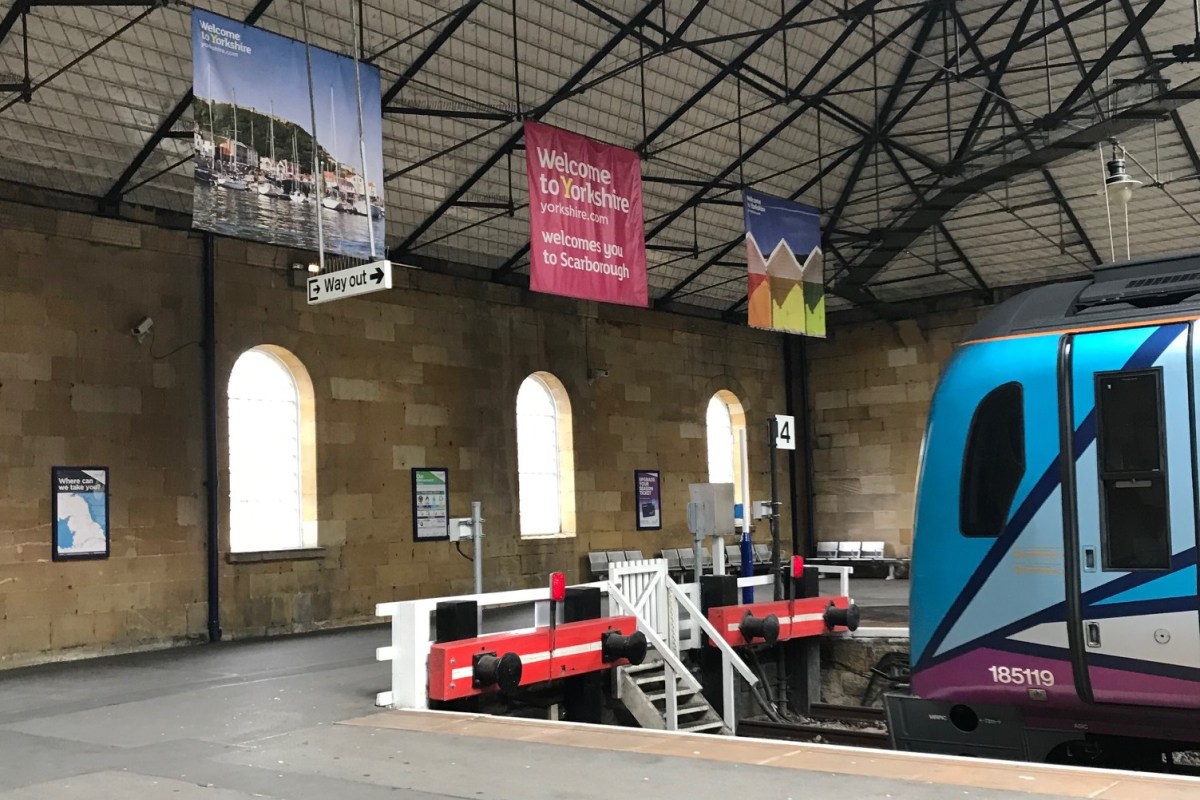
The End of the Line: Scarborough

The End of the Line is a 10-part travelogue journey to some of the highest Remain and Leave areas in the United Kingdom’s 2016 Referendum on EU membership. It was written over two years from 2018 to 2020, before Coronavirus made Brexit seem like a spot of man flu.

Scarborough voted 62% Leave in the EU Referendum

Originally written in March 2019

There’s a certain romance to an English seaside town. Rather than florid emotional poetry of sunsets and summer seductions, however, it is romance written firmly in study prose. It’s a whole world of emotional drama restrained behind a very British façade. A somewhat buttoned up and regimented sense of fun that has a charm all of its own. And few places epitomise that so perfectly as Scarbados, the self-named, ‘Queen of the Coast’. Kiss me quick, squeeze me slowly: but always remember, we’re British.

Before heading to Scarborough, I have a few other stops to make on a short Northern tour. My first journey is from Kings Cross to Leeds in order to catch a connection to Skipton, where a friend of mine had recently moved. I’m booked on the 1.33pm train but it’s cancelled due to a member of the train crew seemingly not turning up for work. That action has resulted in three trains worth of people cramming onto just one. I stand for the entire journey, boxed into a space where the carriages connect so small that even Houdini would fear lasting back pain. My spine slowly curves from leaning up under the arch and my ears ring from the squeaking creak of the linkage between the carriages.

The windows of the train carriage soon steam up as the temperature of crushed bodies increases. When the train reaches a station a blessed blast of cold air rushes in, but it’s merely a temporary relief as more people immediately replace the ones that have just got off. I glance over and see a pregnant woman also standing, with no one appearing keen or even able to give her a seat. She’s just too far away for me to offer her help. Not that there is much I could actually do. It’s 2pm in the afternoon on a weekday, hardly the peak time of rush hour.
Travelling by train in England

The guard apologises over the public address system for the overcrowding and then optimistically suggests that a trolley cart of light refreshments will be making its way down the packed train. You imagine this will involve us ferrying the cart on our shoulders like Paul Hogan surfing the New York subway crowd to reuinte with Linda Kozlowski at the end of Crocodile Dundee. In the end, it never appears. Instead, I stand close to the toilets and try to avoid inhaling the occasional waft of stale urine as the doors open and close, open and close. The guard advises us that we could apply for compensation, so I spend the time imagining what I would buy with the likely £5 of redress coming my way. How cheap are chiropractors, I wonder? Eventually we arrive into Leeds and I tumble out of the packed sweat box, battered bruised and £70-odd quid lighter for the experience.

On the train to Skipton I manage to get an actual seat and it feels like a lottery win. The pretty Yorkshire town of Skipton is in the voting district of Craven, which plumped to leave the European Union at 52.8%. By contrast nearby Leeds just narrowly voted to Remain, at 50.3%. Leeds is a rarity on that score, as the vast majority of the North of England voted out, including my home town of Sheffield, at 51%. In the spring evening in Skipton the starlings flock in the sky, swirling in quite beautiful sweeps of black and raining down faeces like the US Air Force carpet bombing the Taliban. The evening ventures towards blue, then pitch dark as beer, curry and then sleep ease away the strains of a day spent travelling by train in Britain.

In the morning I board the 10.17am train back to Leeds, in order to get a connection over to Sheffield to see my Sister. A group of five women in their 50s and 60s get on just behind me. I ascertain that it is one of their birthdays and they are off on a day out in Leeds. The train hadn’t even left the station before the Prosecco cork popped to happy cheers.
“It’s organic,” one of the woman says as she pours the booze into waiting glasses.
“Where’s it from?” another woman asks.
“Sainsbury’s,” comes the answer. They all laugh.
One of the women reaches in her bag and retrieves cans with mixed cocktails in them.
“Drink up,” she says. “I ain’t carrying these round all day”.
As we reach Leeds around 40 minutes later, one of the party stands up, and wobbles on her feet. “I’d better have a coffee or I am going to pass out,” she warns.
As the party tumbles out onto the platform, a young woman observes them as they pass with a head tilted smile. “I hope I am like that when I’m 60,” she says to a friend.

On the connection from Leeds to Sheffield I log on to the free wi-fi. This always involves some odious request for personal data and so I have become quite creative at developing online personas. I like to think that somewhere a marketing person is sat staring at a list of names, trying to think what promotional messages would suit Tony’s Technicolour Underpants, The Lord of Death or Big John’s Love Sack. Outside the window whizzes past a forest of caravans just outside Wath Upon Dearne. I settle in for the journey to Sheffield.

“I am so sick of hearing about Brexit,” my Sister says after she picks me up from Sheffield station in her cream Fiat. She’s booked a holiday for 1 April, 2019 in The Netherlands. When I asked why, she replies: “It was cheap”. I counter that by suggesting it was possibly cheap because you’ll need a visa if we crash out of the European Union without a deal. “So will I need a visa or what?” my Sister asks. I shrug and say, “No idea.” She merely harrumphes and we continue on the car journey in silence.

Midday in Sheffield, and it’s raining. It continues to rain for the entire day and into the evening. I get thoroughly drenched and dry out on multiple occasions to the point where I no doubt smell like a wet dog. Still, the beer-curry-sleep combination again does its magic.
To the seaside, not beyond

The following day the rain mercifully gives way to bright sunshine and clear skies. Perfect weather for a trip to the seaside. The journey from Sheffield to Scarborough goes via York. Alongside Leeds, York also voted to Remain in the European Union, at 58%. It was unusual in that regard, as being both a place with a great sense of history, yet also a seeming desire to remain in a globalist future. But although its station is a handsome sight, it isn’t the end of the line, so I must move on. Rules is rules, after all.

My Mum was born in York. My Grandad died here. Grandad Ralph got dementia in his later life and I used to tell with puzzlement how he once claimed he had a baby growing in his leg. Now, I look back and realise how terrifying that must have been for him. To know everything and nothing at the same time: at once lucid and also absent. My Mum would later die of Multiple Systems Atrophe, or MSA, a condition that keeps you alive and conscious as it gradually robs your body of motor skills. Trying to decide which is preferable as a way out is a bit like considering which form of Brexit you’d prefer best.

I board a train to Scarborough. It rolls out of the station, giving a trackside view of the large houses of York, surrounding by the fortified city walls. The sunshine pours down and the sky is a powder blue. The light beams down onto the fields, illuminating them in a vibrant green. I try to avoid looking at a man vigorously picking his nose in the seat across from me. It’s like he is rooting down the back of the sofa in search of his car keys. The countryside goes on and on. The ruins of St Mary’s Abbey appear on the left hand side of the train. Manor house lord it over expansive grounds.

A man in a cap holds a conversation on speaker phone a few rows down. He holds the phone close to his face and bellows into it, with the respondent dutifully bellowing back. I wonder to myself why this is still not a crime with devastating punishments for non-compliance. Mercifully he gets off at Malton. The hills keep on rolling. Hulking shire horses stand idly in a field eating patches of grass. I relax back into my seat, but then sigh as someone starts playing music on their smartphone without headphones.

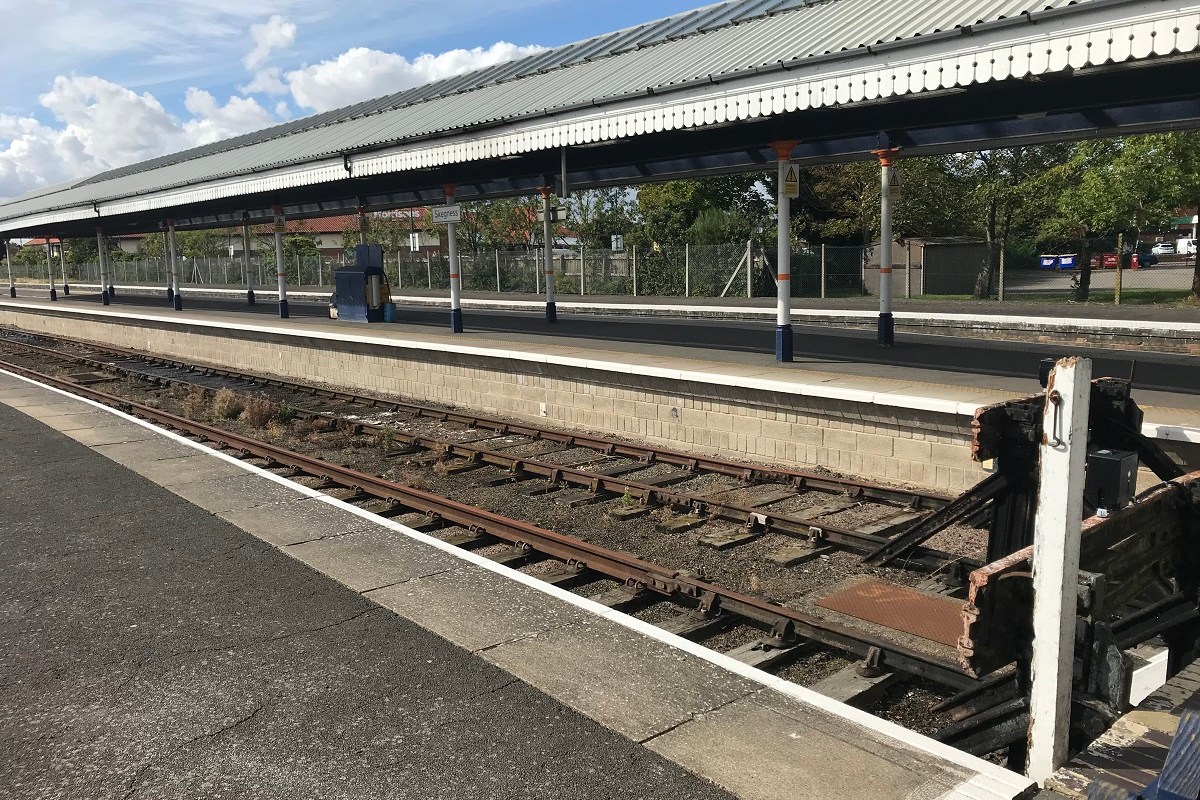
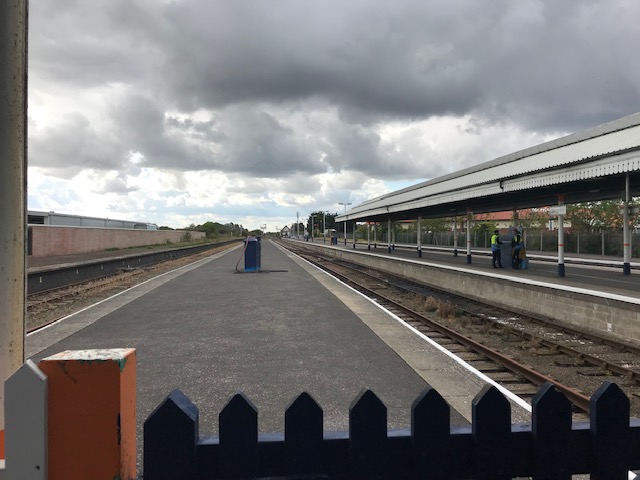
Seamer comes next – a bleak station surrounding by scrub brush and intimidating metal fencing. Then, we roll into Scarborough. Just as in Hastings, while it may seem strange to come to a seaside town in the winter, I know from living in Brighton that you only see the real character of a tourist town or city when it is out of season. Only then do you glimpse what it’s like to live here when the hoards aren’t descending and the attractions aren’t in full flow. You have to come to these places when the music has stopped and when reality has resumed, to see their real character.

This isn’t my first visit to Scarborough. In fact I have been here numerous times. I used to come here for day trips and holidays, along with Filey, Whitby and Bridlington further up the coast. Saltburn by the Sea is much further up, alongside Redcar and then arriving in Middlesbrough. Apart from Newcastle Upon Tyne, the majority of the North East of England voted out of the European Union. Scarborough backed leave by 62%, and this was despite local Tory MP Robert Goodwill campaigning for Remain. As Scarborough Borough Council’s UKIP leader, Cllr Sam Cross, cutely put it at the time of the vote: “This looks like a fantastic result for the ordinary folk.” Mr Goodwill would later be among the group of 202 MPs who backed Theresa May’s EU withdrawal deal, which was rejected by a record 432 MPs. Never take a betting tip from this man.

I exit the train and walk into town, passing a man with a sleeping bag around his shoulders and a two litre bottle of cheap Frosty Jacks cider in his hand. More homeless huddle up ahead to ward off the cold. Around 320,000 people were recorded as homeless in Britain in 2018, up 4% on the previous year’s figures, according to data from housing charity Shelter. Combined, that group of people would be bigger by population than the UK’s 15th largest city. Plus, these figures only included individuals who were in contact with local authorities or in hostels, so the real figure could be much higher. People are struggling, and that doesn’t always end just because someone eventually does get a roof over their heads.
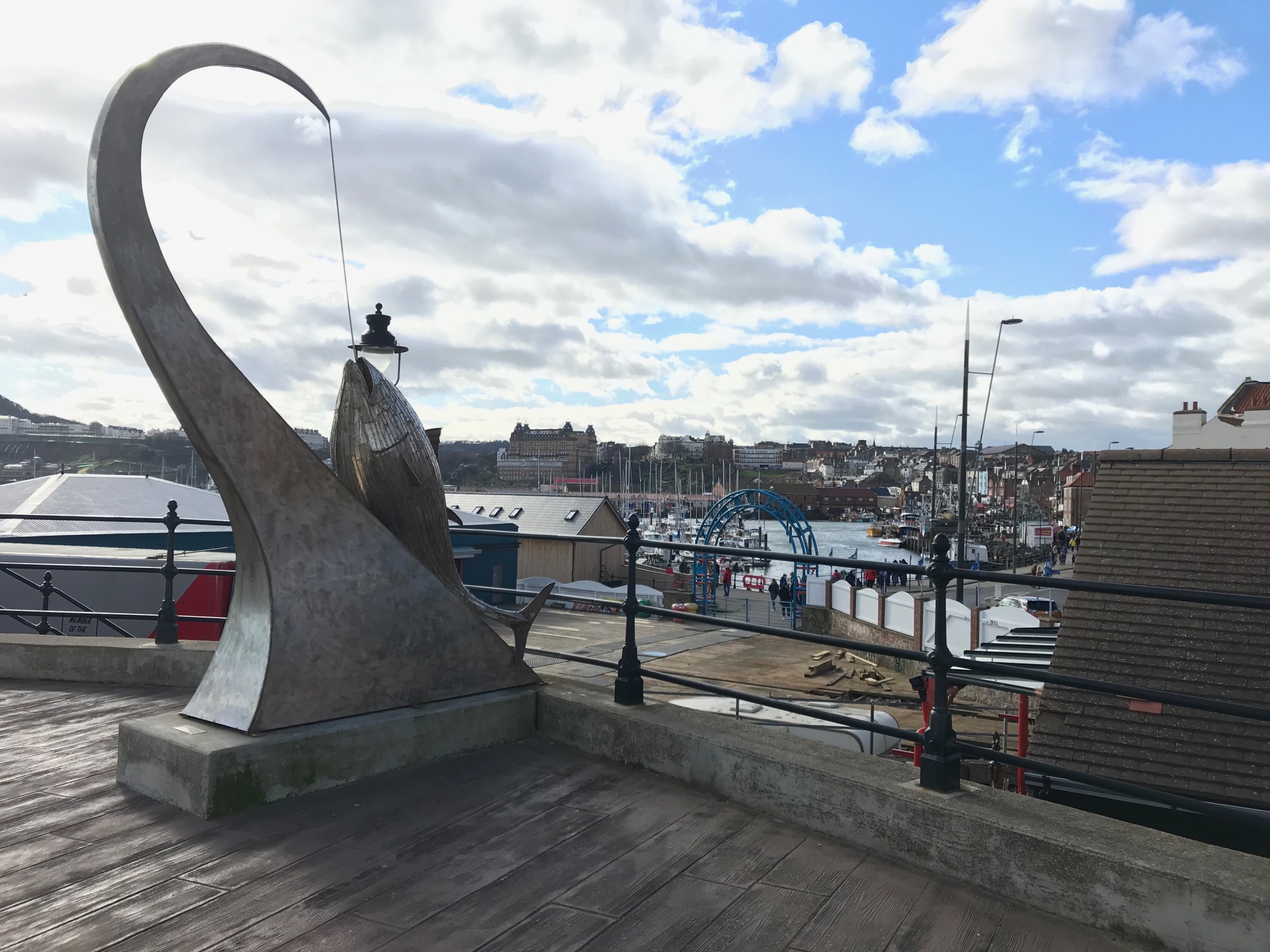
Scarborough developed into a spa town in the 17th century following the discovery of a spring at the bottom of the cliffs. People flocked to the town to drink the water that they thought would cure all sorts of diseases. This was given some medical credence in the 18th century when doctors advised people that bathing in seawater was good for their health. Towns like Scarborough and Brighton soon developed into desirable resorts, and destinations in their own right. Scarborough’s population increased by almost five times over the 19th century as the tourism industry grew. Although Scarborough remained a busy fishing port, gradually its ship building industry started to decline. The resort grew in the 1900s but as with most seaside locations in Britain, it hit the wall in the 1960s with the rise of cheap package tours abroad. Just like Skegness and Clacton-on-Sea it has struggled to recover ever since.

The average salary in Scarborough in 2016 was just £19,925, compared to the national average of £28,442, according to data from the Office for National Statistics (ONS). Permanent jobs are hard to come by, with most work residing in low paid and seasonal tourism positions. Scarborough also has an aging population. According to NHS data for 2015, Scarborough had 13% of the population aged 65-74 and 7.6% aged 75-84, that is 3.6% and 2.4% higher than the national average for England respectively. By contrast the town has 33.2% of the population aged 15 to 44, 6.9% below the national England average.

The UK population generally is getting older. Between 2005/06 and 2014/16, the number of people aged 65 or over grew by 21%, while people aged over 85 increased by 31.3%. It is projected that the population over 65 will grow by 48.5% by 2036 and people over 85 will increase by 113.9%. The demand for care for complex, long-term conditions such as dementia and Alzheimer’s is expected to grow at the same time and that in turn is expected to exacerbate socioeconomic disparity in terms of access. In short, a grey storm is coming and it could hit Scarborborough hard.
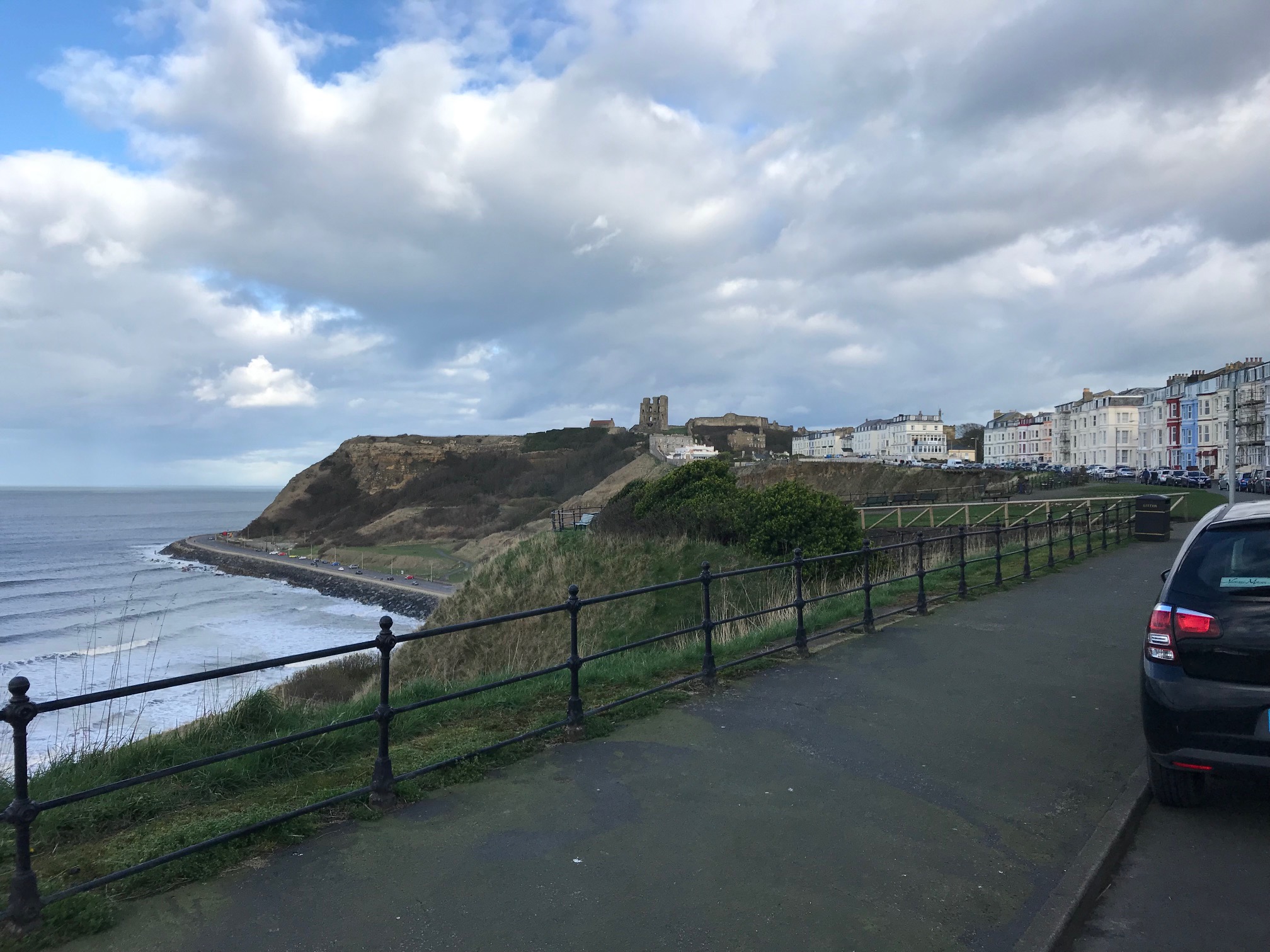
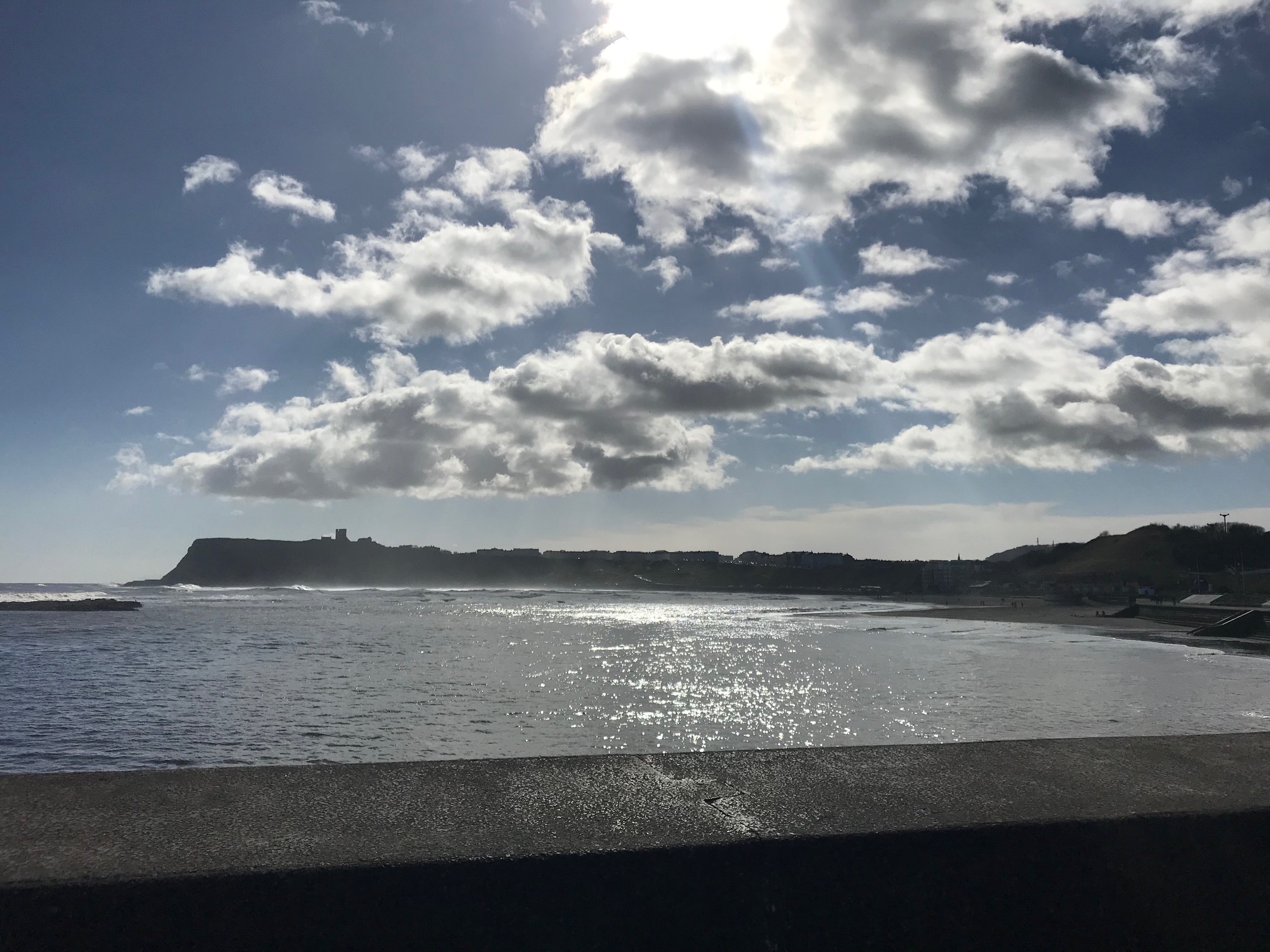
On this crisp spring day, I walk over to The Helaina where I am staying that evening. It is a presentable B&B right on the front overlooking the North Bay. Looking out to sea, the view sweeps from the colourful chalet beach huts on the left all the way across to Scarborough Castle on the right. Further down the cliffs kids play on a playground and two boys kick a football around a small pitch. Dogs amble on ahead of their owners and people sit on benches looking out at the waves.

A small white ball flies past me down a slope leading to the edge of a steep cliff as I sit and take notes in my book. A man approaches, coaxing his small dog with him who seems reluctant to retrieve the ball that she was clearly meant to catch. The man tries to persuade her but eventually just picks the animal up and drops her just over the edge to retrieve the ball. “There,” he says as the slightly shell-shocked dog returns with the ball. “Wasn’t hard, was it.”

Mel checks me into my room. Or rather, doesn’t. “Room’s not ready yet, love. Sorry, we were slammed last night. So busy!” I leave my bag at reception and comment on the chilly weather.
“I like it like this,” Mel replies. “Sunny and cold – can’t beat it!”
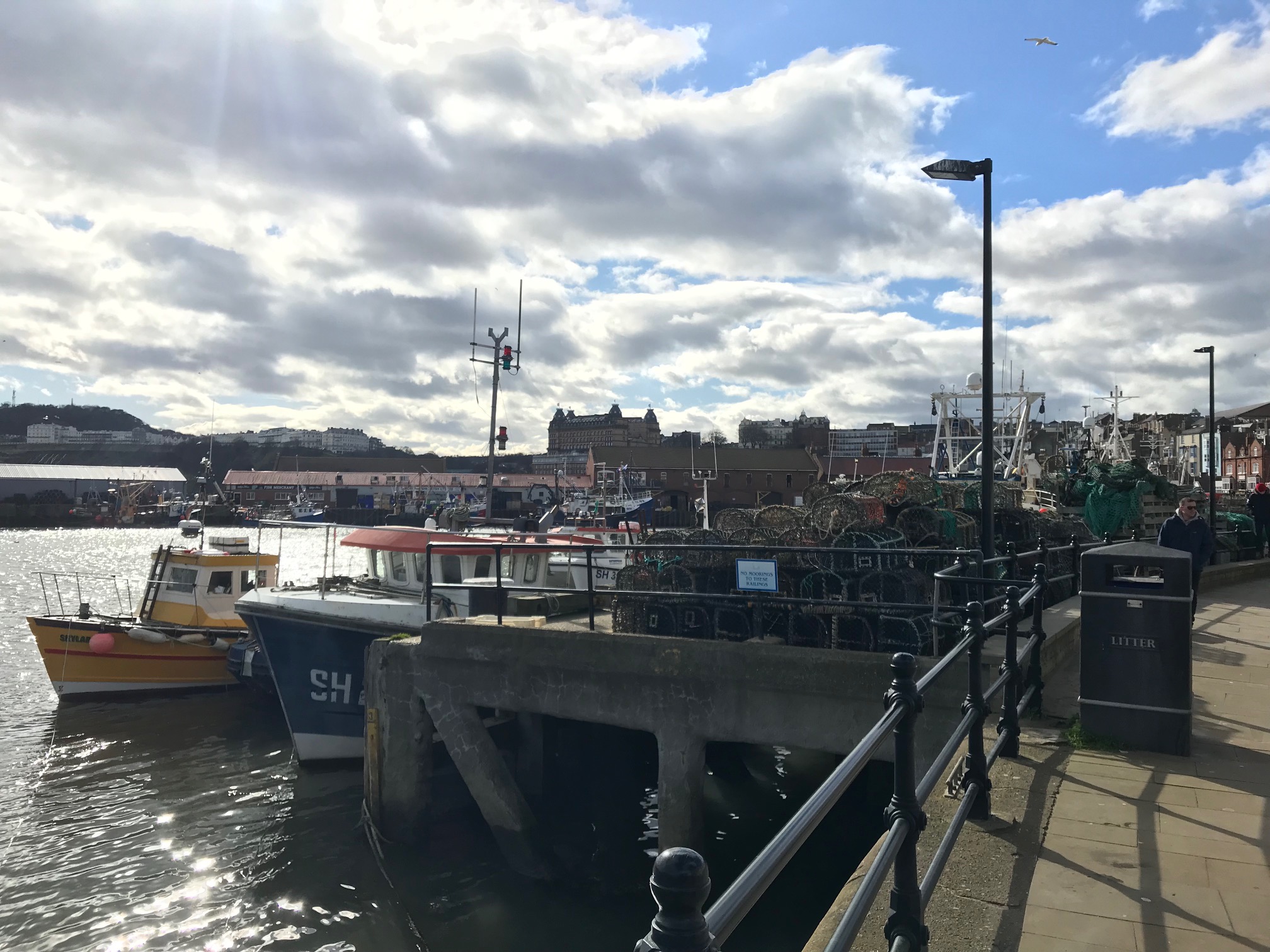
Giving time for my room to be prepared, I head back out towards the Castle positioned on the promontory rock looking out over the North Sea. A fortification has stood here for nearly 3,000 years, but the main castle tower was built in the 12th century as the centrepiece of Henry II’s castle. It was one of England’s most important royal fortresses at the time. Dropping down the winding paths I reach Marine Drive and the Teapot Kiosk. Sunday bikers are out in force. They gather around outside tables in leathers or high-tech romper suits, trying to look manly as they tuck into tea and slices of cake. Luna Park is closed up for refurbishment, but no doubt provides a heady mix of fun and health and safety concerns when it is open. Ahead is a working harbour: salty ropes are coiled in wet piles, lobster pots are stacked in rows and workmanlike boats sit waiting for tomorrow’s catch.

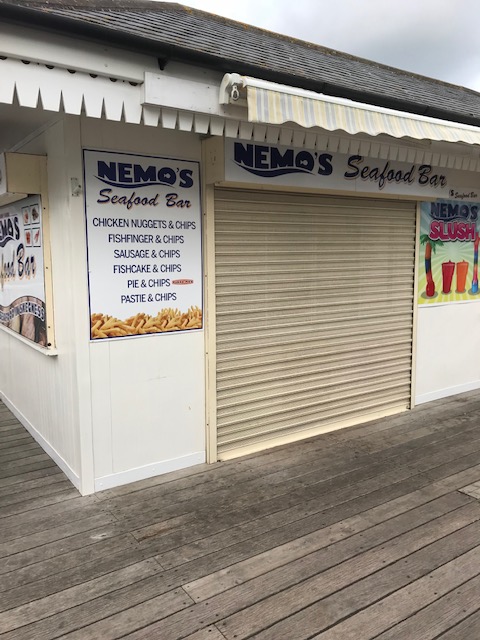
Surprisingly given it is a chilly Sunday in March, the South Bay harbour bustles with tourists. Families and couples amble down the front, dipping into shops for fish and chips, sugary snacks or an afternoon pint. Above them hovers an airborne army ready to relieve them of their purchases. The seagulls in Scarborough are aggressive, so aggressive that warnings line the front advising people to guard their food against the threat, along with the Twitter hashtag #yourfoodisnottheirfood.
“Shut up, you,” a woman chastises a squawking gull as she walks past the bird.
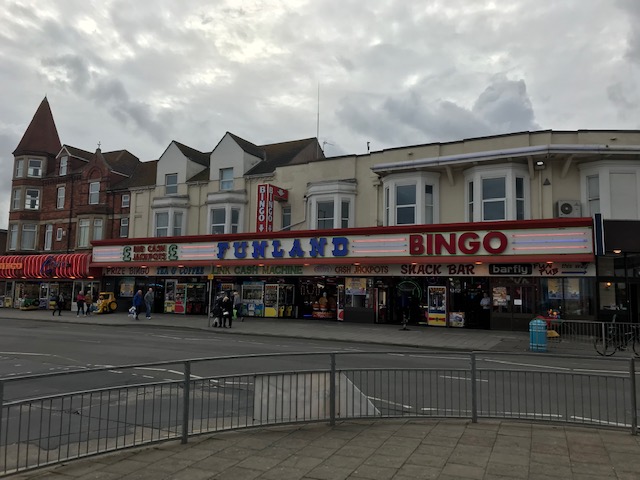
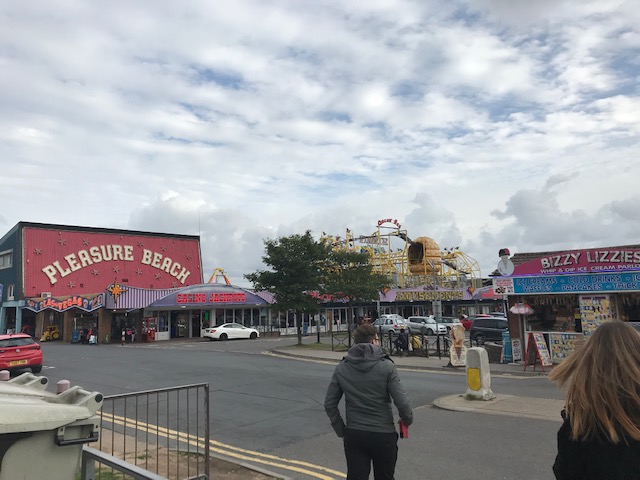
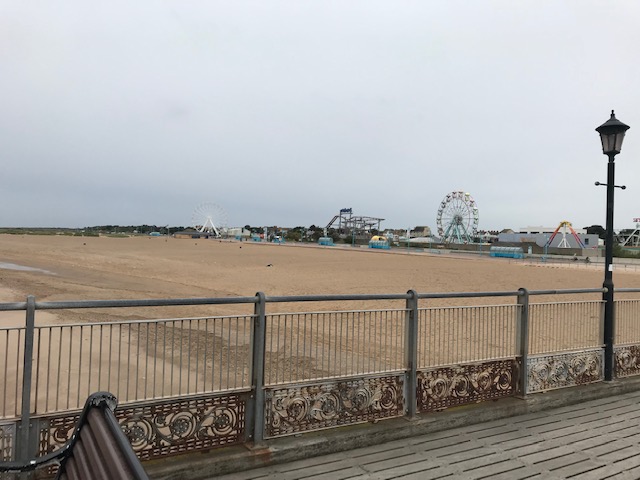
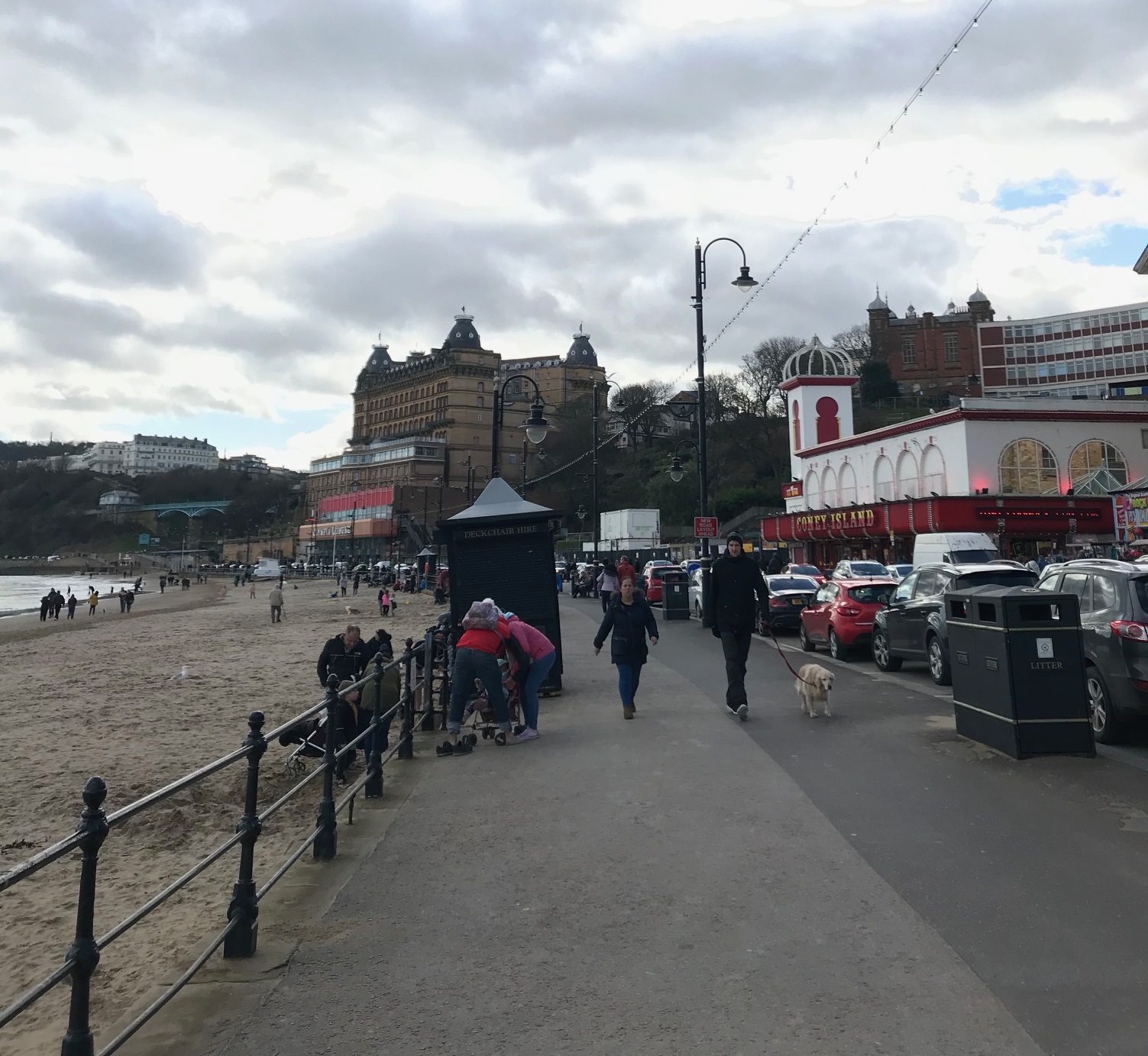
Heading down Sandside leads onto Foreshore Road. On the thick, inviting sand people play games, take rides on donkeys and try to get a tan from the occasional flashes of sunshine. A man wearing a leather deerstalker rather sheepishly runs a metal detector down the shoreline in the hope of finding something valuable. The amusement arcades rattle and hum with life inside. I dip into Coney Island and am immediately hit with a wall of noise – like a brightly coloured mental breakdown. I play a few games and then, over fear of impending tinnitus, head back out again.

Further down the front leads to the Grade II* listed Scarborough Spa. I can recall coming here as a child. It feels vivid, like it was only yesterday when I would visit the little row of shops, always obsessing over some plastic toy or trinket. We’d get ice creams and my parents would enjoy a few moments of peace while they had a cup of tea. Just like many people, I grew up with these sorts of holidays, which would now odiously be called ‘staycations’. The Spa is now a theatre and entertainment venue, with a beautiful outdoor performance area bedecked with glass windows and a rotunda with views out to the sea.
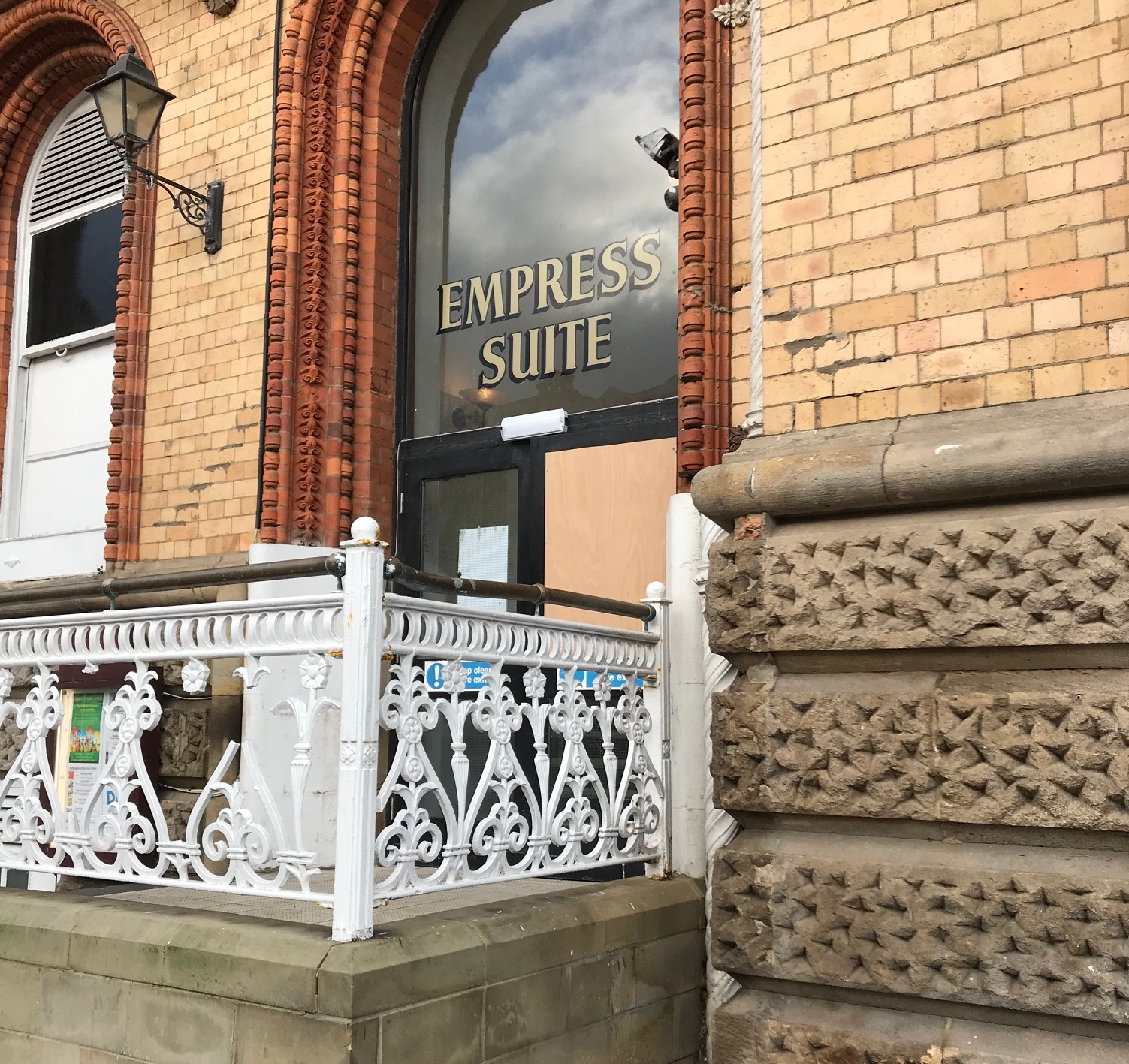
Above the Spa is the Grand hotel, which has a lot of history (apparently, it was built on the same site as a house where Anne Bronte died) but has clearly lost its way. Built in 1863 to cater to wealthy visitors, the hotel is under the Britannia Group, named by Which? magazine in 2018 and 2019 as the worst hotel chain in the UK (disclaimer, Which? is also my employer). It had more than 2,800 ‘terrible’ reviews on TripAdvisor, including tales of dirty and decaying rooms, disinterested staff and tasteless food. As I walk past I notice that the door apparently leading to the Empress Suite has one of the panes broken and hastily covered with a slab of chipboard. Come in, your Imperial Majesty, just avoid the needles as you go.

Glad that I had not booked that particular delight for this evening, I instead head back to The Helaina to check in. After getting refreshed in the small but very comfortable room, I head back out. Instead of retracing my steps I go the other way towards the front. It’s starting to get late in the afternoon and the shopping arcades are now dead. Rubbish floats on the wind like tumble weed as bored-looking kids gather searching for something to do. Old people congregate around Greggs drinking tea to ward off the cold. It’s rather a bleak scene so I go back down to the South Bay front.
As I reach the Spa, the skies begin to dim in preparation for sunset. Surfers are in the sea braving the cold for the robust waves rolling in. Most are wrapped up extensively in wet suits. The majority of day trippers have now gone and the front has the feel of a party starting to wind down. There is a sleepy lull in the atmosphere, an almost soporific calm as people ratchet down from their various highs. I look up at the skies as the first droplets of rain start to fall. So, I venture into The Golden Ball pub for a drink.

As I sit down with my pint in the rather funereal upstairs bar area, the now heavy rain starts to batter the outside window. Three couples are in the room: the oldest natter away to each other, the youngest stare intently at their phones, only sparking conversation when one runs out of battery. After the rain stops I swap venues for the Scarborough Flyer – a huge pub that really should be a Wetherspoons, but oddly isn’t. As I get a drink at the bar a man wearing a St Patrick’s Day oversized hat and appearing to have been drinking for quite some time, eyes me sideways.
“You look shifty,” he comments to me. I laugh nervously, but he doesn’t. I move as un-shiftily as I can a little bit further down the bar. Later, I see him being thrown out of the pub and the hat, which it turned out wasn’t even his, relinquished from him.

A group sat near me talk about how people fetishize living by the sea. One of their friends wants to come back home to Scarborough after living in London, and it sparks a debate.
“She don’t need to be here. Stay in London,” one says.
“I can’t stand it down south,” another counters. “I have done it a few times and I find it fucking horrendous.”
“I like London but after a couple of days I am ready to go back. It’s the rat race, right. But I don’t think Georgie would be happier coming up here. She just thinks she would be.”
“She’s 39 and chasing this image of what she think will make her happy. But she needs to stop chasing. You should know by now what makes you happy. I see the fashion life and it is fun and all, but then soon you are like, ‘take me back to the slow mundane life by the coast. Take me home’.”

I end the evening in Tricolos, an Italian restaurant whose décor is akin to the set of a local theatre company’s take on Merchant of Venice. I dine alone on a pretty serviceable calzone. It is always a slightly odd experience dining alone, but I encourage everyone to try it. There is something about enjoying your own company that feels a positive, life-affirming experience. Of course, there’s also a high possibility that other diners just look at me and think, “Well, that guy looks pretty shifty.”
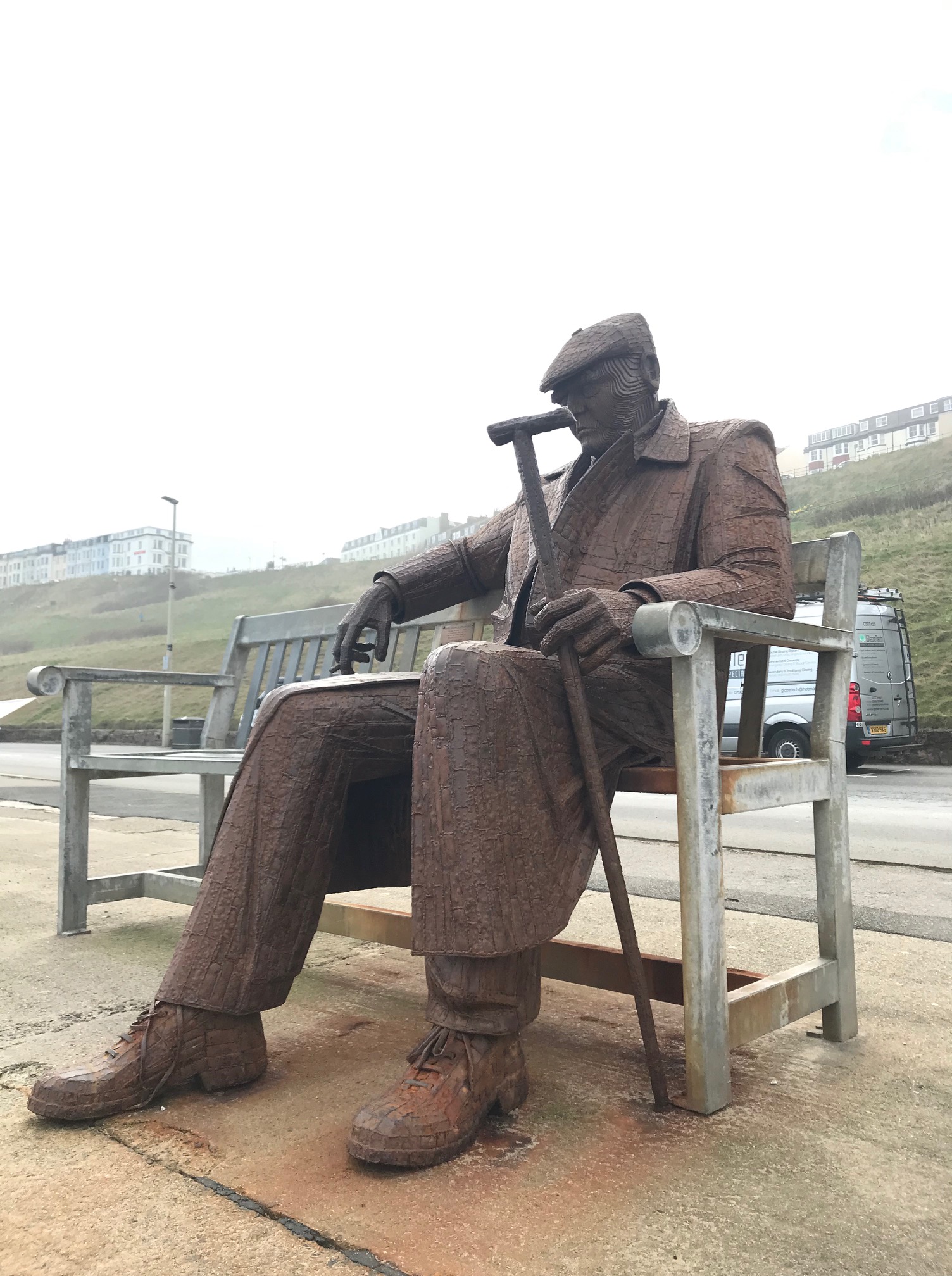
Freddie Gilroy looks out to sea

I love the atmosphere at a B&B breakfast in England. Couples, groups and singletons emerge like overly polite meerkats from the privacy of their own rooms, forced to interact – however briefly – at the collective wateringhole in the need of sustenance. The breakfast at The Helania is hearty and everyone seems satisfied. After finishing up I check out and have a chat with Mel again. She only came to Scarborough just over three years ago. The B&B is closed over the cold winter months of November and December, but the start of 2019 had already been busy, with guests staying for a weekend or longer visits. There are even residential apartments where people working on the fishing boats reside for a month or longer.

“It’s been busy, yeah,” Mel says as she hands me a bill. “More so as people are worried about the terrorism.”
“The terrorism?” I ask, somewhat concerned.
“Yeah, you know. Not so much here, as it is quiet, but in London,” she says. “People are worried to go there. They want somewhere quieter. Then again, if all you thought about was that sort of thing, then you probably wouldn’t go anywhere!”
She smiles broadly, before making her excuses to answer the endlessly ringing telephone.

The morning is hazy, but also bright and sunny. The view of North Bay outside the B&B is truly stunning. The waves roll in thick swells and the sea sparkles in the sunlight. This time, I set out walking down to the North Bay promenade. People are out walking in the clear air. Dogs gather on the beach like a canine coffee morning, frolicking and catching up on important dog matters. Tired young parents bereft of sleep push sleeping infants, hoping that the chilly air would keep them asleep and, in turn, themselves awake.

On a giant bench is a towering statue entitled Freddie Gilroy and the Belsen Stragglers. It depicts a local man and former miner who was one of the first Allied soldiers to enter the notorious Belsen concentration camp when it was liberated in World War II on 15 April 1945. What he saw there would stay with him for the rest of his life: the most extreme form of human cruelty given full lease to roam. Gilroy was hit by the smell of rotting bodies, and of those still alive, almost half were as close to death as a human can get.

Gilroy would spend his 24th birthday at the camp, and in a later interview with a newspaper in the 1980s, he explained how he cried on every birthday since that day. He died of cancer in November 2008. Freddie was an ordinary man who witnessed extraordinary things. The statue was eventually made a permanent addition to Scarborough’s seafront after it was purchased for £50,000 and gifted to the city by pensioner Maureen Robinson. Mrs Robinson bought the sculpture as a thank you to Scarborough for all the happy years she had spent in the town. I get a little choked at this moment, but then a man walks past wearing a jumper with the slogan, ‘I believe in the Loch Ness Monster’, and that brings me firmly back to reality.
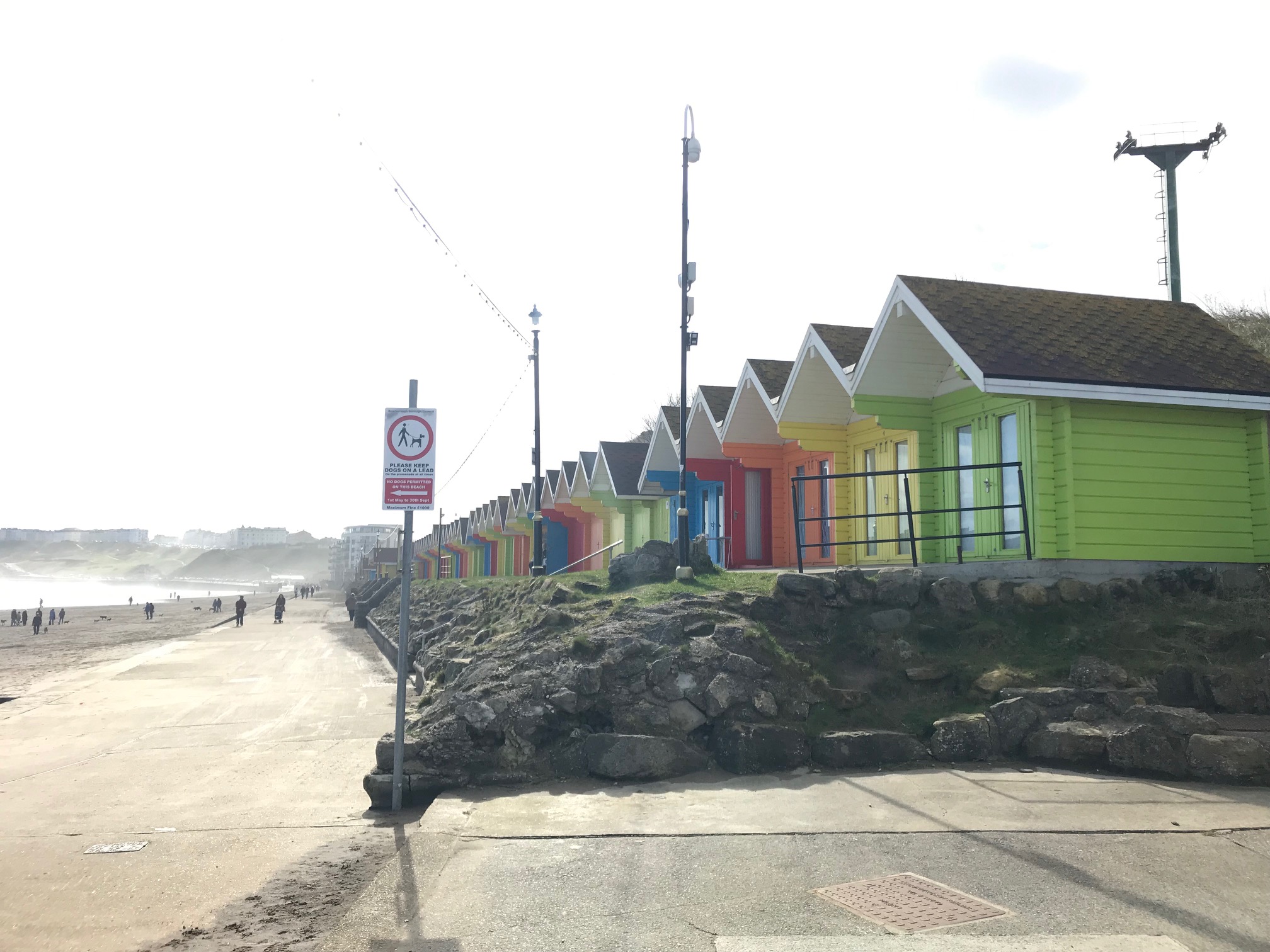
Further up from the statue is a rainbow swathe of brightly coloured beach chalets. Many are named after types of birds, such as kingfisher, grouse and lapwing. Pensioners sit on chairs outside sunning themselves or chatting with friends. I stop off in the Watermark café for a coffee. The café is filled with elderly people making a laboured effort to either stand up or sit back down again. A woman in her 70s sits down next to me and spends 15 minutes moving things around the counter top, like an elderly version of block puzzle game Tetris. Her friend arrives and does exactly the same thing. Her dog barks intermittently but she does nothing about it. Time to leave.

Walking onwards leads to the Sea Life Sanctuary, a series of tented buildings housing an aquarium and mini golf centre. I loop around it and on towards Scalby Mills. A small train platform sits here as the end of the line, with miniature steam trains going from Peasham Park and back again on the weekends. Up on a short cliff walk you get a staggering view across the bay. It really is a beautiful sight. Behind are the Scarborough suburbs. On Scalby Mills Road sit modest but well preened houses, with manicured gardens and family SUV cars parked up in the driveways. It is the kind of road where it is the done-thing to name your house. It’s always a fine balance between the grand and the modest, the poetic and the practical – The Headlands, Greenacre, Lilywhite. Why doesn’t anybody go for something a bit spicier, I wonder? Maybe, ‘War Bastard’, ‘The Fuck Bunker’ or ‘Chemical Weapons Testing Facility’. See how that goes down with the Nimbys.

I walk back towards town, making a beeline for the old Scarborough Prison on Dean Street. The Grade II listed building was opened in 1866, but only lasted 12 years before closing in 1878. In that time it accommodated only around 50 prisoners and it is believed that one of those managed to escape by scraping away unset mortar and removing the bricks. The site is now used by Scarborough Borough Council for storage.
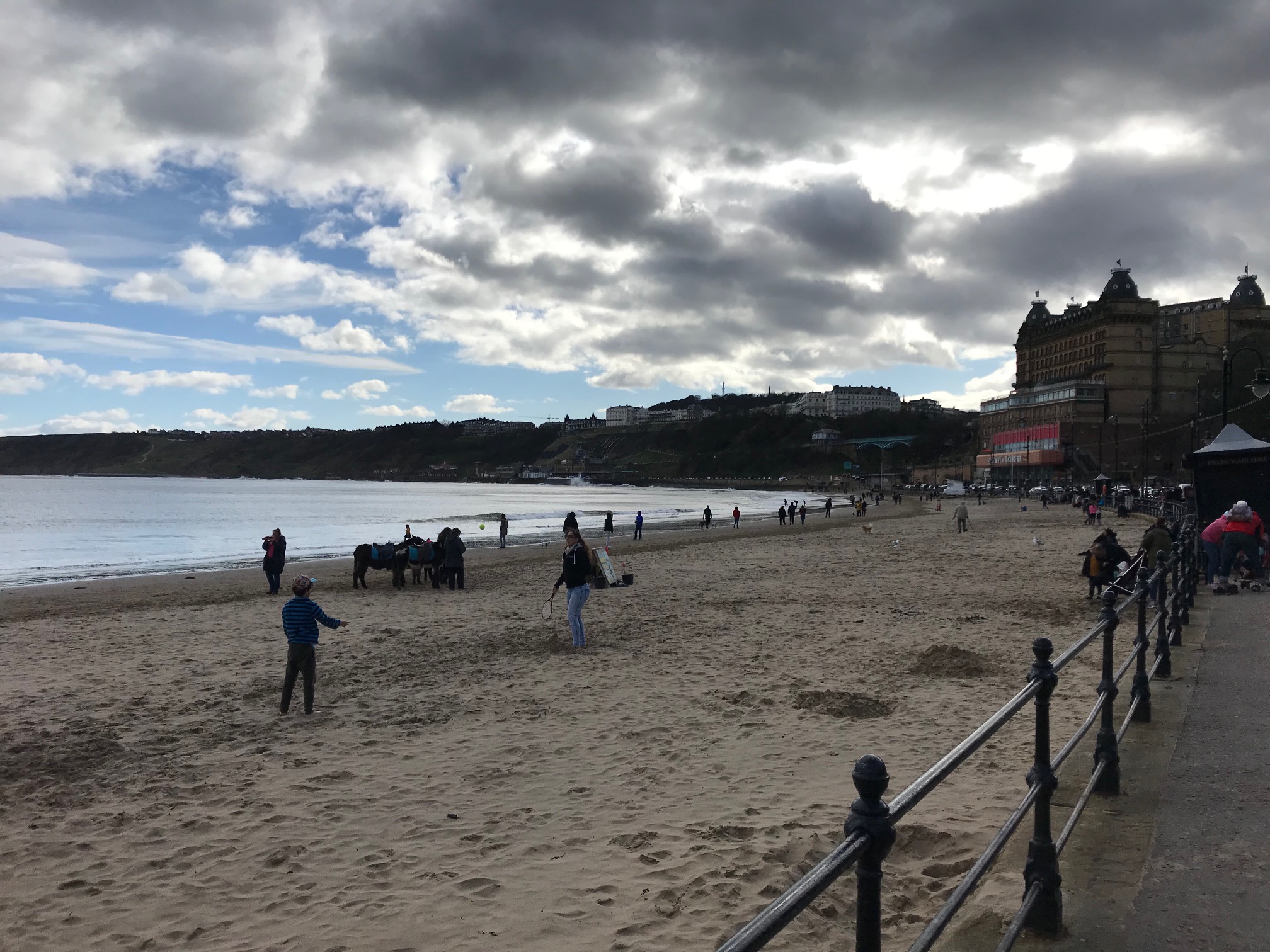
Just up the road is Scarborough Workhouse, a particularly cruel institution from British history. With origins dating back to the Poor Law Act of 1838, the workhouse had conditions deliberately intended to be harsh and unforgiving to deter able-bodied people from looking for a free accommodation. In many ways this was the first marker in a long held belief that you could batter and beat infirm, broken and damaged people into being contributory citizens. The ‘pull thyself up by thy bootstraps’ form of welfare still sustains to this day in the form of Universal Credit.

Back on the front, the sunny weather has ensured it is lightly busy for a Monday afternoon. Day trippers dip in and out of the amusements and food outlets. I opt for Winking Willy’s fish and chip shop as my final stop, ordering fish and chips with slices of bread and butter, because, well, there just aren’t enough carbs in this meal already. I am upsold to have curry sauce with my chips, but while tempting, I decline on this occasion. When I first moved to Brighton and asked for curry sauce with my chips the man behind the counter looked at me like I had just asked him to lather the potato with boot polish. “Gravy then?” I followed up, somewhat optimistically. Maybe there is no place like home.
Next stop, we go north of the border to Scotland, and Glasgow.

The End of the Line: Clacton-on-Sea

The End of the Line is a 10-part travelogue journey to some of the highest Remain and Leave areas in the United Kingdom’s 2016 Referendum on EU membership. It was written over two years from 2018 to 2020, before Coronavirus made Brexit seem like a spot of man flu.

Tendring voted 69.5% Leave in the EU Referendum

Originally written in March 2019

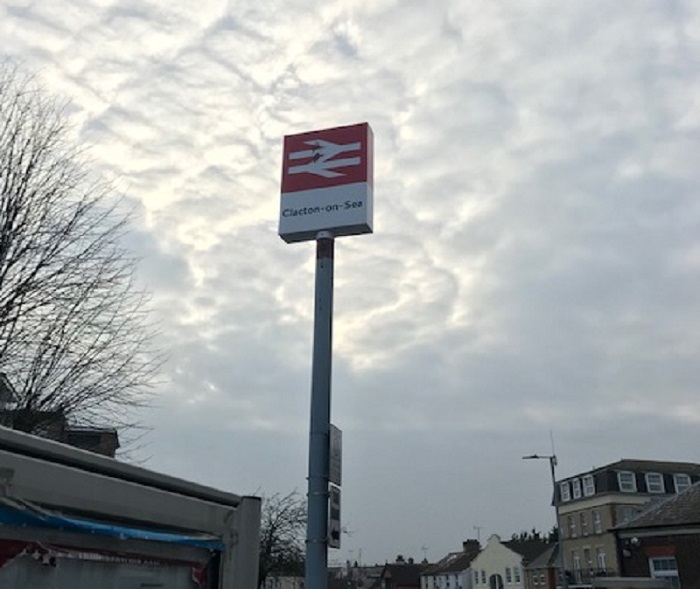
Clacton-on-Sea has a history of fending off European invaders. Along the glorious sandy beaches of the Tendring coast lie dotted Martello towers – remnants of the coastal defences against the threat of a seaborne invasion by Emperor Napoleon Bonaparte. Some 29 such towers were constructed in a fortified line running from Brightlingsea to Aldeburgh between 1809 and 1812. Each cylindrical tower was formed of 750,000 bricks, making the walls two to three meters thick and capable of absorbing a direct canon shot. They were armed with three canons, and a gun battery usually sat nearby. Each tower was designated with a letter, with towers C, D, E and F standing dutifully in watch from Jaywick to Clacton.

In the end the invasion never came as victory for England in the Battle of Trafalgar secured British control over the seas. Besides, Napoleon had become distracted by the new threats from Prussia and, in a common bête noir for your power-mad European dictator, ill-advisedly taking on the big bear of Russia to the East. Now, the Martello towers stand as stout monuments dominating the coast, permanently marking the threat that can be posed by an unshackled European power, real or imagined.

Although Boston in Lincolnshire recorded the highest proportion to vote Leave in the 2016 EU Referendum, in many ways it is the east coast of England that can lay the claim to be called ‘Brexit country’. Of the top five highest Vote Leave areas, three were in the East of England – Castle Point 72.7%, Thurrock 72.3% and Great Yarmouth 71.5% (the others were in Lincolnshire, including Skegness). Of the entire region only Norwich voted to remain in the UK. Tendring, including Clacton-on-Sea, voted Leave at 69.5%, well above the national average for England at 53.4%.

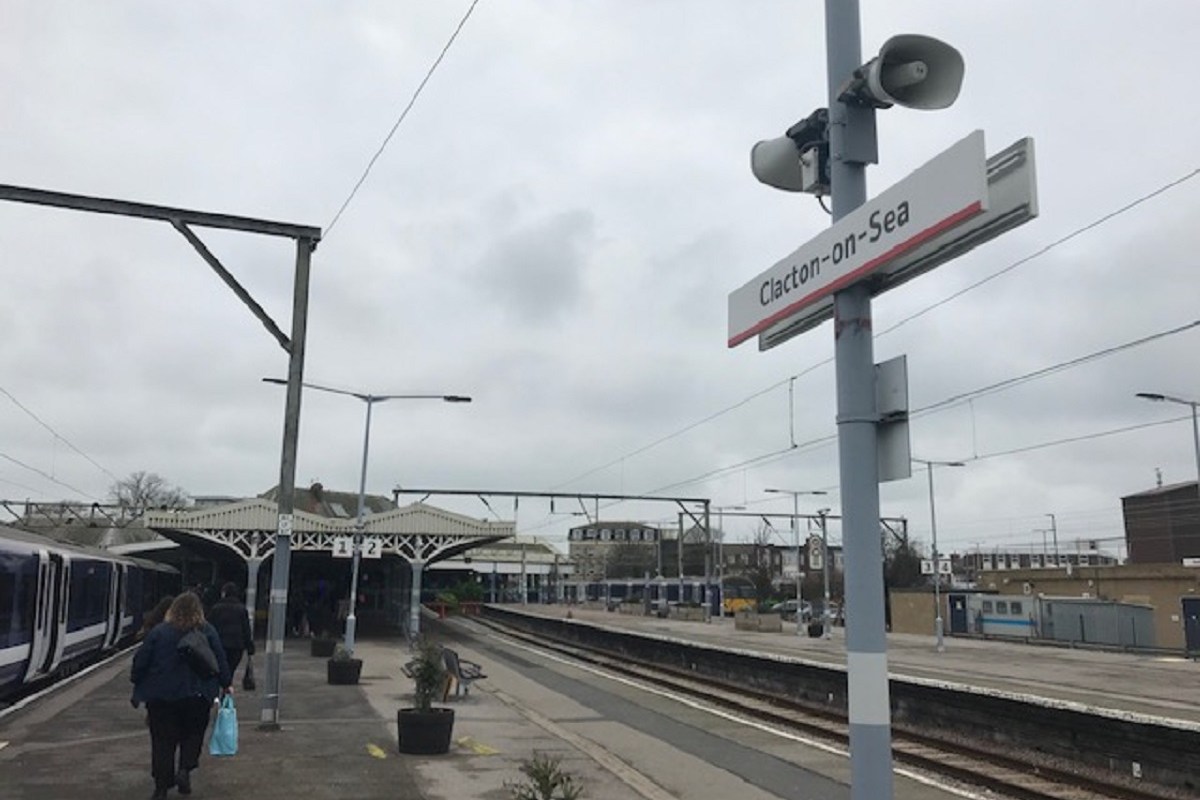
On a pallid grey Friday on 1 March 2019, I set out to visit Clacton. This day marked the near month-long countdown to Britain supposedly crashing out the European Union on 31 March, 2019. My Dad accompanies me on the trip. He used to live in Essex and we’d come to Clacton-on-Sea in my late teens for day trips. My Dad had separated with my Mum when I was 15 in 1994 and then later moved to Essex to work at the University. I’d come down for occasionally awkward yet generally fun weekends when he lived in the village of Wivenhoe, and then spend equally fun yet also equally awkward days out in Clacton, enjoying the attractions on the pier, walking the promenade and eating heaped plates of fish and chips.

On this spring day, the train we intended to get from London Liverpool Street was cancelled, a situation so common when travelling by train in Britain that one barely raises an eyelid anymore. Indeed, on every single trip I have made on The End of the Line, at least one train has been cancelled, delayed or disrupted in some fashion. We instead board the train to Colchester and change for the Clacton connection. Heading out of London the sky hangs as a dull grey shroud, a state exacerbated by the thick grime on the windows of the carriage. You can just about make out the Olympic Park at Stratford to the right, home of the London 2012 Olympics. The double helix of the red Arcelor Mittal tower pokes out from the ground and the London Stadium sits like a black and white basket dropped in the centre of the park. It’s now home to football club West Ham United.

A woman across from us frets about her ticket. The inspector had appeared and she couldn’t get the electronic ticket to display on her tablet.
“I’m not one of those people,” she urges to those seated behind her, somewhat desperately. “I have bought a ticket. I’m an honest person!”
She eventually manages to get the device working and lifts up the two seat trays laden down with make-up and hair straighteners to go in search of the inspector, who seems decidedly uninterested as to whether she had a valid ticket or not. She returns, mightily relieved, and promptly phones a friend to replay the entire tale.

A man bedecked entirely in a hue of beige restricted mainly for hearing aids waddles down the aisle and then, for some unknown reason, immediately waddles back again. Outside London chugs and chugs before eventually running out of steam. The sprawling outer suburbs amble into view as we move further and further towards the county of Essex. Upon arriving in Colchester, we face a twenty minute wait until the 11.16am to Clacton is due to arrive. So, we buy a dreary-tasting cup of hot brown liquid from the station café and my Dad somewhat wearily regails me of his commuting stories.

He had moved to Surrey part way through working for the university and had to do the long commute across the whole of London to get to work. It clearly isn’t a happy of memory for him, so I try to move the conversation on, but with the usual carnival of rail cancellations and delays in full force today, it isn’t so easy to break out of the painful reminiscences. As a commuter myself, I can sympathise. It’s like we are in a mundane version of Vietnam. If you enjoy the privilege of being able to walk to work, all I can see is; ‘you weren’t there, man, you don’t know!’ Some excuse of a broken down train flutters around the station loud speakers. Seasoned rail users tend to drone out such platitudinous piffle. The 11.16am is announced on the loudspeaker as arriving but after there’s no sign of it at that allotted time, the announcer decides it is best that it is now the 11.18am instead. Seriously.

The train eventually rolls out of Colchester and we pass the functional architecture of the University of Essex complex. Dad worked here from 1995 to 1998 and lived in the area up to 1997, when he moved to Surrey and commuted back to Colchester. A grey haze hangs over the complex as we zip by – Dad looks out as a substantial chunk of his life appears and disappears in a matter of seconds. We soon arrive at the pretty village of Wivenhoe, where he used to live. The timber clad buildings and cute cottages give it a quaint feel. He’s now retired and busying himself on a genealogy project. From his research (which I am rather cruelly revealing before he has had time to publish) our family lived in the area in the 1700s and 1800s. Wivenhoe was home to many generations of the Willis Family – of which my grandmother, whose maiden name was Willis, was part – from 1772 until the 1880s. The majority of the Willis males during this time were Seamen, Master Mariners and Shipowners many of whom sailed out of the Port of Colchester.

The flat landscape outside seems to go on forever. We roll through fields of mobile homes just outside the fabulously named, Weeley Heath. Onwards to Thorpe Le Soken, with the station surrounded by carcasses of derelict buildings, clinging on life support via a scaffolding exoskeleton. You can just about make out a quite pretty village beyond the Soviet bleakness. Eventually we roll into Clacton-on-Sea – all change, end of the line.

Clacton-on-Sea is a seaside town on the Essex sunshine coast that was and still is one of the most Eurosceptic towns in the UK. At the time of the 2016 vote, Clacton had 16 Ukip councillors and Britain’s only Ukip MP, Douglas Carswell. It is represented at the time of our visit by Giles Watling of the Conservative party. Watling first contested the seat in 2014 but lost to Carswell. He eventually won the seat in 2017 after Carswell, who had subsequently left Ukip and gone independent, did not stand at the election.

Ever since Ukip’s system-shocking third place finish in the 2015 general election with 12% of the vote, the Eurosceptic movement had been on the rise. Despite numerous gaffes, controversies and ill-advised Facebook rants, the movement continues to gain support in communities like Clacton, which have a high percentage of the population being of pensionable age. It is predicted that within 20 years 60% of Clacton’s population will be 60 or over. Although not guaranteed, this scenario can lead a place to lean towards more reactionary approaches to developments.

In 2014, an attempt to turn a former beauty salon on Pier Avenue into Tendring Islamic Cultural Association was met with strong local opposition, fuelled by intervention by the English Defence League (EDL) but with solid local support. The cultural centre had been originally rejected by Tendring Council, yet that decision was overturned by a planning inspector on appeal based on the belief that it would be beneficial to the rejuvenation of the town centre. However, it was reported that locals felt their views had been ignored during this process, and they found the EDL more than willing to listen.

We head down Station Road towards town. Various businesses line the street – estate agents dominate, alongside financial advisors and a scattering of funeral homes (one of which appears to have recently departed this world). A group of boys, riding bikes and wearing track suits, do wheelies as appears to be en vogue again. One tries to play chicken with us but I decline to move and he blinks first.
They observe my Dad’s white hair and beard. “Hello Santa!” one boy says to my Dad as he passes, which, admittedly, does raise a smile.

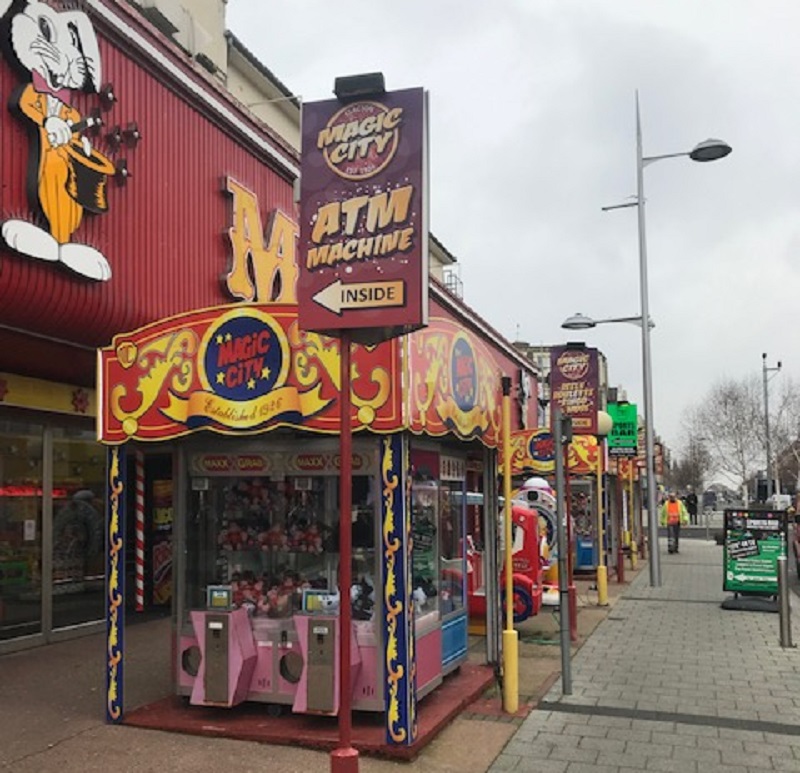
We head towards the sea front, across the precinct at the bottom of Station Avenue and onto Pier Avenue, a tight single lane road down to Marine Parade on the front. The Magic City arcade hums away on the right hand side of us, with brightly coloured buzzing machines lined up outside and processional banners pronouncing that it has an ATM inside in case you’re short of cash. On the other side is Amusements Gaiety Amusements, a clunky but base-covering name if ever there was one.

“Molly, get back here!” a woman in a tracksuit looks up from smoking to shout at her dog, soaked through as it bounds up to greet us. “Not everyone wants a wet dog bothering them.” We smile politely and side step the animal, which is now more preoccupied with trying to chew its own backside. We’ve walked down the coastal walkway and are now on the thick sand of the beach. It brings back pleasant memories of being here all those years ago. Martello Tower E sweeps into view.

The towers were original clad in white render but that has long ago been lost to the harsh winds whipping off the sea. According to the information board in front, it was somewhat bizarrely converted into a family home after the Napoleonic War finished and then in 1938 it became a water tower for the new Butlin’s Holiday camp. Clacton was the second site chosen by Billy Butlin for his burgeoning holiday camp empire, the first being Skegness. Butlin’s second camp was built on the West Clacton estate in 1936. It opened in 1937 and added a camp site a year later, able to accommodate 1,500 holidaymakers.

Just like Butlin’s in Skegness, the army took over Clacton Butlins in 1939. A plan to turn it into a POW camp complete with barbed wire and flood lights enraged the locals and was eventually dropped. Instead the camp was used to house the survivors of the Dunkirk evacuation. While Skegness Butlin’s was left in a reasonable state after the war was over, the Clacton site was a mess and it wouldn’t reopen to holiday makers until spring 1946. During the 1950s and ‘60s Butlins Clacton grew rapidly, adding chalet accommodation and increasing capacity to 6,000. Cliff Richard made his professional debut at the camp and it was featured in the closing credits of popular BBC sitcom ‘Hi-de-Hi’. Just as with Skegness, Clacton Butlin’s hit problems in the 1970s with the rise of cheap holidays to Spain and other sunny European destinations. In 1983 the camp closed down – at the time it employed 900 seasonal staff.

A buyer was found for the site and it reopened as the Disneyland-style Atlas Park in May 1984, but that lasted just four months before the owner hit financial problems. Everything left in the park was auctioned off and the land sold to developers, who turned it in the housing estate that sits on the site to this day. The estate utilises some of the original chalets and footprints. It feels a long time, though, since you could hear the call of the Butlin’s red coats echoing around the coast. Tourism remains a key part of the economy in Tendring, estimated to be worth more than £1m a day in revenue and accounting for 16% of jobs in the district.

We walk further onwards towards the next Martello tower. It is somewhat dilapidated and in need of repair compared to Tower E. Next to the beach is Clacton-on-Sea Golf Club. A group of men stand around waiting to tee off as we walk past. They’re all dressed in expensive looking golf gear and guffaw at a shared joke. One of the men approaches the tee, steadies himself, sucks in his sizeable gut and then hoofs the ball around 10 yards straight into the water trap. He tries to style it out, as though he meant to do such a thing purely for amusement, but his friends had already begun the mockery.

Further up the coast is Jaywick, named one of the most deprived places in the country in 2011, with more than half of working age residents receiving state benefits. Jaywick was again named England’s most deprived area on the Indices of Multiple Deprivation list in 2015 and will most likely feature again in 2020. It is internationally renowned, too. A view of Jaywick was used by a US Republican party politician and congressional candidate, Dr Nick Stella, in a political attack ad against Democrat opponents. ‘Only you can stop this from becoming a reality’, the slogan warned.

Jaywick was the location where Channel 4 recorded the controversial Benefits by the Sea reality television series. Critics accused the broadcaster of developing a new genre of ‘poverty porn’ that enabled middle class people to gawk at the deprived lives of those less fortunate, akin to some modern day freak show. However, you can imagine the Channel 4 film crew had spent much more time with the residents of Jaywick that any politician had at that time, or since.

Credit: Facebook

In the drama, Brexit: The Uncivil War, Carswell is depicted as visiting Jaywick with Vote Leave chiefs, Matthew Elliott and Dominic Cummings. They arrive at a run-down estate in Jaywick and Carswell is depicted, with arguable accuracy, as saying: “I don’t know this place.” The actor playing Cummings cutely replies: “Well, it’s in your constituency.”

Multiple complex issues combine in Jaywick, but one notable problem is housing. Much of the housing in the area was built for holiday homes aimed at people coming from London for a break. It was never designed for year-round living. Grumblings abound among residents of a disinterested local council unwilling or unable to tackle the problems in housing and beyond. They are the truly left-behind, and so it is unsurprising that a vote for the status quo in the EU referendum was never going to appeal.

As time is tight on our visit, we don’t walk further on towards Jaywick and instead head back towards Clacton to explore the town. (I fully appreciate the contradiction of criticising politicians for declining to come to Jaywick, and then doing exactly the same myself.) As we head back along the winds-swept but pleasant beach walk, a woman with purple hair strolls past us, dragging two small dogs behind her that have become preoccupied with a much larger dog, who in turn appears somewhat reticent to engage with proceedings. On the sand a mother and her children pick up litter from the sand and put it into a bin bag. It’s clear this beach is well loved.

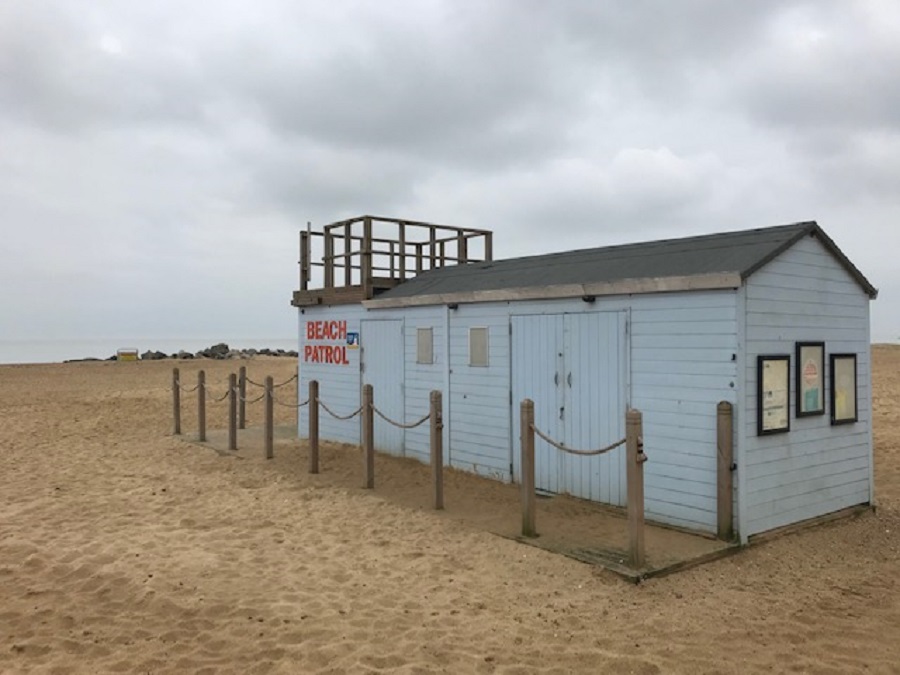
The sand is thick and inviting. A squat hut sits with the words ‘Beach Patrol’ written in red on the blue painted wood. The Essex coastline is one of the most protected in Britain due to the wildlife. It has the strongest level of European preservation under the European birds and habitat directives. Further on, a memorial marks the spot where Sir Winston Churchill, then the first lord of the Admiralty, made a forced landing in a naval seaplane in April 1914. If it had happened today, Sir Wintson could have availed himself of the offer of an unlimited breakfast for £4.69 at the Toby Carvery nearby while he waited for a rescue.

We walk back into town and see a rather dour looking Premier Inn hotel, which sits on the site where the house on 7 Marine Parade once was. This was home to my Great Great Great Uncle William Willis in the 1880s until his death in 1892. William Willis was a Master Mariner and Shipowner who was born in Wivenhoe but retired from a life at sea to Clacton-on-Sea and took on the role of Harbour Piermaster in the 1880s until his death. (Credit must go to the countless hours that my Dad spent in the archives of the National Maritime Museum in Greenwich and the National Archives in Kew for this nugget of family history).

In front of the hotel sit some pretty landscaped gardens, each with a different theme, such as the Mediterranean Garden. A sign features a dog pointing in the style of Lord Kitchener with a message that says, ‘TENDRING NEEDS YOU: To bag it and bin it!’ Benches are everywhere, each with messages marking the passing of someone’s relative, loved one or friend. In one garden is a clearly well-tended memorial to PC Ian Andrew Dibell. In 2012 Clacton resident Trevor Marshall arrived home to find his neighbour, Peter Reeve, there to confront him. Reeve was armed with a gun. Marshall attempted to flee but Reeve shot at him and then pursued in a car. Marshall headed towards Redbridge road, where PC Dibell lived. He was off duty on that day, but upon seeing Reeve he dived in through his car window to seize the weapon. In doing so he was shot in the chest in a fatal wound. Reeve escaped, but his body was later found in a churchyard in Essex. He had shot himself. PC Dibell was given a guard of honour at his funeral and was later posthumously awarded the George Medal for gallantry, the first police officer to get the award for more than 20 years.

The sky above thickens with soupy clouds and it’s clear that rain is coming. We decide it’s time for lunch, and so head to Geo’s fish bar. A takeaway is at the front, and a restaurant at the back. A musty heat hits us upon entering. The décor is mostly based around brown melamine. It’s the kind of place with proper plates, bottles of vinegar on the tables and steaming mugs of tea. It’s cash only. I instantly love the place.

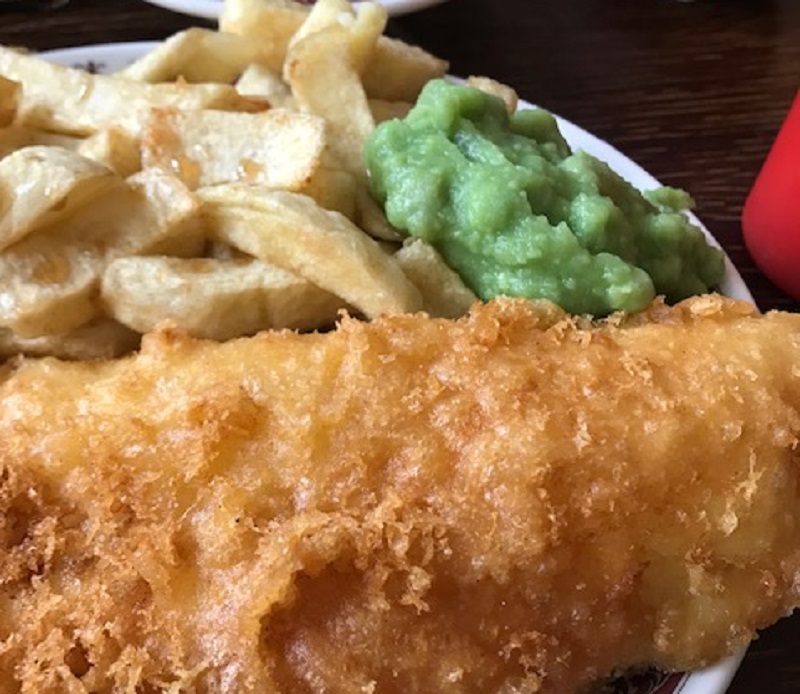
We sit down at a table and peruse the menu, while also eavesdropping on two couples nearby, average age of around 65, discussing the merits of different types of hearing aids. We order and not too long after arrives mountainous plates of cod and chips. The portions are huge – fish falling over the plate, chunky chips and a bucket of mushy peas. Bread is optional, but encouraged. We eat until it gets uncomfortable to go any further.

With a strong need to walk off about three pounds of solid food slowly digesting like a radioactive core in our stomachs, we head out to further explore the town. The last time I was in Clacton-on-Sea was more than 20 years ago. We find the specific spot where I posed for a photo in 1997. My messy thick curtained hair has reduced considerably over the years and the lines and wrinkles have deepened. I look at my previously fresh faced complexion and curse the passage of time. It is my fortieth birthday in a few days and I can now comfortably measure memories in decades.

Across the road is the Pink Palace Hotel, a passable take on a deco Miami hostelry complete with a vintage black American car parked outside. The rain that was threatened earlier has now arrived, so we head back towards town. An electrician argues with two men about wiring outside the Kassaba restaurant. “You can’t have wires exposed on the deck,” the electrician says. “Someone will kill themselves.” The other men don’t appear overly convinced by that argument. An amusement arcade fire truck ride rolls across the road, pushed by two workers hidden from view. It looks as though the ride has become sentient and made a break for freedom, but is now being pulled back into captivity. Go little fire truck, go.

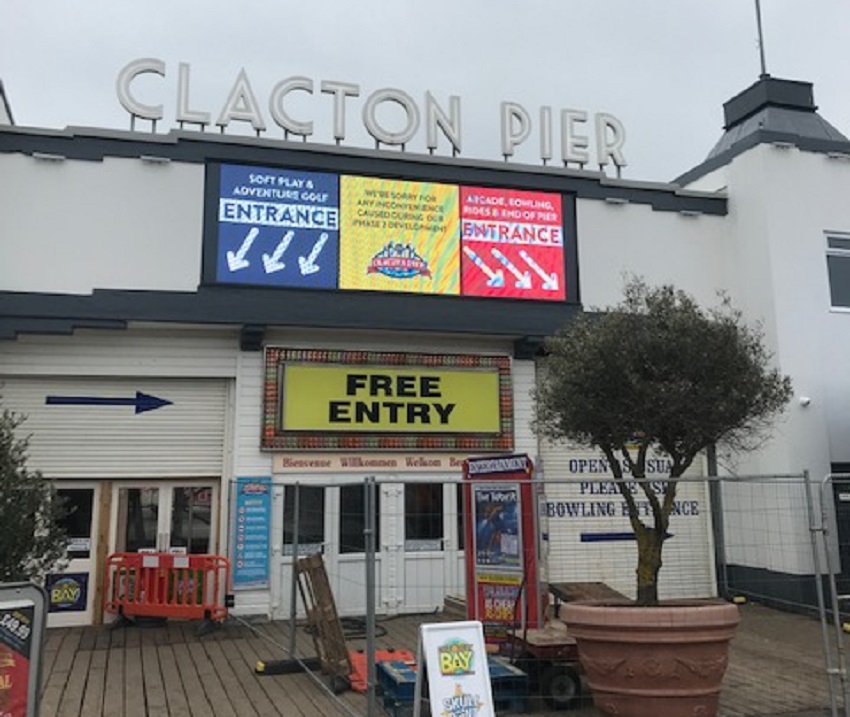
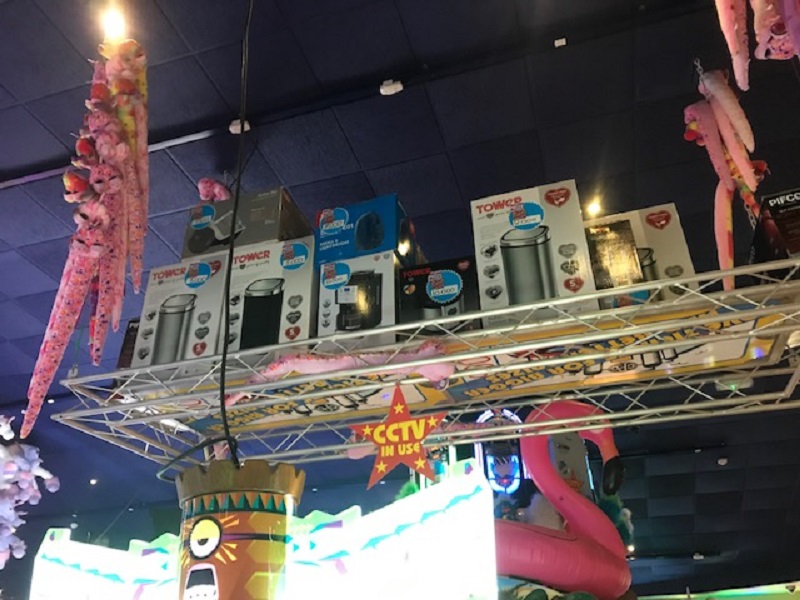
We follow the enslaved ride on its journey back to Clacton Pier. Although work is being done on repairs it is still possible on this spring day to get onto the pier. As we enter the amusement arcade we’re hit with the usual wall of noise. Hundreds of machines compete in a bleeping contest, punctuated by chattering floods of coins, like pots and pans falling down a flight of stairs. Prizes are available for winning tickets, and you can see the promised bounty hanging from the ceiling. It’ll take a rather daunting 10,000 tickets to win a slow cooker. Winning 8,000 tickets seems somewhat more achievable to take home a fetching pedal bin. Both challenges appear to be utterly beyond us, particularly as our reaction speeds are still rather slowed by the still digesting mound of carbohydrate in our stomachs.

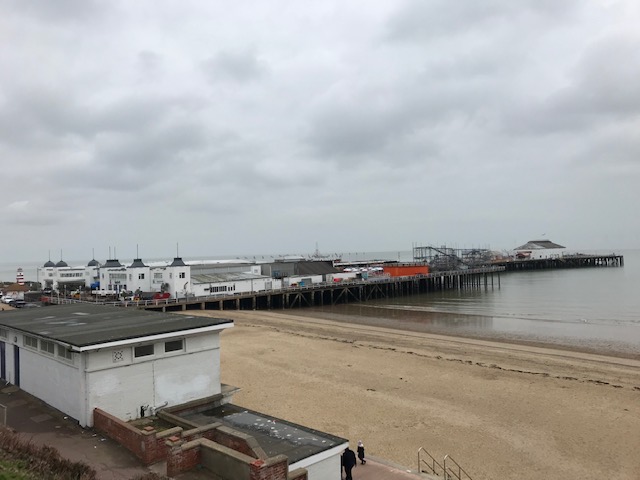
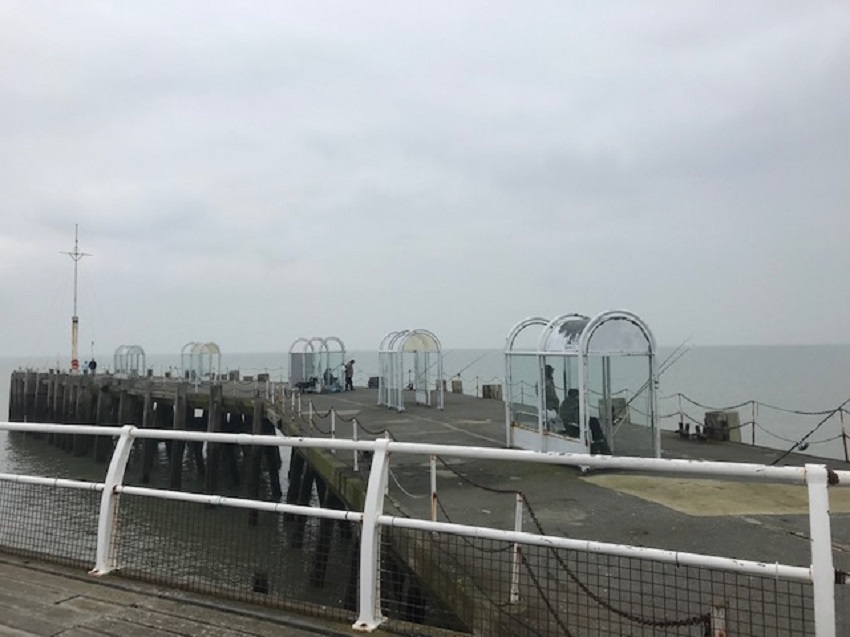
Instead, we leave the orchestra of victory behind and head outside onto the pier. The sea air whips across as we navigate the various attractions and amusements, most of which are closed for the winter. At the end is a rotunda café giving panoramic views out to sea. It’s virtually deserted on the wooden board pier, barring some men fishing at the far end inside glass walled enclosures, like bus stops, giving them some protection from the elements. Their fishing rods twitch in the air, but no one seems close to a catch. We stand and look out to sea, enjoying the moment and the silence.

Three months after my visit to Clacton, my employer, the consumer group Which?, would name Clacton-on-Sea as Britain’s worst seaside destination alongside Bognor Regis in West Sussex. Clacton gained a customer rating of only 47%, compared to 89% for Bamburgh in Northumberland and 81% for Southwold and Aldeburgh further up the coast from Clacton in Suffolk. Which? members surveyed gave Clacton just a solitary star for attractions, as well as peace and quiet. That rating possibly has basis but does seem rather harsh.

Clacton beach is well kept and inviting. Considering Clacton is only an hour from London, it seems strange that it doesn’t have the same pull as Brighton, with its pebble based beach lacking similar charms. While places such as Whitstable in Kent have reinvented themselves to appeal to holiday makers and younger people looking to escape London, it appears that Clacton is stuck in the past, frozen in time as the world around it changes. And in such circumstances it is always easy to look for who is to blame.

Exiting the pier, we head back towards town. It’s now late in the afternoon and the atmosphere seems notably tenser and more rowdy. As we walk back up West Avenue a pallid-skinned woman marches past with a twitching gait. Two men and a woman cackle loudly in the doorway of Peacocks clothes shop. “Yeah, well she can go fuck herself!” the woman bellows like she was calling out a food order for collection.
My Dad looks up at a Poundland store, ‘didn’t they go bust?” he asks. I blow my cheeks out and decide that it’s time for a drink.

We head to the Warwick Arms pub, surrounded by a bleak car park, like a moat made of concrete and weeds. The pub itself is a converted semi-detached house, with paving slabs of varying pastel colours in front from the golden age of ‘crazy paving’. Advertising boards outside promote the B&B accommodation and a function room for hire. It’s so dark inside that we aren’t sure if it is actually open. Undeterred, we try the door and venture inside. It’s 3pm and there’s a gaggle of drinkers at the bar. A few seem already several drinks into the session.

I motion my Dad to find a seat in one of the pinky-red velour booths, and then get us both a drink. All around the walls are mock Tudor beams. A couple sits at the bar. The man drinks a pint of lager and she has a sugary alcopop of some description. I figure they’re probably in their late 60s. A younger man talks to them, gesticulating with his pint to punctuate certain points. “So he needs to go into assisted living and the council says no,” he explains to a few ‘oohs’, ‘ahs’, and shaken heads. “So, I says, ‘look, you just bought a £3m building in town, how can you say no?’ Well, the bloke don’t know what to say to that, does he.”

The couple ‘tsk’ in agreement. A giant of a man walks in. He must be well over six feet tall and easily more than 20 stone. He walks with a cane. You could imagine he was called Frank or Dave or John, with either the prefix ‘big’ or ‘little’ depending on his friends’ penchant for irony. They continue to lament the alleged ineptness of the local council, occasionally look over with bemused indifference at my Dad and I sat in a booth near the window. I wonder if we would be pulled into the conversation or possibly have our heads kicked in. In the end neither outcome occured and we just finish our drinks and head back out into the afternoon drizzle.

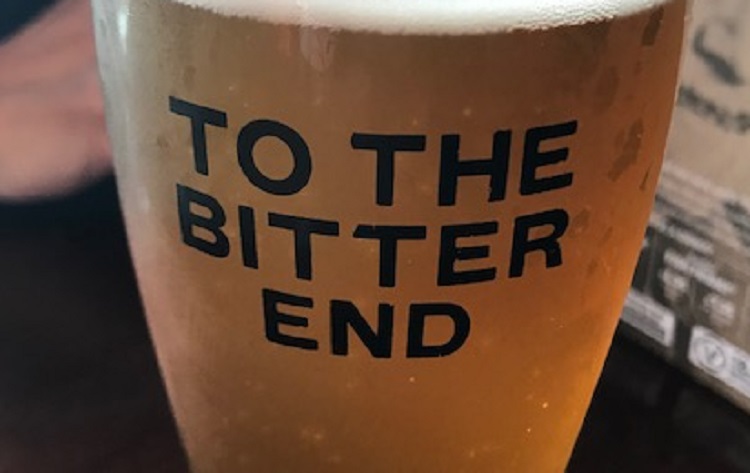
As is often the case with these trips, I end up in a Wetherspoons. It is, after all, hard to resist the siren song of cheap beer and sticky carpets. In the Moon and Stars, we get another drink and sit down on one of the high tables. A couple sat near the window canoodle each other, periodically slugging on large bottles of Hooch or going out for a cigarette break. The latest Brexit developments are displayed on the flatscreen TV on the wall. A man idly watches with a grim-faced expression. I look down at my pint glass. The golden liquid inside illuminates a marketing slogan on it. It says; ‘TO THE BITTER END.’

Next stop on our journey, Bristol

The End of the Line: Bristol

The End of the Line is a 10-part travelogue journey to some of the highest Remain and Leave areas in the United Kingdom’s 2016 Referendum on EU membership. It was written over two years from 2018 to 2020, before Coronavirus made Brexit seem like a spot of man flu.

Bristol voted 61.7% Remain in the EU Referendum

Originally written in March 2019 (before Edward Colston ended up in the drink)

Bristol’s always been a place that has evaded me. Not literally, of course, as cities don’t tend to move around that much. But rather nothing in my life ever took me there. The only time I ventured to Bristol was for a few hours spent at Bristol Temple Meads railway station with other festival goers waiting to head to Glastonbury by minibus. That was 1997, the year when Tony Blair stormed to power on a wave of big political dreams and a sound track of D-Ream. ‘Things, can only get better,’ the band belted out. Well, yes and no, as it turned out.

Pretty much the entire South West of England voted to get out of the European Union. The five anomalies in the more than 25 region block were South Hams, Exeter, Bath & North East Somerset, Mendip and, of course, Bristol. These remain redoubts now sit like blue lily pads, bobbing on angry ripples of a vast yellow sea. If so many of their neighbours wished to leave the European Union, why did Bristolians prefer to remain?

I take the train from Brighton to Bristol, changing at Fareham near Southampton. On the first leg of the journey, two men board my train carriage clearly in the thralls of a thunderous hungover. A whiff of stale beer and cigarettes wafts from them as we cross the river Adur out of Shoreham and past the airport. The man with the bigger beard and a nose ring leans his head on the window glass and says to the other, ‘Wake me up when we get there.’ The other man replies, ‘That means I am going to have to be the responsible adult.’ But his travelling companion is already asleep.
To keep himself awake, the man cracks open a pint can of Monster energy drink and takes a sizeable slug. A free table becomes available and they move over, with one remarking kindly; “Let’s move before we stink up the place.”
After they have settled, he orders his friend. “Now back to sleep with you.” The other happily obliges.

The sky outside is grey and pregnant with rain. The air already appeares damp but it’s clear that a greater deluge is on the way: the kind of rain that never relents and never seems likely to stop, until of course, it does. A misty haze hangs over the stippled green fields as we roll through the Worthing stations. East Worthing, Worthing and West Worthing: why a relatively small West Sussex town needs three station remains a mystery. Worthing voted Leave by 53%, as did neighbouring Adur (54.6%), Arun (62.5%) and Chichester (50.9%). By contrast Horsham, Mid Sussex, Brighton & Hove and Lewes all voted Remain, with the biggest margin being Brighton.

The flat landscape outside extends onwards, seemingly without limit. The sea of dull brown is punctuated periodically by the odd town or settlement. The garishly bright yellow puffer jacket worn by a boy sitting across from me begins to give me a headache. He has man-spreaded so successfully that, even though we are on a table of four with two empty seats, I feel thoroughly boxed in. Outside, gnarled and naked trees stand starkly, waiting for more bountiful seasons to return. The hungover man gets off at Chichester, pulls his hood up and stumbles towards the exit and presumably a welcome bed somewhere.

Chichester station has a Waitrose next to it. You can always tell a posh place if there is a Waitrose. According to a 2018 report by Lloyds Bank, a home near a Waitrose supermarket sold for 12% more than the average for that neighbourhood. You’d get a value bump, too, if you live near a Marks & Spencer or branch of Sainsburys, but Waitrose remained the golden ticket for middle class England.

Just outside of Nutbourne, a tatty Union Jack floats in the wind on someone’s conservatory. Onwards we go through fields punctuated by clusters of identikit new build homes forming new towns with humorous names, like Warblington. The man-spreader gets off at Havant, and I enjoy a momentarily delicious return of my freedom of movement, only for a woman to replace him and block the entire table with her huge suitcase.

At Cosham, a woman waves at the train with a look of sheer terror on her face. She looks right at me, but also beyond me. Should I wave back? Will she curse me if I don’t? Is she a ghost of a passenger lost in the never ending delays that blight our railways? She is at once a warning from the past and the future. By the time I have decided it’s probably best to hedge my bets and wave back, we’ve already long left the station. Outside, rows upon rows of houses roll past the train. Each has its own story to tell. Laughter, tears, love, hate. Christmas arguments, birthday surprises, shouting matches: all the stories I will most likely never get to hear.

Finally we arrive into Fareham and a short wait to get the connection to Cardiff that stops at Bristol Temple Meads. A bitter wind lashes the open station, cutting me to the bone. I step from one foot to the other to keep warm until the three-car train arrives. I take a seat at a table. A woman opposite me gives me a disapproving look for disrupting her afternoon with my desire to sit down. She peers at a magazine with mouth open a sliver, as if slowly sucking up the printed words and pictures.
“Can I get a coffee at Eastleigh?” she asks the passing conductor.
“Yes,” comes the reply. “There used to be a trolley service on this train but that went in the cuts.”
“Oh,” the woman says, full of concern. “What a shame.”
She dutifully gets off at Eastleigh, bearing what appears to be the entire contents of clothing shop Primark in a series of large paper bags, forcing me to duck out of the way as she passes.
At the station a huge group of middle aged women get on and embark on a chaotic journey to find seats together. ‘One there, one there, one there,’ a woman with frizzy hair bellows at the others behind her. They fret about two people who have sat further down the carriage, until they are shamed into re-joining the group. Bags of crisps, sausage rolls, sweets and other snacks emerge in a festival of chomping. ‘Anyone want a chocolate mini-egg?’ ‘Sausage roll?’ ‘These are gluten free?’
My stomach rumbles.

The rain that was advertised earlier has now met its delivery slot. A thick soupy haze hangs in the air. The train approaches Westbury. The group of women conduct a similar kerfuffle when getting off the train, with the frizzy haired lady once more acting as the cox.
“It’s this stop, get up!” she bellows.
“Alright Elaine, you’re not the conductor!” another woman responds.
They all get off. One woman, called June, straggles behind and they urge her to hurry up. She looks at me smiling as she goes past.
“Now you can have some peace!”
I smile back.

In the far distance out of Westbury you can see the White Horse, a giant horse embossed in the hills and the oldest such marking in Wiltshire. The skies darken further as we near the beautiful sandstone buildings of Bath Spa. Sizeable estates stand guard over the lush green countryside. Towering manor houses watching over everything they survey. Rugby pitches dominate over football. Then can be seen long, proud rows of attractive houses. Everywhere, wealth pervades.

Eventually, the train arrives into Bristol Temple Meads station and I get off. Although the station is grand in scale and appearance, the area around it at the time is definitely a work in progress. A messy tangle of road works herald development, but right now create a circuitous and laborious maze to navigate into town for the pedestrian. Every passage appeares to be blocked either by plastic barriers or exhaust fumes. Eventually I emerge, slightly bewildered, close to the harbour and spot for the first time the lovely, brightly coloured rows of houses that gild the cliffs around Bristol harbour.

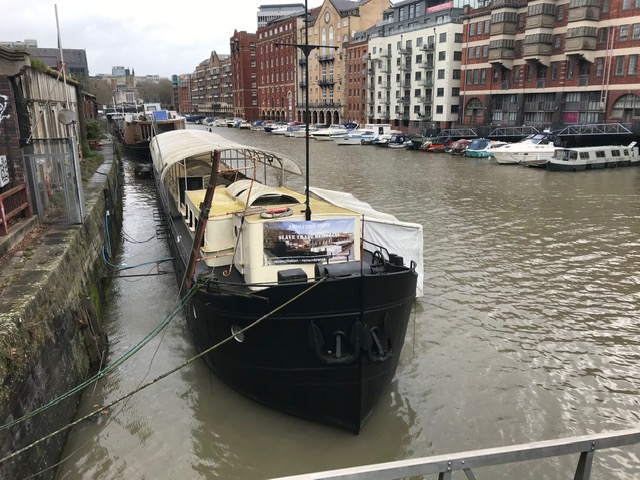
With an estimated population of 459,300 people at the time, Bristol is the largest city in the South West of England. It’s a youthful city, with more children under sixteen than people of pensionable age. Like Brighton and Liverpool (similar shipping history and also voted Remain at 58.2%), but also Amsterdam in many ways, Bristol is a place where wealth, history and youth combine to create somewhere unique. It’s a place of substantial development. Bristol City Council has committed to building more than 2,800 new homes in the city in the 2019/20 financial year. The area around Bristol Temple Meads was designated as the first of the Enterprise Zones in the 2011 Budget. Some 11,000 homes were to be created in the 70 hectare site and the station given an upgrade. As I walk over the canal a barge boat hangs a big banner for an Abolition and Slave Trade Memorial. The message states; reconciliation, remembrance, reflection. As I will find over the course of my visit, Bristol is a city eagerly eyeing the future, but also grappling with its past.

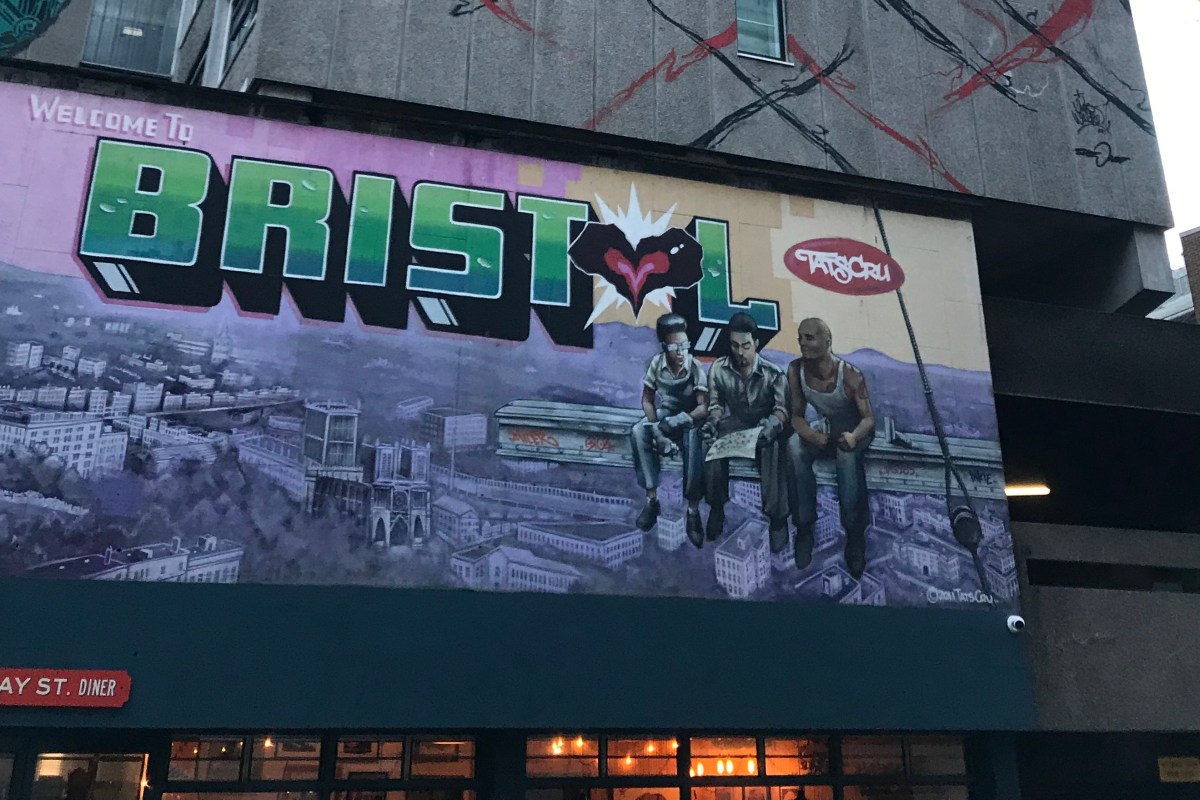
Leaving the spaghetti junction of road works, I reach Queen Square. A group of tourists are receiving a tour and I stop to steal a few eavesdropped moments of local history while pretending to inspect the statue of William III on his horse. I head further into town. Bristol’s a cool place. Trendily dressed young people mooch about town, some ride on bikes in convoys like you see in Amsterdam. There are huge graffiti murals, celebrated as pieces of art rather than just urban blight. Shoppers browse eye-catching vinyl albums in Rough Trade Records.

The precinct ahead is more akin to any English city. All the usual chains are here and teenagers hang about trying to entertain themselves. A lad on his bike deliberately blocks my path and chuckles as I have to walk around. I ‘tsk’ and shake my head at him as is the way to register displeasure without getting a right good kicking in return. There is an edginess to Bristol town centre, but no more than anywhere. The wind dashes through the precinct, the earliest warning of the coming Storm Freya. It had already been dubbed a ‘killer storm’ by the papers but no one seemed overly bothered here.
“Still better than last March,” the barman in the Drawbridge pub says as he pours my pint. “Made a right mess of my garden.”

Everton are playing Liverpool and it is being beamed out on giant tellies throughout the pub. Outside, a couple of street drinkers walk down the road, bellowing at each other. The barman clearly knows them well.
“Who’s that bloke e’s with?” a drinker asks at the bar at the kerfuffle outside.
“That’s his wife!” the barman replies.

The row outside starts to settle down, as other homeless people gather with the group. Sleeping bags are draped round their necks as they try to fend off the already freezing temperatures.
“Hope they’ve got somewhere to go tonight,” the barman says as he cleans some glasses.

After finishing my drink, I take a walk down the waterfront area. Alongside the Watershed pontoon, people slumped in shop doorways periodically emerge from the gloom to ask for change or a cigarette. According to figures from Bristol City Council, there were 82 rough sleepers in Bristol in late 2018, the fifth highest number nationally at the time and up by around 50% on 2014’s figure. Thanks to a tough economic climate and skyrocketing rents in the city, many have been left without a home. The city council’s rough sleeping team had contact with 951 people in 2018, up 23% on the previous year. The gaggle of street drinkers seen outside the pub earlier passes me as I head back towards King Street.

Small Bar turned out to be, in actual fact, not that small. Behind a thick wooden bar stand two trendily dressed people serving up advice on all the beer selections on offer, and periodically taking orders for fried chicken and burgers served in plastic baskets. A small tuck shop offers a range of retro snacks, such as Kinder Eggs and Pickled Onion Monster Munch crisps. Art on the walls appears to have come from am upmarket tattoo parlour. The tables are formed of old scaffolding tubes and joints, and there are the inevitable filament lightbulbs hanging from the ceiling.

Still, though, it’s a nice enough joint with a bubbly, youthful clientele. A woman with strawberry blonde hair talks loudly and with ferocious speed about everything from her art to her daily Pilates routine. The bearded man she’s with nods, smiles and laughes heartily at all the right places. Time to move on. The King William is opposite Small Bar, in more ways than one. It’s a Sam Smith’s pub and so has both cheaper prices and more grizzled drinkers. A group in the front bar decides not to even bother hiding that they’re topping their pints up with cans brought with them. The barman appeares to have stopped caring a long time ago. I order a pint of Taddy Lager (imagine a beer made from diluted cordial) and head to the back of the pub. A couple are deep in conversation but look up at me as I take a seat.
“Is she bothering you?” the man asks me, motioning to the woman, “because she sure is bothering me!”
They laugh at the tediously predictable joke. I manage to muster a weak smile in return and hope that this is the end of the audience participation.

It’s getting late and my stomach is wondering why I am ignoring its clear and unequivocal rumbles. Before I seek sustenance, though, I am tempted sufficiently to pop into Kongs of King Street, a trendy loft style bar with neon, craft beers and retro video games. A row of arcade machines sits at the back of the bar. I buy a pint and then play Megaman, quickly realising that I have no idea what I am doing and have always found this game deeply annoying. Instead, I sit down and watch a group of friends play the Tekken fighting game on a projector screen. A panda is selected to fight an obese man on an exploding oil rig. I share a bemused look at the combination with the two underage drinkers also watching the action close to me. When in Rome, I guess.

Dinner is had at Pieminister, an expanding Bristol-based chain serving up, well, pies. The service is somewhat chaotic that evening, with staff appearing stretched despite it being 10pm and the restaurant relatively quiet. The pie is well received when it arrives, though, with thick, rich pastry and a good filling, plus decent gravy on the side. I pay up and head out into the cold, night air. A couple of street drinkers argue over something outside my hotel, barking in incoherent angry slurps. ‘Hope they have a bed for the night,’ I think. I feel guilty that I have a warm and cosy hotel room to myself, but soon sleep takes me.

Clifton Down

I wake up, unsurprisingly, in the same hotel room on my own. Today is my 40th birthday. Forty years spent living in England. Forty years on planet Earth, and all I have to show for it is the foresight to buy a breakfast sandwich the night before from Sainsbury’s. I make a cup of black coffee (never trust UHT milk) and tuck into my meagre birthday breakfast bounty. Maybe I will wrap up the shower gel and then I can pretend that someone bought me a present to open. No, mister, you just sit there and eat your sandwich and think about what you’ve done.

After showering the tears out of my eyes (joke), I check out of the hotel and head off to explore more of Bristol. As you might have noticed, Bristol Temple Meads isn’t at the end of the train line. There were a number of reasons why I was drawn to this city, but I have started the End of the Line shtick now, so had better convolute some reason to be here. Clifton Down station is therefore my destination today. If you don’t like it, write to your MP and they can ignore it, too. I walk down by the quay side, past the Andolfini Contemporary Art Gallery and over the bridge to Wapping Wharf. A café has cable spools overturned and made into tables. Thick metal links sit in bunches on the floor for the boats to tie up to. Red-faced joggers pant their way across the cantilevered bridge. Cool-looking kids wearing big headphones head to work or University or to play ironic Tekken.

Heading onto the wharf you can see the giant shipping cranes, stretching up like industry edifices. In the 1300s Bristol was the second most important city after London. This had been made possible after the River Frome had been diverted to create a wider channel able to take bigger ships into Broad Quay, just further up from Wapping Wharf. In the 1400s the trade with France declined and merchants looked farther afield for riches, to the Far East and also eventually, Africa and the Caribbean.

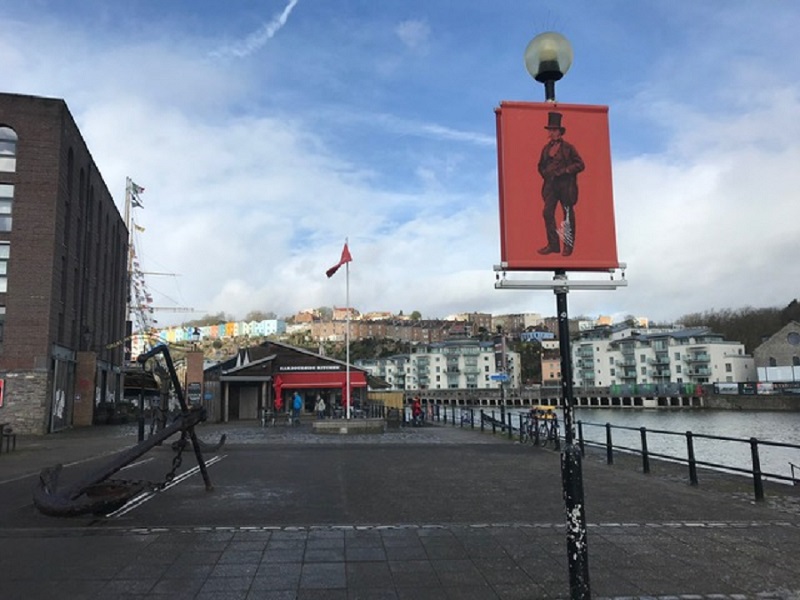
Bristol remains a working port city, but it has moved with the times. Around the corner from the cranes, shipping containers have been stacked and converted into a venue for shops and cafes. Further up past the dockside railway, a modern complex of flats promises quay-side views. It had started to drizzle when I reached the SS Great Britain, the first propeller-driven, ocean-going, iron ship to cross the Atlantic to America and the largest passenger ship of her day in the late 1840s. The ship was designed by a genuine British genius of industrial design, who could arguably claim the title for best name in history, Isambard Kingdom Brunel.

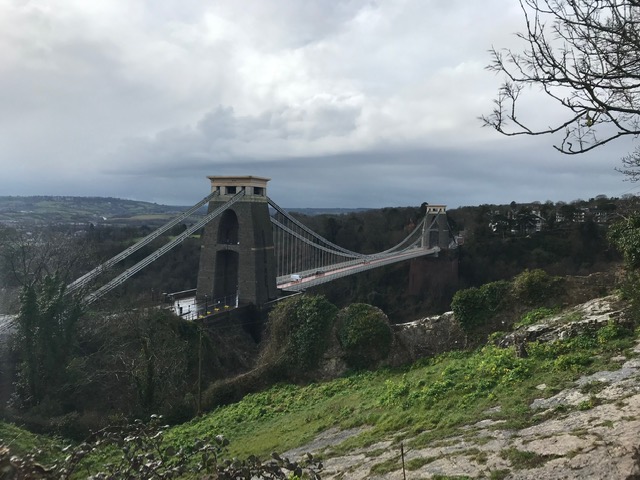
The SS Great Britain, along with the earlier SS Great Western, had revolutionised ship design. Brunel died shortly after the ill-feted launch of his industrial, sea bound monster. It had a controversial life, but still made its mark. Brunel seemingly could turn his mind to any design challenge. It was his original design that was adapted by William Henry Barlow and John Hawkshaw to create the Clifton Suspension bridge that spans Avon Gorge over the River Avon, linking Clifton with Leigh Woods in North Somerset. The Grade 1 listed bridge remains a symbol of Bristol to this day.

The clouds above me darken as I move on through the dockside, passing the Underhill working shipyards filled with various businesses, from ship buildings to artistic iron workers. The South West accent has a wonderful sing-song lilt to it.
“You wan me tow bring ‘em dowen, or rrr yoo gon come ‘erp?” a man in overalls calls from the top of a ship being repaired to an unseen colleague. I can’t help but smile at the sound.
I head on over Spike Island (not to be confused with the island in the Mersey where the Stone Roses played a notorious 1990 concert) and then travel up to Clifton. Halfway up the ridiculously steep hill, and with nowhere to shelter, the clouds open and the rain pours down in an absolute deluge. Happy birthday to me, happy birthday to me….

I can just about make out a pretty row of dockside cottages as slicing cold sheets of rain batter my face in diagonal lines. It’s the type of relentless rain you get occasionally in England. Most time it’s just a drizzly cold war of attrition, but on occasions that escalates into extreme atmospheric bombardment. I scan the submerging scene desperately for a coffee shop but my glasses have steamed up to such a degree that I am temporarily debilitated. I stagger about like Mr Magoo, my clothes getting more saturated and tighter with every step. In a mad panic I plough up Granby Hill and immediately regret relying on Google Maps. The road proves to be a near vertical grind up the hill, all the time the weather slapping me around the face like a dandy goading me to a one sided duel.

Eventually I reach the top of the hill and the salvation of a coffee shop. I stumble inside, sit down and watch through the window as the rain magically stops and a sliver of sunshine punctures the clouds.
‘Well played, weather,’ I think to myself. ‘Well played.’
My clothes are so soggy and wet that they had begun to steam. My hair (well, what’s left of it) is slapped to my forehead as though I am Lego mini figure that didn’t pass quality control. I shiver and clutch my coffee for warmth. Meanwhile, at a nearby counter a woman is eulogising about the benefits of eating dates.
“Before I came here I just thought they were for my grandma,” she says happily to the waitress, who is politely showing interest.
On another table a bald man talks loudly on his phone while staring at a spreadsheet on his Macbook with an expression of mild irritation. Another lady enters, orders a lemongrass and ginger tea, and finds a seat.

Outside I see the Clifton Village Fish Bar, with a sign in its window proudly stating that it is in the top 100 fish and chip restaurants. But where, I wonder? Is it 1st place or 99th? That seems an important bit of information to know. Much like Bath, Clifton Village exudes wealth. The average price of a house sold in Clifton over the past year was £436,076, almost twice the national average property value of £225,621. The average price of a flat sold in Clifton was £349,838, a terraced property would set you back £699,533, while you’d need more than £1m for a semi-detached house, according to data from Right Move.

You can understand why people would want to live here. Tall sandstone buildings stand elegantly around well-presented squares. Boutique shops and cafes line the main roads. Expensive cars sit parked up waiting for their owners. The Clifton Suspension Bridge is not far away, and nearby it the Clifton Observatory. The view from there is staggering, with the sweeping bridge straddling the gorge and the undulating Somerset hills further ahead. If I wasn’t damp and freezing cold, I would have stayed and enjoyed it for longer.

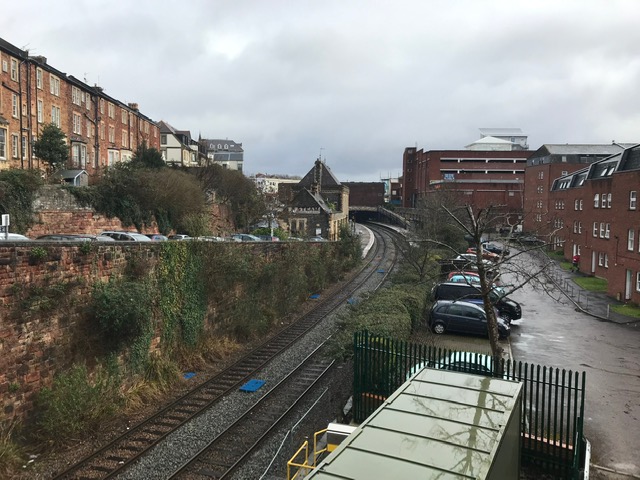
Dropping down through the park at the back of the observatory I soon find myself on Clifton Down, a grand road that curves around the Cliffside green space. The road is lined on one side by huge buildings that were clearly once the homes of very wealthy individuals (and, no doubt, many still are). Here the fortunes made from shipping and maritime industries forged mansions for the prosperous and fortunate. Eventually I find Clifton Down train station. This used to be a through station but now trains go just one way from both platforms towards Avonmouth, Bristol Temple Meads and, an actual end of the line station, Severn Beach in South Gloucestershire. Severn Beach is just 24 minutes away from Clifton Down station, yet is located in a region that voted 52.7% to leave the European Union. The reasons for such a scenario are presumably too complex to generalise, but it is perhaps telling that the average house price in Severn Beach is £235,184, nearly £200,000 less than the average for Clifton. At that rate you are losing just over £8,000 in property wealth for every minute of the train journey.

Clifton Down station is pretty nondescript. It has two platforms, but with just one way in and one way out (with a disused tunnel in the other direction). The platforms are dingy and dank, being in the shadow of the brick mountain that is the back of the Clifton Down Shopping Centre. The drizzle continues as I walk down the platform. A woman asks me where she can get a ticket for the train. “Ah,” she says after I point her to the ticket machine she is standing right next to. I walk up the stairs to leave. A homeless man stands at the top taking shelter from the rain.
“Good morning,” he says, before correcting himself. “Good afternoon, I should say. It’s nearly 12.” He peaks around the corner and points at the clock on the tower of Tynedale Baptist Church. “That’s how I know what time it is. That’s how I know.”

I exit the station and head towards Whiteladies road, passing the Black Boy Inn. Both names have had rumoured connections to the slave trade, but both with no clear basis in fact. Same is true for the myth that slaves were brought from Africa and held in caves under Redcliffe before being auctioned off. There is no evidence to support this, but an unchallenged myth has a habit of morphing through repetition into historical ‘fact’. However, Bristol does have a long association with the slave trade, and the modern city continues to grapple with its own complicated history. Nowhere is this more clearly seen than in the connection with one of Bristol’s most famous sons.

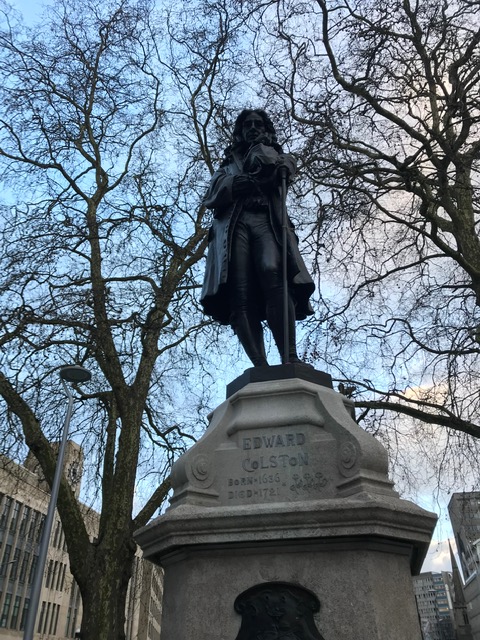
Edward Colston was a wealthy shipping magnate in the late 1600s, who became famous for his philanthropic work in the city. A significant chunk of his fortune came from the slave trade. During his time at the Royal African Company, it is estimated that between 1672 and 1689, Colston’s ships ferried around 84,000 men, women and children from Africa and the West Indies. It is believed that around a quarter – more than 20,000 people – died during the journeys as conditions were so bad.

There’s a statue of Edward Colston in the town centre of Bristol. When I visit it, the man looks down on me with disdain as I stand at his feet. The accompanying plaque says; ‘Erected by the citizens of Bristol as a memorial of one of most virtuous and wise sons of their city. 1895’. However, for much of Bristol’s population, the statue and the legacy of Colston jar with the modern world they live in. Bristol is a diverse city, with 16% of the population belonging to a black or minority ethnic group. However, a Runnymede Trust Report released in 2018 showed Bristol has the greatest disparity between white and ethnic minority communities anywhere outside of London.

Understandably, having a statue to a known slave trader has attracted protests. Graffiti drops of blood were once placed on it (rumoured to be done by Bristol artist Banksy). A red ball and chain was placed on Colston’s leg in May 2018. Rather less subtly in the 1990s, someone daubed ‘fu*k off, slaver trader’ on the statue. When I visit in March 2019 a guerrilla art exhibit had been placed at the statue involving human figures laid at his feet and words written on boards saying things like ‘sex worker’, ‘fruit picker’ and ‘kitchen worker’ in reference to the modern slavery that now blights society. Trafficked people from Lithuania had only been recently found locked up in a home on Hathway Walk in east Bristol.

There had been calls to take the statue down, in a similar way that statues of Confederate figures had been removed from parts of the United States. But how do you unpick Colston from the city? His name is everywhere: from streets to buildings, to pubs and halls. Every mention is a reminder that the city was made, in part, on the backs of slaves. Edward Colston’s statue sits on Colston Avenue opposite music venue Colston hall. You might as well call Bristol, ‘Bristol – brought to you in association with Edward Colston.’

However, the city is now quietly trying to shake off this controversial patriarch. The St Mary Redcliffe and Temple School said in February, 2019, that it would rename a house bearing Colston’s name to ‘reflect diversity’. It will instead become Johnson House, in honour of NASA mathematician Katherine Johnson. Assistant head Karuna Duzniak told Bristol Live: “We cannot change the past, but we can change the future.”

Such moves have inevitably stirred feelings of resentment among certain communities that they were being made to feel guilty or ashamed of Bristol’s history. Although there are clear tensions, it feels a healthy sign for a city to confront and challenge its past. Just as is happening with the Windrush Generation in Brixton, sections of Bristol’s society are beginning to ask important questions about the city’s past. Dealing with such a past does not mean that you were guilty of the crimes, or should carry the shame. Rather, to honour history means to confront it and to be prepared for answers that run counter to the prevailing view.

The Black Boy Inn is closed when I walk past so instead I go to the Jersey Lily for a pint. A big group arrives for lunchtime drinks, possibly from a local business. Another group near me discusses such diverse topics as computer hacking and being in the army. I finish my pint and then head back to Bristol Temple Meads to go home. Down Whiteladies Road, I pause as a man carries a 55-inch 4K television from Richer Sounds to his BMW. Across the road are two sofa shops – Sofa Shop (no prizes for that name) and the intriguing Sofa Library. You could imagine a terse silence inside as people pour over tomes detailing the history and theory of sofa design, punctuated by the occasional polite cough.

Veering off the main road I head onto Cotham Hill and down through the University district. Students are out for lunch and there’s a big queue for Parsons bakery. I take a meandering route back towards the station. More university buildings pass, some stylish and new, others old and austere. Then the Christmas Steps, one of the oldest streets in Bristol, this stepped way’s name is thought to derive from a bastardisation of its previous title, Knyfesmyth Street. Or it could come from nativity scene on the window of The Chapel of the Three Kings of Cologne at the top of the street. Or it could be just because Christmas Steps sounds good and attracts the tourists.

The River Frome originally used to run at the bottom of this steep hill and barrels would be rolled down the steps to waiting ships at the bottom. As with most things in Bristol, the sense of history is balanced always by the modern. Classic vintage shops are juxtaposed with trendy art galleries and a pub that’s dark inside for a deliberate reason. A man asks me for directions as I stand looking up at The Christmas Steps pub pondering another drink. I shrug and explain that I am not a local.
“Ah,” he says. “I used to come here when I was kid. It’s changed so much, I don’t know where anything is anymore.”

Crossing over the pretty Queen Square, I walk past the statue of William III once more. The edifice, which depicts William looking majestic on horseback, was erected in 1736 to mark Bristol’s support for the Crown and Parliament Recognition Act 1689. This rather bizarre piece of legislation, which stands to this day, declared that James II had abdicated, when in fact he had been allowed to flee to France after William had invaded England with the backing of the political elite and a rather sizeable naval fleet.

With James gone, parliament could not hand the crown to William of Orange until it had some sort of legal standing to do so. Hence the Crown and Parliament Recognition Act 1689 came into force, effectively saying, “Some really illegal stuff just happened but it’s OK because this gives it the rubber stamp of approval, so we’re all good, right?.” They would have loved Brexit, I think to myself. I look up at William’s statue. His face gazes fiercely towards the horizon, as though surveying another country to invade. A pigeon then defecates on his head, with the residue rolling down his cheek in a solitary white tear.

Next stop on our journey, Clacton-on-Sea


The End of the Line: Skegness

The End of the Line is a 10-part travelogue journey to some of the highest Remain and Leave areas in the United Kingdom’s 2016 Referendum on EU membership. It was written over two years from 2018 to 2020, before Coronavirus made Brexit seem like a spot of man flu.  

East Lindsay voted 70.7% Leave in the 2016 EU Referendum

Originally written in October 2018

On a boring train journey from London to Grantham, where we were due to change for a connection to Skegness, my girlfriend (still in post at the time) and I watch a terrible film. We half listen as two young men, all gangly limbs and charity shop chic clothing, planned their new events business. They were called Miles and Casper, but also had a business partner called Xander. Casper bristled with irritation as the important phone call he had left to make on a train kept cutting out, because, well, he was on a train. Presumably ‘for a thing’, they dissected the latest radio listening figures, expressing bemusement at how many people listened to popular radio networks, such as Heart FM.

We arrive into Grantham station conveniently as the connection we were supposed to get to Skegness rolls out of the station. An almost daily calamity somewhere on Britain’s modern rail network orbits a galaxy of guaranteed smaller inconveniences. A missed connection, an overly packed carriage, nowhere to sit, flooded toilets, and carriages more worn-in than a regional commuter service in Siberia. There’s always either a robotic apology, a weary apology, or, sod it, no apology at all. Overcrowded, overloaded, miserable; but at least our rail fares are reliably expensive.

On the platform at Grantham station two old crones eyed our still creaking train with docile expressions. They smiled at the new arrivals, revealing a mini Stonehenge of brown teeth inside their half-gaping mouths. One was under a blanket, the other seemingly melting slowly into the bench where they sat. It’s unclear whether they are waiting for a train, or just waiting.

With an hour to kill until the next connection, we hole up in the waiting room. A pretty stain-glass window depicts the glory days of steam trains in a rather stirring image. Around the edges are various destinations: Edinburgh, London, Durham, Doncaster. Coloured light shines through the windows, illuminating a vending machine in an ethereal light. A young man in a tracksuit ranges around it, wondering why his selected Monster energy was staying so steadfast in its original position.

Outside, trains whizz by with a ‘heee-hawnk’. The red and white livery of LNER blurs past, followed by the orange and blue of East Midlands. A towering woman enters the waiting room, peroxide blonde curls mounded on her head like a Mr Whippy ice cream. Leopard skin leggings cling to her for dear life. And then emerges a ginormous pink suitcase, like a veritable rolling wardrobe, pushed by her wiry husband, out of breath in a grey sports tracksuit.

We sit down on the scooped plastic of the waiting room chairs and idly take in the atmosphere. Two young women enter, all dressed for a night out, despite it being 3.30pm. They sit opposite to us and each retrieve a can of Bacardi Breezer alcopop from a bag.
‘Can we drink these here?’ one asks the other.
They shrug, crack them open and tuck in. The next train to Nottingham rolls in on the platform behind us. The women get up.
‘Easy to drink this,’ one says to the other, ‘Like fizzy pop.’

We watch as people got on and off the train. Two other women enjoy one last vape before heading off to Nottingham. They’re also dressed to the nines, cleavage raised up proud like IKEA shelving. They wear tight jeans with rips in them, as appears to be trendy again. Through slashed holes peek ridged rolls, like orange bread dough baking in a denim mould. They finish vaping and board the train for the 30 minutes-ish journey to Nottingham.

A man wearing a baseball cap, a giant spidery tattoo on his neck and drinking a pint can of energy drink, barrells down the platform trying to keep up with his girlfriend. Another man walks into the waiting room wearing a curious combo of a bobble hat and shorts. ‘Is it warm or is it hot? I just can’t decide’, he didn’t say. He squints up at the screen displaying train information. After looking away, the squint remains, suggesting that is actually his normal expression. A heavy-set man enters the room and body slams himself down heavily on a seat. He talks on the phone loudly, but it is impossible to understand anything apart from periodic expletives. Outside, a boy rides his bike down the platform. It starts to drizzle.

Eventually, the crawling passage of time does its work and the 2.27pm East Midlands train to Skegness rolls into the station. It was already half full with people coming from Nottingham. After everyone gets on and settles into their seats, the train creaks slowly out of Grantham and heads out through the usual industrial sprawl that tends to congregate around railway stations. Like unruly teenagers, dirty warehouses loiter in the area, while giant mega-stores are ringed by sprawling car parks. From a distance we see St Wulframs church, with its pretty, towering Medieval spire.

We first arrive into the market town of Sleaford. The attractively station’s tile mosaics add a splash of colour to the Yorkshire stone buildings. A woman boards the train. She walks on match stick legs, her face a blotchy nicotine colour. She appears twitchy, eyes darting hither and yon. She’s followed by an older woman, laden down with bags. She sits on a chair with the effort of someone who has just climbed Mount Everest. The train rolls out of the station as the drizzle thickens.

Onwards, through Heckington: an even prettier station, with rich red brick buildings, lead roofs and draping greenery. And then, the time has come – we arrive into Boston. This was the place with the highest percentage of the local population to vote for the Leave side in the EU Referendum, at 75.6%. The writing had been on the wall. According to the 2011 Census, Boston had the highest proportion of immigrants from Eastern Europe than anywhere else in England and Wales. Just over 10% of the town’s population of 65,000 hailed from old Eastern bloc countries, mostly Poland, earning Boston the unimaginative nickname, ‘little Poland’.

A Policy Exchange report from January 2016 described Boston as the least integrated place in England and Wales. In the research, Boston ranked lowest of all 160 towns and cities assessed based on how minorities were integrated on identity and structure, and how well they mixed with other ethnic groups in the town. An enclave of Tsykie and pierogi, it seemed, surrounded by a sea of Lincoln Lager and haslet pies. While Boston may have been dubbed ‘little Poland’, most of its population, in part at least, seemingly wished it wasn’t.

Boston station isn’t draped in St. George’s flags and burnished with ‘foreigners out’ signs. It’s just a station. Vending machine filled with overpriced snacks, staff looking bored, trains parading listlessly past and the only splash of colour being a large advert for a local Thai restaurant. A scrapheap sits by the trainlines on the way in, but it’s just a scrapheap. Not a smart-arse metaphor.

Rolling out of Boston station, the train passes by the river Whitham. A man eyes me suspiciously from a few seats ahead as I made some notes. I discreetly put my notebook away. New build bungalows and cookie-cutter homes pass by the window in a blur of mundane mediocrity. We arrive at Wanfleet and a barrelous man with high-waist trousers gets off. The male passenger down the carriage still fixes me with a stare. I try not to think how much he looks like a Brexit voter.

At just before 4pm, we arrive into Skegness station. It had stopped drizzling and there was even a hint of sun peeking through the grey clouds. We gather our things and head for the train door, careful to go the opposite way to the Brexit voter. The man, I mean, the man. As we exit the train, a gaggle of drunken women of varying ages chant, ‘oo are ya, oo are ya’, at no one in particular.

Skegness. Or, as it’s also variously known; Skeg, Skeggy, Costa Del Skeg, or possibly most optimistically, Skegvegas. This seaside town sits in the East Lindsey district of the Lincolnshire coast. It had a population of around 20,000 at the time of our visit in September 2018, many of whom worked in the seasonal tourism industry. The name Skegness may derive from the word Skegg in Norse language, dating back to the Danish period of settlement in Britain. Skegg meant ‘bearded one’, possibly referring to the beard-shaped headland on the banks of the coast. However, this could also be one of those historical ‘facts’ that is, in fact, total bollocks.

Outside the station is the Jolly Fisherman, a symbol of Skegness. At the time, the rotund fella was ringed by bright orange workman’s tape. It was unclear what, if any, work was actually being done. Skegness did start life as a fishing village, and it would be easy draw comparisons with disputes over fishing quotas that, for some, played a role in the EU Referendum. However, the Jolly Fisherman has little to do with actual fishing.

The development of Skegness as a seaside resort started in the early 1870s, led by the Earl of Scarborough. This culminated in the railway line opening in July 1873, effectively putting the small town on the tourism map. In 1908, Great Northern Railway wanted to turn Skegness into a premier seaside get-away. It needed an eye-catching advertising campaign and so turned to the work of an obscure painter called John Hassell. Hassell depicted the rotund Jolly Fisherman skipping with gay abandon down Skegness beach in a classic railway tourism painting. The slogan accompanying it noted, ‘Skegness is SO bracing’.

OK, the bitter North Sea wind is face-burningly cold, but do you really want to highlight that? It would be like Manchester saying on a poster, ‘It rains all the time’, or London going with, ‘watch out for your valuables’. The slogan stuck, though, and became somewhat of a badge of honour for the town. The poster worked, too. In 1913, 750,000 visitors flocked to Skegness. John Hassell apparently died penniless if reports are to be believed.

Tuck in, kids!

Oh, to be by the seaside

Despite growing up in the North of England, this was actually my first visit to Skegness. The place was instantly familiar to me, though. I used to holiday frequently further up this part of the English coast, including to Robin Hoods Bay in the North York Moors, along with Whitby and Scarborough. I have fond-ish memories of spending time in a Haven holiday camp in Primrose Valley when I was young. My mum, sister and I stayed in a static caravan. I can recall wearing shorts and a t-shirt, going to the camp disco with my mum and sitting with a styrofoam cup of slimy prawns listening to ‘So Macho’ by Sinitta. Ah, good times.

Haven was not the first British holiday camp. That was created in Ingoldmells, a parish north of Skegness, by Sir William Heygate Edumund Colborne Butlin, more widely known as Billy Butlin. Butlin was a South Africa-born entrepreneur who had escaped a troubled early life to build a tourism empire in Britain. He had originally opened a static fairground in Skegness in 1927. He was making a good living, but realised that the real cash was to be made by also offering accommodation. He opened Butlins Skegness in 1936, followed by his second site in Clacton in 1938. During the Second World War Butlins was occupied by the Royal Navy, renamed as HMS Royal Arthur, and used for training. There were up to 4,500 personnel barracked there and it was bombed by the Germans in 1942.

Butlins enjoyed huge success in the immediate post-War period, but fortunes changed in the 1970s as the rise of cheap package holidays to Spain decimated the UK seaside towns. Alongside being affordable, Costa Del Sun also wasn’t face-meltingly cold for most of the year. Butlins Skegness remains in operation to this day, but has diversified to music events and festivals to broaden its appeal. As of 2018, it attracted a reported 4m visitors a year and generates millions for the local economy.

Skegness has been twinned with the chocolate box German town of Bad Gandershien since 1979. Yet, Skegness’s local council in 2018 was majority UKIP. At the time of our visit, it had nine UK Independence Party councillors to eight Conservatives, two Labour and one Independent. Vote Leave blanketed Skegness around the referendum. Posters littered the roads with big promises about ‘taking our country back’. It worked; East Lindsey voted to leave the European Union by 70.7%, just a touch behind neighbouring Boston.

On Sunday, 26 June 2016, three days after the vote, at around 6am Matthew Lewis White strung a makeshift border across Sea View road in Skegness made of wheelie bins, bits of fencing and a pushchair. The man, in his early 20s who was allegedly still intoxicated from the night before, took it upon himself to enforce the not yet agreed border to our European neighbours. When Adrian Carrington-Hunt approached the unofficial barricade at 6.55am, White demanded to see his passport in order to let him pass.

Carrington-Hunt insisted that he didn’t have a passport with him (or, possibly, pointed out that he didn’t actually need one to go down a road in Skegness), but White was insistent. After Carrington-Hunt attempted to break the wheelie-bin barrier down, White head-butted him, exulting: “Now what are you going to do?” After pleading guilty White was given 12 months conditional discharge and ordered to pay £100 in compensation.

We exit the station and walk towards town. High Street is a narrow, near pedestrianised street with faded shops boxing you in. A few branded chains have set up in Skegness but mostly you’ll see local shops with names like Flippers, Spall’s and Peter’s. Vape shops sit next to fish and chip bars. Sweet smells combine together in an intoxicating mix. Many people rove around in mobility scooters, wheelchairs or have some kind of mobility aid. Some look way too young to be in such a situation. As we walk down the High Street news of the latest Brexit debacle sounds out on a radio. No one seems bothered.

Why didn’t I book the Quorn hotel?

Onwards we head to our hotel, located on the main seaside strip. We head down the promenade past the bingo calling arcades and what must be one of the biggest Yates’s Wine Bars in Britain. We pass people enjoying the afternoon Skegness fun. Tribe-like families bounce from attraction to attraction, with mothers and fathers herding children like angry shepherds. An irate father tries to calm his daughter’s volcanic meltdown by lifting her up by her pony tail. All around rings the orchestra of the seaside; the bleep of machines, the lyrical chime of announcements, the thunder of music systems competing against each other, and groups of people shouting their approval for everything and nothing. And in the far distance, you can just about make out the hushed tones of the North Sea lapping against the sandy Skegness beach.

The Grand Hotel is a dusky peach and maroon guesthouse nestled in a row of seaside hotels. Close by is the Quorn Hotel, presumably hoping to hook in the vegetarian crowd. I rebuke myself for not booking just to see if the meat substitute theme continues within. As with most regional hotels in England, The Grand Hotel has a whiff of Fawlty Towers about it. There’s an atmosphere; an uptight tension so delicately restrained. Andreas checks us in. It’s a brisk process enabled by booking online in advance, as is the norm these days. We head up to the room, eyeing the Stannah Stairlift runners on every staircase as we go.

After spending a few moments checking out a basic but functional room, we venture back out to explore Skegness. We head straight to an arcade, with the blast of noise almost as bracing as the North Sea air outside. Inside, it’s mostly gambling machines; slots, bandits, electronic casino terminals. Many are themed to the Deal or No Deal Channel 4 game show. Noel Edmund’s well-worn face beams out, always on the phone to the banker, goading me to make a Brexit analogy. Be gone you bearded harpy.

After some searching we find a shooting game themed to the rather dreadful Terminator Salvation movie (the one in which Christian Bale allegedly had a meltdown that was leaked on the internet. Seriously, Google it). We grab plastic assault rifles and posture like cocksure twats on a stag do. While spending a rather disappointingly short time battling the tyranny of Skynet, bafflingly we attract a small crowd. A family group hover around watching as we try in vain to have decent reaction speeds. When the resistance truly was futile, we turn for the inevitable small talk.

‘Can we have a picture?’ the dad of the family says. He motions to my girlfriend’s Aircast boot that was doing a pretty poor job of correcting a problem with her ankle.
‘He’s got one, too,’ the dad adds, motioning to what we assumed was his brother, who was in a mobility scooter but was awkwardly getting up to show off his own Aircast boot.
‘Twins,’ the dad says, beaming. We smile. My girlfriend poses for the photo. We exchange pleasantries and shuffle off.
Walking Dead, Jurassic Park, Transformers; all the games follow a similar pattern of shooting the hell out of something as fast as possible until the game decides that, like a weary landlord facing the last regular on a Friday night, ’you’ve had enough, son’. It was fun, but also a very fast way to blitz through a tenner.

Around the corner is the Tower Cinema, a building rather loosely described as ‘art deco’ and showing various blockbuster films. A giant banner constantly beams out adverts for what’s on. At the time, it says, ‘Come to Skeggy and see ama Mia..’, crucially mangling the actual name of the film. A couple, both in mobility scooters, zip across the road and into the Marine Boat House Bar, a functional corner pub that had clearly seen some action over the years. Downstairs a sprawling bar has the feel of being on a ferry to France. Instead, we head upstairs for a view over the road.

The place is mildly busy, with some drinking, but most eating. A hulking man in sweat pants, sandals and socks hovers over a table like a silverback gorilla. He appears pensive, concerned, awaiting his partner’s return with a plate of carvery that it would be an understatement to describe as heaped. He beams at the mound of roast potatoes, Yorkshire puddings, meat and a scattering of vegetables. It sits on the plate like a food hillock, soon to be dismantled like a thousand years of wind erosion in fast forward. This was truly an impressive sight to behold as we sat and drank our fizzy lager.

It was time for Churchills. If you Googled ‘Brexit pub’, Churchills would no doubt pop-up. There’s a parade of St Georges flags outside and a statue of Winston almost as big as the one on Parliament Square in London. (In reality, it’s arguable whether Sir Winston would have approved of Brexit. A united Europe was one of his greatest ambitions, and on September 19, 1946, he even publicly advocated for a United States of Europe as a way to ensure the horror of World War II was never repeated). Churchills is the kind of pub that you creep into, expecting an O.K. Coral intake of breath. As is often the case, however, the reality is very different.

In fact, Churchills is a standard British pub. It serves beer, it serves wine, it serves spirits, and it serves food. It isn’t covered in pretentious dove grey paint with filament light bulbs. Aside patriotic accoutrement draped wherever possible, Churchill’s idea of decoration is dusty fairy lights in the shape of wine grapes. Everything isn’t preceded with the word artisan as an excuse to add a 30% premium to the price. There’s a shirt and shoes dress code on Saturday nights. The bar staff uniforms oddly look like they were borrowed from a Beijing bordello. Oh, and screens; screens everywhere showing sport. Tiny little tellies installed on the beer pumps so you can watch while you wait is clearly a touch of genius.

Churchills isn’t intimidating in the slightest and you’ll only find trouble if you seek it out. We sit on that grey Saturday afternoon and enjoy a drink, while watching Brighton lose 2-1 to Tottenham Hotspur on one television, and the undercard of Anthony Joshua’s heavyweight championship fight against Aleksander Povetkin on another. One television threatens to go into a stand-by, prompting protests from the locals until the non-plussed barmaid finds the remote control and puts them out of their misery. In another room, a group of people play oversized Jenga on a table. The chunky bricks topple over to mild cheers.

We get another drink and watch a truly dire boxing match on the Joshua Wembley bout. Two men appear to hug each other for an entire 36 minutes, yet neither seems to have an emotional revelation of some sort. Two ladies arrive in the pub dressed up for a night out. From some polite eavesdropping it appears they are a mother-daughter combo out on the town looking for love. It’s like the plot of a movie, but it’s probably best not to think of the genre. They sit at the bar and order mixing bowls of gin and tonic. As the pub fills with people arriving to get prime spots for the boxing, we take it as our cue to move on.

Googling ‘best restaurants in Skegness’ brings up a myriad of steak houses, burger joints and fish & chip restaurants. However, we opt for Saffron, the highest-rated Indian restaurant in Skegness at the time. At 8pm it’s absolutely heaving. A table opens up but it’s already booked. We slink away like rejected suitors. Thankfully, the second highest-rated Indian restaurant, Ghandi’s, is just a few minutes’ walk. It’s packed, too. A group of men we recognised from earlier in Churchills are lining their stomachs. They talk loudly and the staff politely but quickly take their orders. We sit and wait in what is loosely billed as a bar area. Leather banquettes surround a heavily carpeted floor. The walls are lacquered in black. The usual art you’d expect from an Indian restaurant bedecks the walls.

Staff buzz in and out attending to the tables. On one of the banquettes sprawls the young daughter presumably of someone who works there. She’s in her pyjamas, watching YouTube videos on a phone held about an inch from her face. We hear occasional buzzes and bleeps. So intently interested in the phone is she that others waiting wonder what she is watching. They observe her with head-tilted smiles, but the girl isn’t interested in the slightest, nor does she bother to move when new people arrive. They instead have to shuffle in and sit in a space getting ever smaller. After consuming what was clearly the second best Indian meal in Skegness, the young girl was still there in the same place watching videos on her phone at past 10pm when we left.

We head back to the Marine Boat House Bar to watch what was left of the fight. In just a handful of stadium bouts, more than 400,000 people have gone to watch Anthony Oluwafemi Joshua fight. He has become a phenomenon in a sport that can still heavily polarise opinion. His opponent that night, Povetkin, is a Russian who appeared to have some very powerful backers. But this was no Drago vs Stallone. The Russian was too polite and ordinary for that. And besides, Joshua didn’t need a story to sell a fight. He is the story.

On the upper part of Joshua’s right arm is tattooed a map of Africa, the nation of Nigeria pulled out in honour of his mother, Yeta. Joshua was born in the UK, but lived in Nigeria until he was 12, when he moved back to live in Watford. He could even have represented Nigeria at the 2008 Olympics had he not been reportedly turned down by the country’s selectors. Instead, he would go on to win Super Heavyweight Gold at the London 2012 Olympics, marked by the lion tattoo on his back. He’s now a multi-belt world champion, a multi-millionaire and a household name.

The male-heavy customer base of the bar show periodic interest in the fight. In-between trips to the toilets to snort cocaine, they shout and bay at the TV screens; ‘Kill ‘im’ and ‘knock im aht’ (Joshua eventually obliges in the seventh round – knocking Povetkin out, that is). What they did not appear to do is pay any interest to the tribes of females, dressed beyond the nines, ever hopeful that someone, anyone, will take an interest.

Even in the murky gloom of the bar, the glow of fake tan was at radioactive levels. The women wafted gusts of perfume as strong as napalm, and it mixed with the men’s vinegary sweat into an unholy fog. At some point, you’d imagine, these tribes would collide, as though on some warrior battleground, muscle-bound limbs and hair extensions torn asunder. We had no intention of being there when it happened, so we retire to Fawlty Towers for sleep.

A golden beach extends

When we woke at 8am, it was already drizzling. Hotels in the north of England tend to kick out early, and we needed to be gone by 10 o’clock. It is always intriguing to see the other guests at a hotel at breakfast. It’s a bit like the morning after a house party, at which things went on that no one wants to acknowledge. Best just to keep your head down and mouth shut until it’s all over.

A buffet breakfast unfurls before us. The scrambled eggs appeared to have been around since last week, but everything else was fine enough. I get coffee and regret it. Across from our table sits a hulking man with a bald head, wearing a t-shirt with ‘unleash the monster’ emblazoned on it. He devours a plate of breakfast goods, as his female companion stares into the distance. From what you could divine, he appeared to be in the thralls of a fitness mid-life crises that some men tend to experience. They go from smoking, drinking and doing drugs to at some point deciding to get fit. It starts with the occasional jog and then, in an alarmingly short period of time, ‘yes, why shouldn’t I tackle a triathlon?’ Then in an equally short period of time, a major injury, because, well, you know.

Behind the mini hulk sit a group of four men, dressed in vintage Mod/punk outfits. The bands on their wrists indicate that they were in town for a Ska weekender. We ate our breakfast and the room gradually thinned out until it was just us and the punks. Skegness is a regular haunt for alternative music lovers, often travelling up from the Midlands. In a few weeks’ time from our visit, Butlins was due to host The Great British Alternative Music Festival 2018 (ticking all the boxes with that name), with a line-up including The Boomtown Rats, Bad Manners and Sham 69.

That’s a stark contrast to most other live music in Skegness, which tend to host an elaborate, multi-venue version of Stars in their Eyes. Shirley Bassey, Luther Vandross, Whitney Houston; they all have and haven’t played in the town. We look up and see that we were now alone in the breakfast room, with just a bored-looking waitress waiting for us to go.

Checking out I share some small talk with Andreas, a German from just outside Hamburg, who opened the Grand Hotel in 2014 and now runs it with his wife. He explains that running the hotel is so busy that he didn’t have any time recently to get back to Germany for his father’s funeral. It was the same when his mother died shortly after he opened the place. He tells me that soon he will close the hotel for the winter season, when the wind gets so cold off the North Sea that it costs him a fortune to heat the place.

We depart the hotel and wince at the icy morning air. The drizzle hits our faces in lightly stinging drops. There were no trains out of Skegness on that Sunday until 2.10pm. Just the previous week the timetable had been slashed down to the bare bones. Everyone was having such a good time that they wouldn’t want to leave, we presume. We head out to explore the town. There’s a unique bleakness to an English seaside town on a cold, rainy morning. Equally, it’s not without its charms, particularly when you have time to kill.

Across from the hotel is the Arnold Palmer Putting Course. It was unclear whether it had an official endorsement from the seven-time golf Major winner, but he would no doubt have approved of people honing their skills by getting a ball under a fibre glass rocket. We walk onwards away from town and then pause at an intriguing medieval castle. A knight in a suit of armour stands proudly atop the battle ramparts. Next to him flutters the flag of Lincolnshire – a yellow cross mirrored the St Georges, with green and blue quarters representing the land and sea respectively. In the middle a yellow fleur-de-lis represented the city of Lincoln.

On closer inspection, this fortified structure in fact turned out to be a pub. Known as Suncastle, this alehouse boasts the enticing prospect of ‘castle themed rooms’ available for parties of up to 500 people. As it was too early to drink the £2-a-pint Carlsberg beer on offer, we move on. A bowling green is behind the pub and some old boys are already playing an early game. We stop for a moment and watch, until the bracing cold becomes too bracing to remain stationary.

To keep warm we head for a walk behind the bowling green and alongside a river. Greeting us is a sizeable mound of dog excrement at the entrance. Undeterred, we take a walk down the path as the water slowly flows alongside, a glistening oily slick on its surface, punctuated by the occasional carrier bag or piece of litter. You can take a boat down here in the summer, when the bright sunshine is probably somewhat kinder on the surroundings than a cold, wet and grey autumnal morning.

Down a sweeping curve of the boating stream, looking out onto the sea from the other side, are beach huts. As it was out of season, they’re mostly boarded up at the time. The sky hangs in a gloomy grey as we head onto the pier. These old wooden board piers are always a treat. We walk to the far end and look out to sea. The wind farms on the horizon are now a familiar part of British coastal economies. This moment feels satisfying; bracing, but satisfying.

This golden beach, holder of a Blue Flag since 2011, extends either side of us. The sand is thick, clean and welcoming. Peer over and you could just about make out the lovely Gibralter Point Nature Reserve on the northern limit of the Wash. In 2017, parts of the Skegness foreshore gained ‘registered park and garden status’, effectively making the area Grade II listed. Skegness has so much going for it.

We head back past the scattering of rather sad looking stalls at the base of the pier, trying not to make eye contact for fear of a guilt purchase. A muddy looking pool promises some kind of fun for all the family (and presumably some kind of infection). A speaker belts out a pop-dance number that’s bracing for all the wrong reasons. Soon, we are back in town by the Clock Tower. Across from it is a rock shop. A sign proudly announces that this is British Rock, with a picture of a British Bulldog in varying shades of sugary pink and yellow. None of your foreign muck shall rot our British teeth.

A woman with a respirator in a specially-designed back pack inspects the produce. She’s joined by a pair of teenage parents, all dressed in sweat pants and sportswear, their child chomping at the bit to tumble out of the pram. Then a wiry drug addict joins the party, eyeing the sugary treats with suspicion. Instead of joining them, we head for a cup of tea. After refreshments, we visit Hildred’s shopping arcade. Opened in 1988, it appears to have hardly changed in thirty years. Shoppers flit between the stores selling jewellery, gift items and general knick-knacks.

A noticeboard at the far end of the arcade is filled with little colourful messages. One advertises an event entitled; ‘Relive the past, 1940s Remembered’. It promises World War Dress, memorabilia and, with somewhat foreboding, 1940’s style food. Another advertises a Remembrance Day Parade, while another punts a Christmas fayre – offensively early in October. In the corner a note is marked ‘save our services’ and calls on residents to protest downgrades at Pilgrim Hospital, in the neighbouring town of Boston, to the children’s ward and the neonatal and maternity units. There’s a Facebook group to sign up to.

We leave Hildred’s and head over to a covered market area. Stalls are setting up to sell their wares, including one with a veritable bounty of Betty Boo paraphernalia. A clothes stall has numerous signs saying ‘no dogs’, but is situated right next to another stall specialising in dog treats and accessories. A computer repair shop looks ready to be rebooted.

Onwards, back up the High Street; approaching midday the town becomes much livelier. Roving tribes of families patrol the streets, stonewash denim mixing with sportswear, like The Warriors reimagined by Jeremy Kyle. They hunt for something to occupy the little ones until they’d expired sufficienty pent-up energy, yet all the time keeping them fuelled up with sugary treats. The faint smell of dog excrement becomes stronger as we move further into town.

We pass the Smoke Safe vape shop, and then Williams bar, with the drooping ‘M’ in the sign held in place with yellow tape. We see another person with a respirator pack, and then have to side step out of the way of a couple on mobility scooters. They peer inside Flippers restaurant and ponder a deep fried lunch. We exit the High Street and head over to the precinct area in front of the station. The sign that announced ‘Welcome to Skegness’ on our arrival, pronounces, ‘See you again’, on the way out. We are an hour early for the train but there’s already a queue forming. A couple with unfeasibly large suitcases vape furiously at the front. They had clearly been there for a while.

As we stood and waited for the train, there’s time to think. Why does Skegness not only feel like the end of the line, but the end of the Earth? According to data from the Office of National Statistics (ONS), Skegness ranked as the most deprived seaside area in 2013. The ONS reported that deprivation levels, factoring in income, health, jobs, education and crime, were around two and a half times the national average. In data reported by the ONS in 2015, Skegness was in the top 20% most deprived areas in the UK. Between 2010 and 2015, the East Lindsay district, including Skegness, saw the 10th highest percentage point increase in the proportion of most deprived neighbourhoods.

Buoyed by the listing of the Skegness foreshore, consultants had been hired shortly before our visit to regenerate the foreshore and, in theory, bring back former glories. You can understand, though, why people in Skegness have heard all this before. British Railways tried to close Skegness station in 1964 following a decline in passenger numbers, but was unsuccessful. The station, giving a vital connection to the outside world, has clung on ever since. The Skegness Interchange Re-Development and Revival Project transformed the hub and introduced many improvement works in 2013. The funding came from the EU.

We shuffle into a regimented queue inside the station. Ahead of us in the queue a rotund man-child boasts about the sexual encounters he most definitely had the night before. His friend, rather unfortunately named ‘OJ’, sniggers along. The girls with them appear wearily familiar with the routine. The train eventually rolls out of Skegness. We settle back on the long journey home. On the way it becomes clear that the spectre of ‘disruption on the line’ had struck again. Are the London connections through Grantham running? It said they were but also that they weren’t on the mobile app. So, we ask the guard. He just checks the same app as we had and agrees that, ‘yes, that is rather confusing’. We ask National Rail on Twitter. Someone (or maybe a bot) replies that all trains were cancelled. We decide to chance it.

On the apparently cancelled train back to London, two young men sit down heavily in the seats in front of us. One wears a pink Nike cap, the other a beanie. They both have JD Sports draw-string bags filled with possessions. Wrist bands tell that they have been to Mint festival in Leeds. In the gap in between the seats we can see the phone screen one of the men is showing to the other. It has the Apple Maps app, clearly displaying the location point going in the opposite direction to that which they wanted; Boston.
‘I told you this is the wrong train,’ one says to the other.
They flag down the conductor.
‘What’s the next stop?’ one of the men asked.
‘London,’ the woman said, as the boys went a shade of grey.
‘I told you this is the wrong train,’ one repeats to the other.

Next stop, Brixton in London